
Product Description
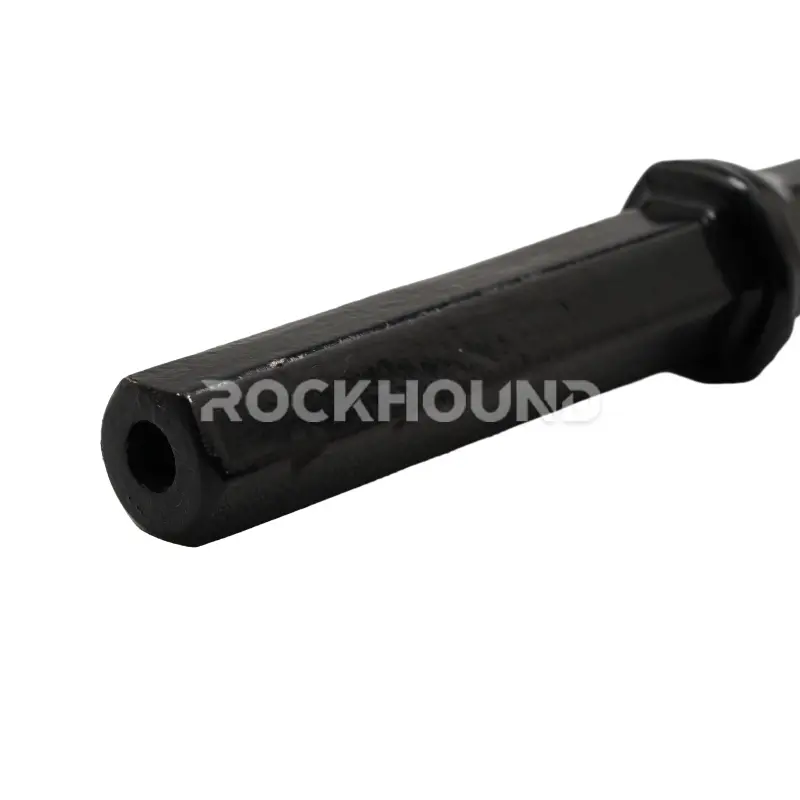
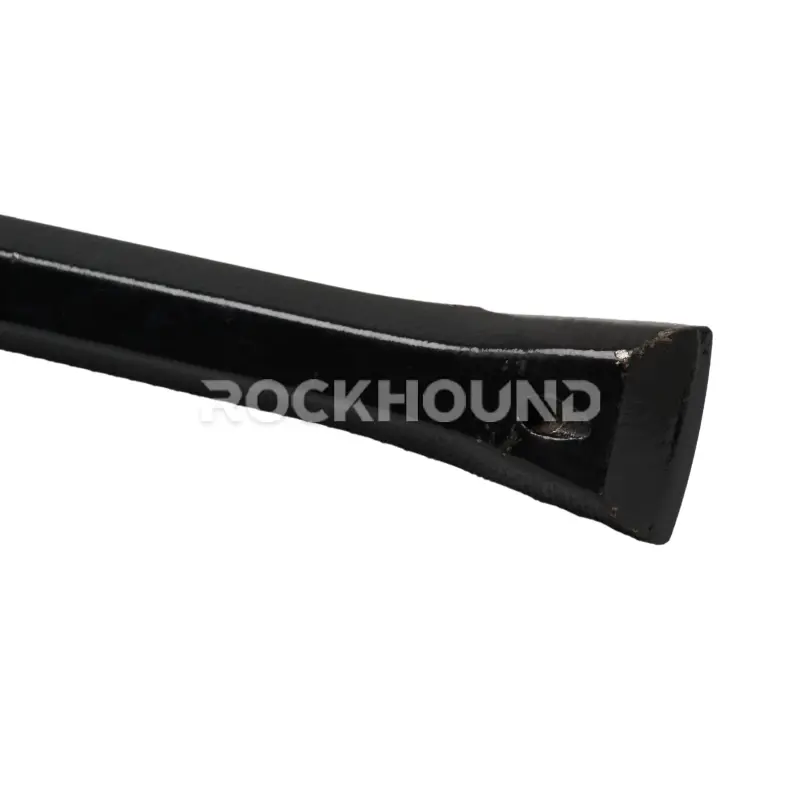
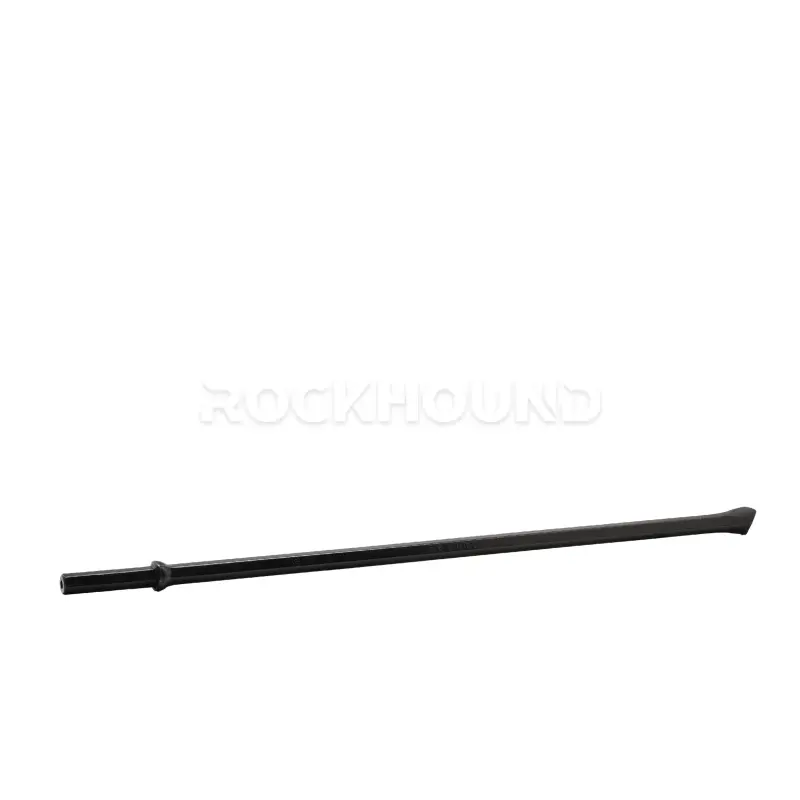
RockHound H22×108mm Integral Drill Rods — also referred to as Integral Drill Steels — are the industry standard for percussive small-hole drilling (26–41mm hole diameter) in medium to very hard rock formations. The one-piece monolithic construction integrates the chisel bit head directly into the hexagonal shank, eliminating threaded couplings and maximizing energy transmission from the piston to the rock face.
Manufactured from 55SiMnMo or 23CrNiMo alloy steel, these rods are engineered to withstand high-frequency cyclic percussive loading in abrasive environments. The standardized H22×108mm hexagonal shank ensures drop-in compatibility with Y24, YT24, YT27, and YT28 handheld pneumatic rock drills, making them the preferred choice for granite quarrying, underground drifting, roof bolt drilling, and construction anchor work.
Why RockHound use 23CrNiMo Compare With Sandvik Sanbar64?
Visit: Rock Drill Rod Material Comparison:23CrNiMo vs Sanbar64
Key Features
ZK55SiMnMo Alloy Steel
RockHound proprietary 55SiMnMo or 23CrNimo alloy delivers tensile strength exceeding 1,400 MPa with superior fatigue resistance. Silicon, manganese, and molybdenum additions optimize the hardness gradient and impact toughness required for sustained percussive loading, significantly extending service life compared to standard drill steel grades.
One-Piece Integral Construction
The monolithic design eliminates threaded joints — the most common failure point in conventional coupled drill strings. Energy transmission efficiency exceeds 95%, and there is zero risk of joint uncoupling in wet, muddy, or highly abrasive hole conditions.
Cemented Carbide Chisel Bit
The forged chisel head is furnished with wear-resistant WC-Co (tungsten carbide–cobalt) inserts, providing sharp and consistent penetration rates in granite, basalt, and limestone. Bit geometry is optimized for the step-down drilling sequence used in integral rod sets.
Precision H22×108mm Shank Geometry
The hexagonal 22mm (7/8″) × 108mm shank conforms to industry-standard dimensions, ensuring compatibility with all major Y-series and YT-series handheld and stopper pneumatic rock drills. Confirm your drill’s chuck specification before ordering.
Advanced Heat Treatment
Induction hardening and controlled carburizing create a hard surface case (>58 HRC) over a ductile core. This dual-zone microstructure prevents brittle fracture while resisting the lateral bending stresses encountered in drifting and quarry drilling applications.
Tapered Bit Diameter (Step-Down Design)
Within each series, the bit diameter decreases incrementally as rod length increases — typically 1mm per step. This deliberate taper ensures each successive rod in a set passes freely through the hole drilled by its predecessor, preventing rod jamming and maintaining efficient flushing water circulation at the bit face.
Technical Specifications
Shank Standard: H22×108mm (Hex 22mm / 7/8″) — applies to all series below.
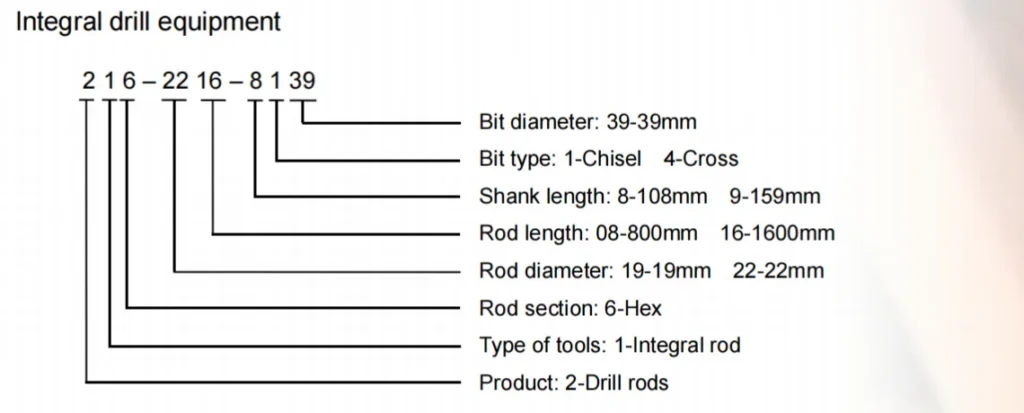
| Length L (mm) | Length L (ft/in) | Bit Ø D (mm) | Bit Ø D (inch) | Product Code | Weight (kg) |
|---|---|---|---|---|---|
| Series 11 – Ideal for Standard Hard Rock Drilling (Common in Granite/Quartzite) | |||||
| 800 | 2’7 1/2″ | 34 | 1 11/32″ | 216-2208-8134 | 2.8 |
| 1,600 | 5’3″ | 33 | 1 5/16″ | 216-2216-8133 | 5.2 |
| 2,400 | 7’10 1/2″ | 32 | 1 1/4″ | 216-2224-8132 | 7.7 |
| 3,200 | 10’6″ | 31 | 1 7/32″ | 216-2232-8131 | 10.1 |
| 4,000 | 13’1 1/2″ | 30 | 1 3/16″ | 216-2240-8130 | 12.5 |
| 4,800 | 15’9″ | 29 | 1 5/32″ | 216-2248-8129 | 14.9 |
| 5,600 | 18’4 1/2″ | 28 | 1 1/8″ | 216-2256-8128 | 17.3 |
| 6,400 | 21′ | 27 | 1 1/16″ | 216-2264-8127 | 19.7 |
| 7,200 | 23’7 1/2″ | 26 | 1 1/32″ | 216-2272-8126 | 22.2 |
| Series 12 – Larger Diameter for Medium-Hard Formations & Higher ROP | |||||
| 400 | 1’3 3/4″ | 41 | 1 9/16″ | 216-2204-8141 | 1.6 |
| 800 | 2’7 1/2″ | 40 | 1 9/16″ | 216-2208-8140 | 2.9 |
| 1,600 | 5’3″ | 39 | 1 17/32″ | 216-2216-8139 | 5.3 |
| 2,400 | 7’10 1/2″ | 38 | 1 1/2″ | 216-2224-8138 | 7.7 |
| 3,200 | 10’6″ | 37 | 1 15/32″ | 216-2232-8137 | 10.1 |
| 4,000 | 13’1 1/2″ | 36 | 1 13/32″ | 216-2240-8136 | 12.5 |
| 4,800 | 15’9″ | 35 | 1 3/8″ | 216-2248-8135 | 14.9 |
| 5,600 | 18’4 1/2″ | 34 | 1 11/32″ | 216-2256-8134 | 17.4 |
| 6,400 | 21′ | 33 | 1 5/16″ | 216-2264-8133 | 19.8 |
| Series 13 – Compact Sizes for Shallow/Precision Top Hammer Drilling | |||||
| 800 | 2’7 1/2″ | 33 | 1 5/16″ | 216-2208-8133 | 2.8 |
| 1,200 | 3’11 1/4″ | 32 | 1 1/4″ | 216-2212-8132 | 4.0 |
| 1,600 | 5’3″ | 31 | 1 7/32″ | 216-2216-8131 | 5.2 |
| 2,000 | 6’6 3/4″ | 30 | 1 3/16″ | 216-2220-8130 | 6.4 |
| Series 16 – Balanced Lengths for Medium-Depth Bench Drilling | |||||
| 1,200 | 3’11 1/4″ | 34 | 1 11/32″ | 216-2212-8134 | 4.0 |
| 1,800 | 5’10 7/8″ | 33 | 1 5/16″ | 216-2218-8133 | 5.8 |
| 2,400 | 7’10 1/2″ | 32 | 1 1/4″ | 216-2224-8132 | 7.7 |
| Series 17 – Larger Bit Ø for High-Production / Faster Penetration | |||||
| 1,200 | 3’11 1/4″ | 40 | 1 9/16″ | 216-2212-8140 | 4.1 |
| 1,600 | 5’3″ | 39 | 1 17/32″ | 216-2216-8139 | 5.3 |
| 2,000 | 6’6 3/4″ | 38 | 1 1/2″ | 216-2220-8138 | 6.5 |
Note: All rods feature the standard H22×108mm hexagonal shank. All dimensions are in millimeters unless otherwise stated.
Applications
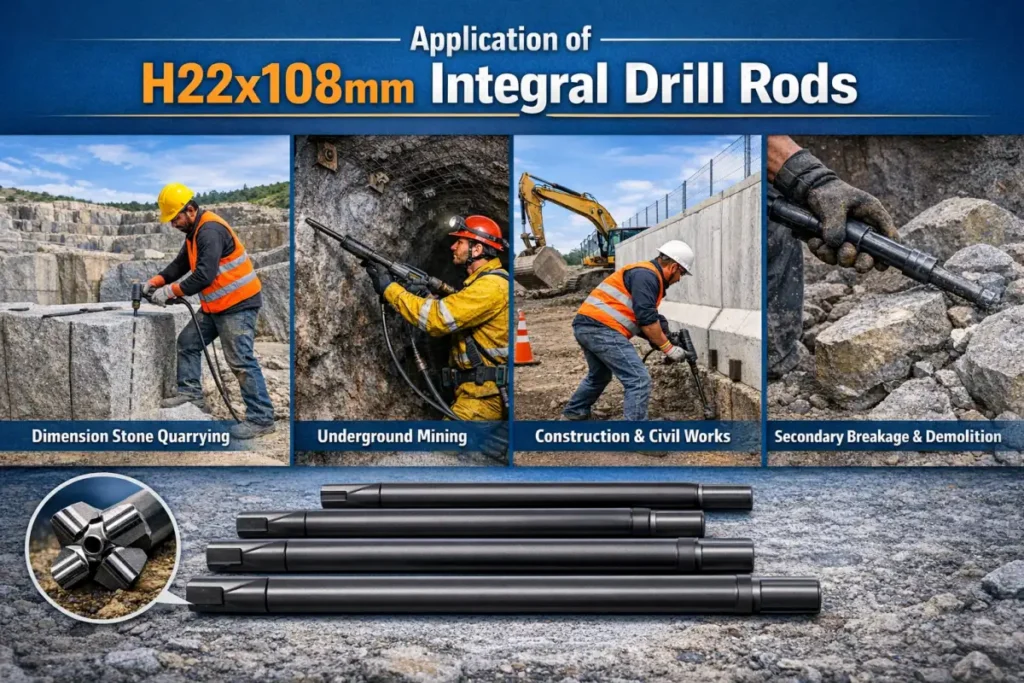
H22 integral rods are optimized for percussive small-hole drilling (26–41mm diameter) in the following sectors:
Dimension Stone Quarrying
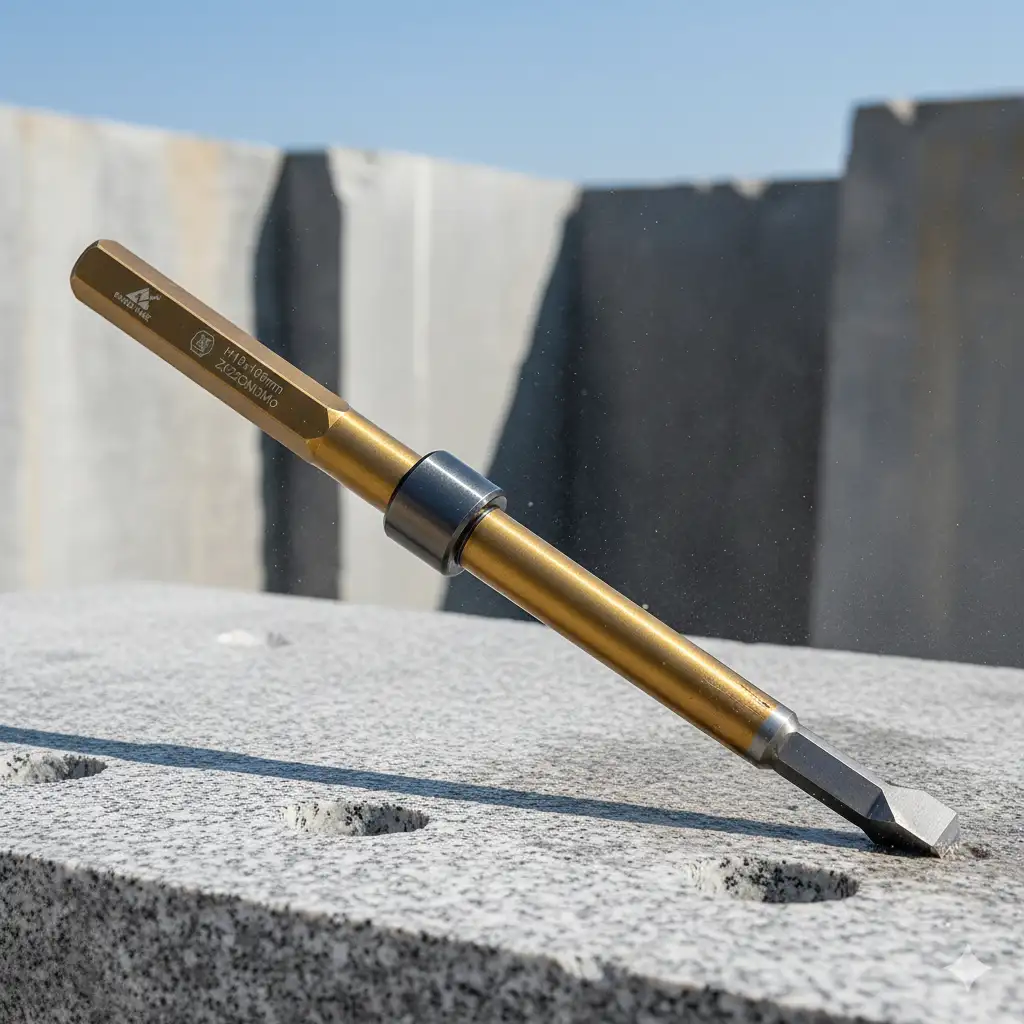
Granite, marble, and limestone operations use H22 rods for channel drilling, wedge-splitting, and block separation. The step-down bit profile keeps holes clean and prevents overcutting the stone face.
Underground Mining — Drifting & Bolting
Used in development headings, cross-cuts, and production faces for both blast-hole drilling and roof bolt installation. The monolithic design’s high energy transmission is critical in confined stopes where drill cycle time directly impacts advance rates.
Construction & Civil Works
Road widening, rock anchor installation, foundation pin-drilling, and trench excavation in urban environments where compact handheld equipment is required and large drill rigs cannot be deployed.
Secondary Breakage & Demolition
Breaking oversized boulders at crusher stations or secondary reduction of reinforced concrete. Short Series 13 and 16 rods are preferred for their rigidity and larger starting bit diameter.
How to Select the Right Series
Choosing the correct series depends on your target hole depth, required starting bit diameter, and rock hardness classification.
- Series 12 (Ø41→33mm, up to 6,400mm) is the best choice when maximum hole diameter and deep reach are both required. Start with the 400mm starter rod at 41mm for the widest initial bore, then step down through the set to final depth.
- Series 11 (Ø34→26mm, up to 7,200mm) offers the greatest total drilling depth in this range and is suited to precision holes in very hard granite where a narrower final gauge is acceptable.
- Series 13 (Ø33→30mm, up to 2,000mm) provides short, stiff rods for secondary breakage and shallow blast rounds where rigidity is more important than reach.
- Series 16 (Ø34→32mm, up to 2,400mm) has a tighter diameter step-down, making it ideal for anchor holes and grouted bolt installations where dimensional gauge control is critical.
- Series 17 (Ø40→38mm, up to 2,000mm) combines a large starting diameter with a short, stiff rod geometry — the standard choice for high-production dimension stone cutting rounds.
Step-Down Drilling Sequence
The integral rod method requires drilling with progressively longer rods whose bit diameter decreases by approximately 1mm per step. Each rod must pass freely inside the hole drilled by the previous rod to prevent binding and ensure flushing water reaches the bit face. Example using Series 12: begin with the 800mm / Ø40mm rod, follow with 1,600mm / Ø39mm, then 2,400mm / Ø38mm, continuing down to the target depth.
Related Readings:Rock Drill Rods: Types,Work,Choose & Maintenance
Maintenance Best Practices
Bit Regrinding
Resharpen the tungsten carbide chisel insert at regular intervals using a dedicated bit grinder, or whenever penetration rate drops noticeably. A dull chisel redistributes percussion energy into lateral stress, accelerating shank fatigue and premature rod breakage.
Drill Lubrication
Verify that the rock drill’s inline oiler delivers the correct oil-to-air ratio (typically 3–5 ml/min). Insufficient lubrication causes accelerated shank wear and piston face damage, both of which significantly shorten rod service life.
Collaring Alignment
Maintain the rod perpendicular (within ±2°) to the rock face during hole collaring. Angular deviation generates bending stress concentrated at the shank-to-rod transition — the most fatigue-sensitive cross-section in the integral rod geometry.
Storage & Corrosion Prevention
Store rods horizontally on dry racks away from groundwater. Apply a light film of rust-preventive oil to the shank and chisel head before extended storage. Chloride-bearing water left on the steel surface accelerates stress-corrosion cracking if rods are stored wet.
Packaging & Marking
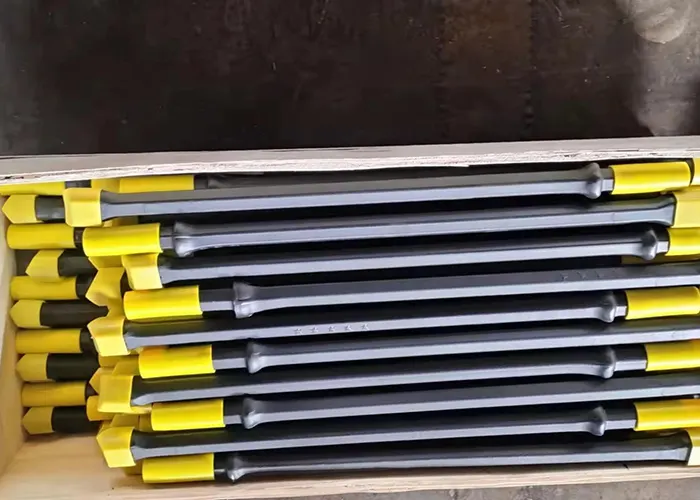
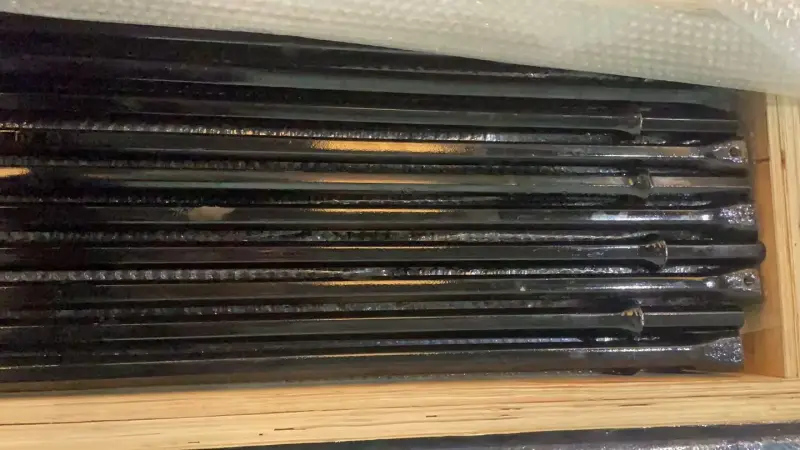
Standard export packaging: steel bundles or steel frames
Wooden case packaging available upon request (additional cost)
Custom marking or stamping services available(Logo Request:10*10mm)
A well-controlled production process ensures:
Stable drilling performance
Longer service life
Reduced rod breakage
Lower overall drilling cost
From material selection to final packaging, each step directly influences the reliability of tapered drill rods in real drilling environments.
Tapered Drill System
FAQ
H22×108mm describes the shank specification of the drill rod. "H22" denotes a hexagonal (hex) cross-section with a 22mm (7/8") across-flats dimension, and "108mm" is the drive length — the portion of the shank that engages inside the chuck of the rock drill. This is a standardized shank geometry widely adopted across Y-series and YT-series handheld pneumatic rock drills, including the Y24, YT24, YT27, and YT28. If your drill is configured for a Hex 22mm chuck, these rods will fit without any adapter.
An integral drill rod — also called an integral drill steel — is manufactured as a single, one-piece component. The chisel bit head, rod body, and hexagonal shank are all forged and machined from the same bar of alloy steel with no threaded connections. A coupled rod system, by contrast, uses separate shanks, extension rods, and bit holders joined by threaded couplings.
The integral design offers higher energy transmission efficiency (typically >95%), eliminates the risk of joint loosening or uncoupling in wet conditions, and produces less rotational energy loss. The trade-off is that integral rods are limited in total drilling depth — once all rods in a step-down set are exhausted, depth cannot be extended further without switching to a coupled system.
The step-down sequence is the standard drilling method for integral rods. Because the rod and bit are one piece, the bit diameter must be slightly larger than the rod body to allow the rod to advance into the hole. As you drill deeper and switch to a longer rod, that longer rod must fit inside the hole already drilled — so its bit diameter must be fractionally smaller than the previous rod's bit diameter.
In practice, the bit diameter decreases by approximately 1mm with each step. For example, using Series 12: start with the 800mm rod at Ø40mm, follow with the 1,600mm rod at Ø39mm, then the 2,400mm rod at Ø38mm, and so on. Skipping steps or using rods out of sequence risks jamming the rod in the formation, which can result in a lost rod and a damaged hole.
The right series depends primarily on your target hole depth and the required starting hole diameter. As a general guide: Series 12 is the most versatile for deep holes requiring a large starting diameter (Ø41mm starter, up to 6,400mm total depth). Series 11 offers the greatest reach in this range (up to 7,200mm) with a narrower diameter profile (Ø34mm starter). Series 13 and 16 are short, stiff sets best suited to secondary breakage, shallow blast rounds, and anchor drilling where depth is not the primary concern. Series 17 is the preferred choice for high-production dimension stone cutting where a large starting gauge (Ø40mm) and short rod length are both required. If you are unsure which series matches your rock conditions and drilling depth, contact our technical team with your drill pattern specifications and we will recommend the appropriate set.
The H22×108mm shank is compatible with the following common handheld and stopper pneumatic rock drills: Y24, YT24, YT27, YT28, and equivalent models from major OEM manufacturers that specify a Hex 22mm (7/8") chuck with a 108mm drive length. Before placing an order, verify both the hex size and the drive length in your drill's technical documentation. Some older or non-standard drill models may use a different drive length (e.g., 82mm) even with the same 22mm hex — these are not interchangeable.
ZK55SiMnMo is a high-alloy drill steel grade developed specifically for percussive rock drilling applications. The designation reflects its core composition: approximately 0.55% carbon (providing base hardness), with silicon (Si), manganese (Mn), and molybdenum (Mo) as primary alloying elements. Silicon enhances elastic strength and resistance to softening under heat. Manganese improves hardenability and toughness. Molybdenum increases fatigue strength and resistance to temper brittleness under cyclic loading.
The combination is critical for integral drill rods because the shank end must be hard enough to resist wear inside the chuck, while the rod body must remain tough enough to absorb thousands of high-energy blows per minute without developing fatigue cracks. Inferior steel grades with insufficient alloy content fracture prematurely at the shank shoulder — the highest-stress point in the rod geometry.
The most reliable field indicator is penetration rate. When your penetration rate drops by 20–30% compared to a freshly ground bit under the same rock conditions and drill settings, the bit requires regrinding. Visually, a worn chisel insert will show a flat, rounded cutting edge rather than a sharp, well-defined chisel profile. Do not wait until the rod stalls — drilling with a dull bit dramatically increases lateral stress on the rod body, overheats the carbide, and accelerates fatigue cracking. Most integral rod chisel inserts can be reground 5–8 times before the insert height is insufficient for further dressing.
Water flushing is the standard and strongly recommended method for all integral rod drilling. Adequate water flow through the drill's flushing hole keeps the carbide bit cool, evacuates drill cuttings from the hole, and reduces airborne dust. Dry drilling significantly shortens bit life and rod service life, and generates respirable silica dust that poses a serious occupational health hazard. Ensure your rock drill's water valve and internal flushing channel are clean and unobstructed before each shift. Minimum recommended flushing water pressure is typically 3–5 bar, depending on hole depth.
Service life varies considerably depending on rock type, drill operating parameters, and maintenance practices, and is best measured in meters drilled rather than hours. In medium-hard granite with proper lubrication and regular bit regrinding, a well-maintained integral rod set can be expected to deliver several hundred meters of total penetration across the full step-down sequence. The factors with the greatest negative impact on service life are: drilling with a dull chisel bit (increases lateral stress on the rod body), insufficient drill lubrication (accelerates shank wear), misaligned collaring (introduces bending fatigue at the shank shoulder), and storage corrosion (initiates subsurface cracking). Addressing these four factors consistently will have a greater effect on cost-per-meter performance than any change in product specification.
Our standard range covers the five series listed in the specification table, which encompasses the most common drilling sequences used in quarrying and mining worldwide. Custom configurations — including non-standard lengths, modified bit geometries, or alternative shank dimensions — are available on a minimum order quantity basis. Please contact our technical sales team with your required specifications, target rock type, and annual volume estimate for a feasibility assessment and quotation.