Table of Contents
Surface & Underground Operations
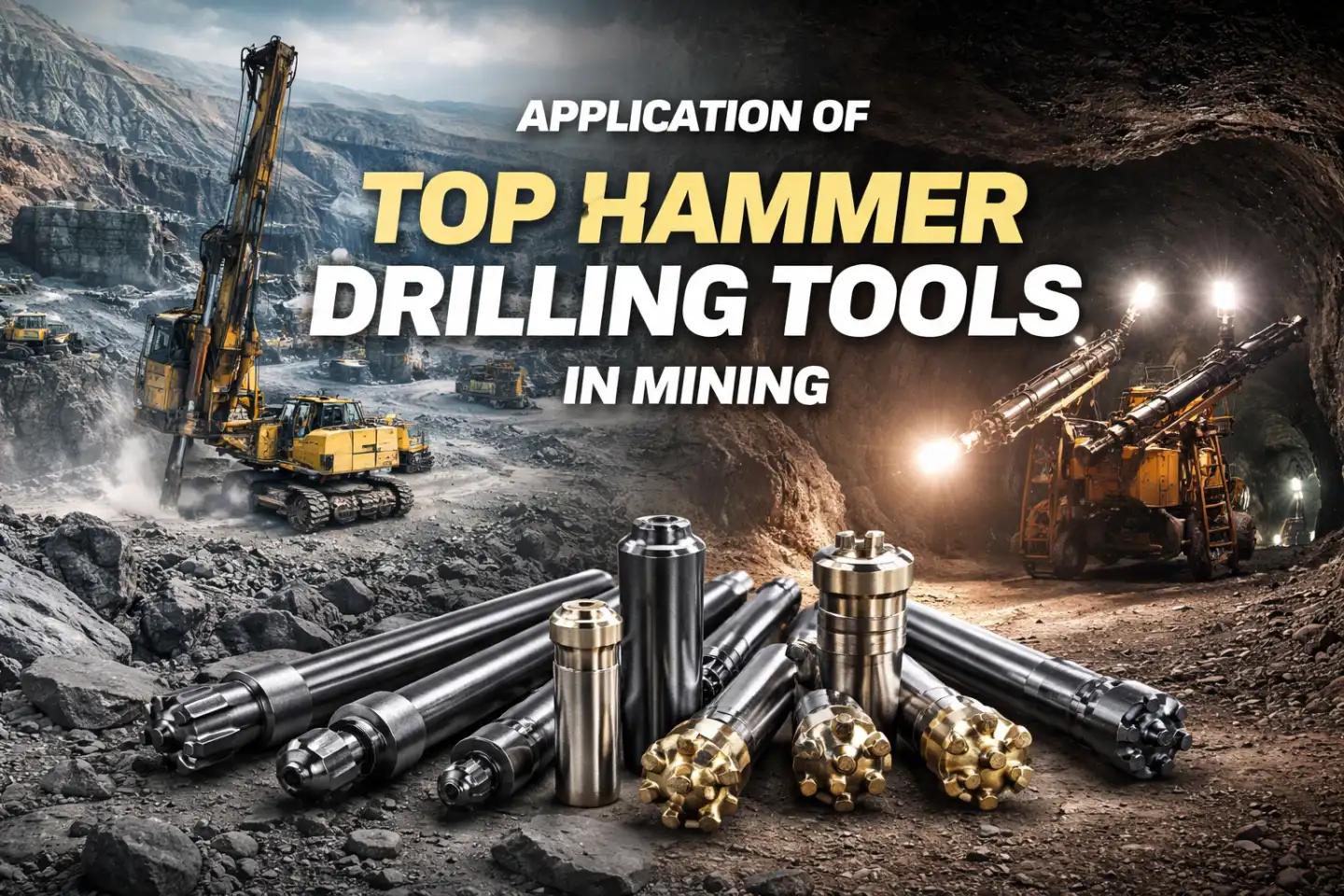
In modern mining, every meter drilled represents cost, time, and risk. The choice of drilling method determines not just how fast you penetrate rock—but how efficiently you recover ore, manage blast geometry, and keep crews safe. Among all available technologies, Top Hammer drilling tools has become the dominant method for both open-pit production drilling and underground stoping operations, trusted by mine operators across six continents.
At RockHound, we engineer high-performance top hammer drill string components built for the real demands of surface & underground mining environments. This guide walks through where, how, and why top hammer technology delivers results—and what to look for when selecting the right tools for your operation.
What is Top Hammer Drilling?
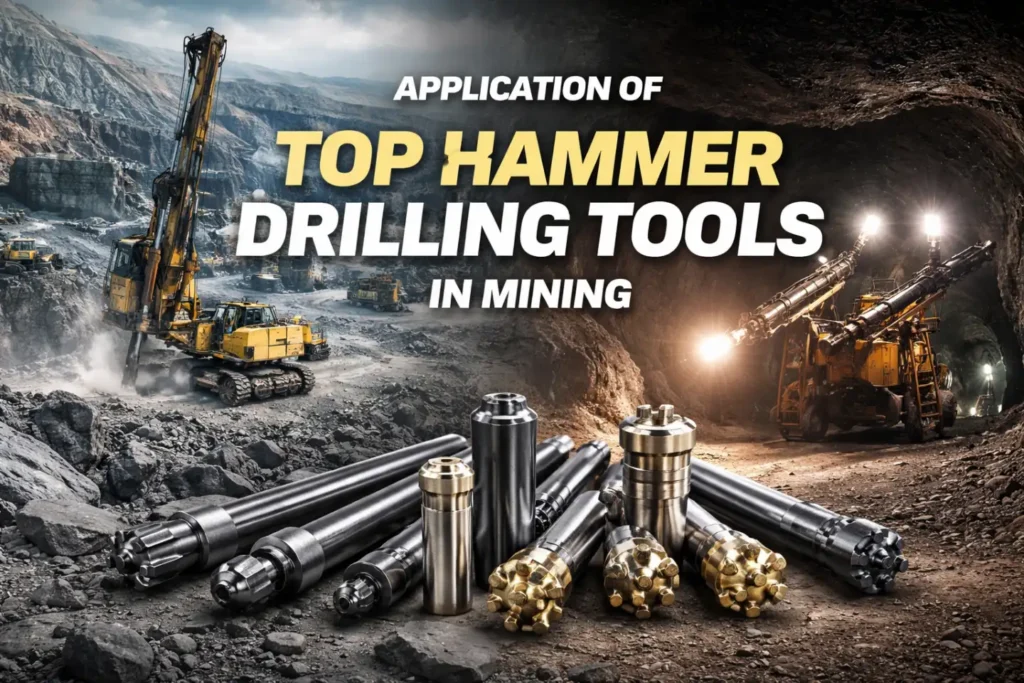
Top hammer drilling uses a hydraulic rock drill (commonly called a drifter) mounted at the top of the drill string to generate high-frequency percussive energy. That energy is transmitted through the shank adapter, drill rods, and couplings directly to the bit face—shattering rock through rapid, controlled impact.
The key mechanical advantage: the percussive force, rotation, and flushing all work simultaneously. This combination produces:
- High penetration rates in hard and abrasive rock formations
- Consistent hole straightness critical for controlled blast patterns
- Lower energy consumption compared to rotary or DTH methods at small-to-medium diameters
- Compact system profiles that fit confined underground environments
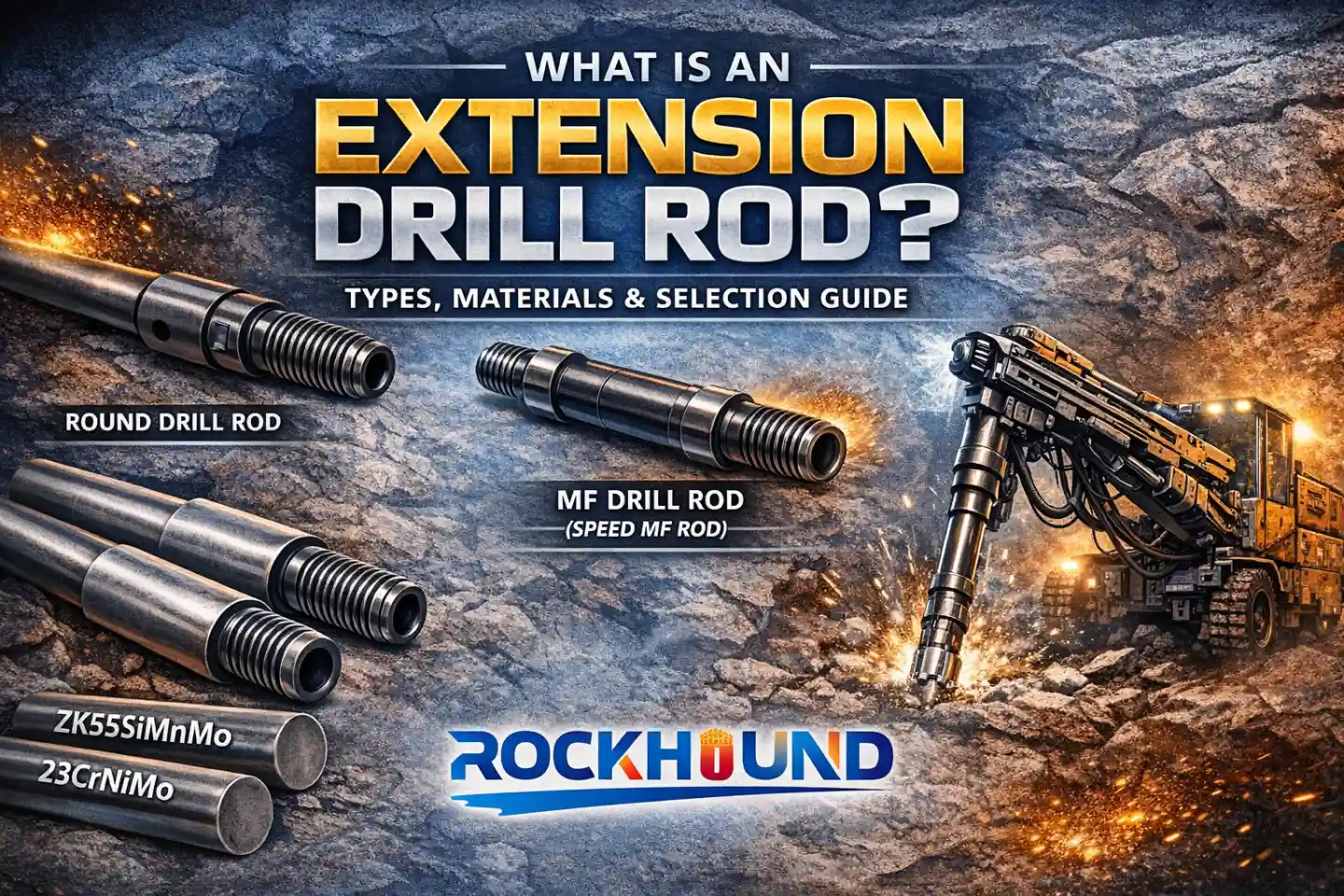
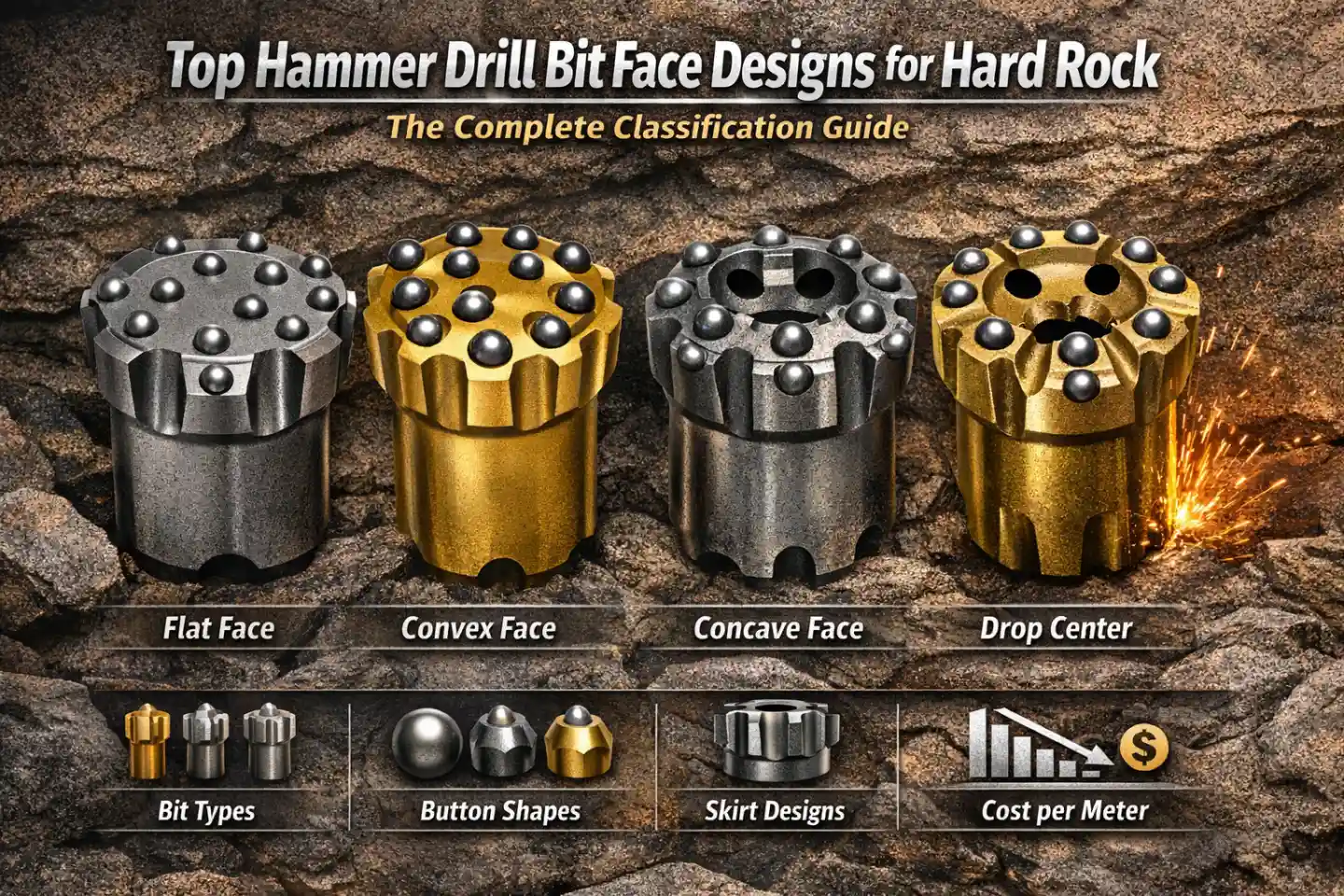
A complete top hammer drill string consists of four primary components: shank adapters, extension rods (or drifter rods), coupling sleeves, and drill bits (typically button bits with tungsten carbide inserts).
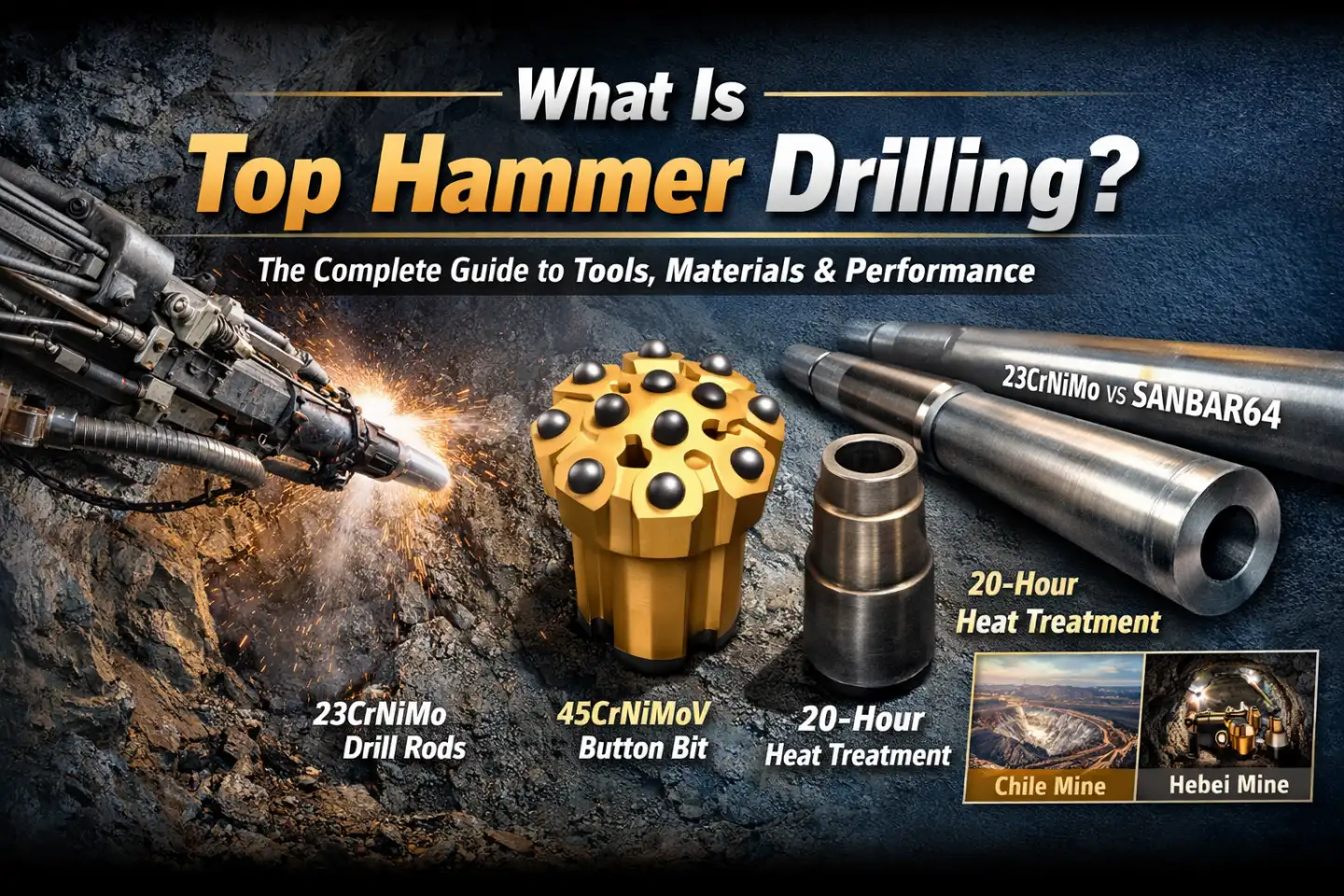
More Information: What Is Top Hammer Drilling? The Complete Guide
Surface Mining Applications: Bench Drilling at Scale
In surface mining—whether open-pit gold, copper, iron ore, or quarrying—productivity is governed by the ability to drill accurate, high-volume blast hole patterns quickly and repeatably. Top hammer drilling is the workhorse technology for this environment.
Bench Drilling in Open-Pit Operations
Crawler-mounted hydraulic rigs equipped with top hammer systems are the industry standard for bench drilling. Working on flat or slightly graded bench faces, these rigs drill vertical or slightly angled holes—typically 76 mm to 152 mm in diameter—to defined depths that match the blast designer’s requirements.
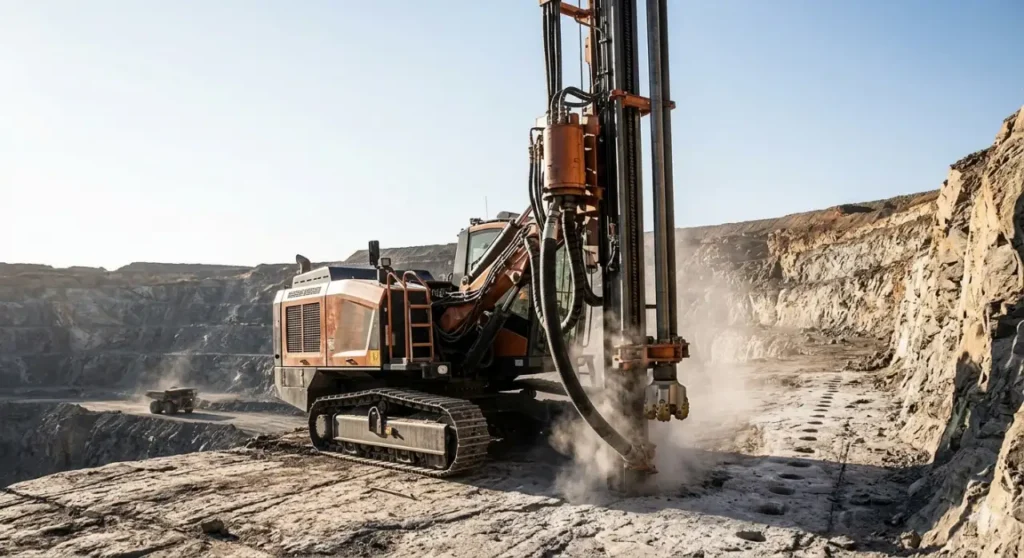
Key performance factors in bench drilling include:
- Penetration Rate (ROP): High-frequency impact combined with optimized button bit geometry allows RockHound tools to maintain aggressive penetration in competent hard rock—granite, basalt, quartzite—without excessive wear.
- Hole Straightness: Deviation from design depth or angle directly compromises fragmentation quality and bench stability. RockHound’s extension rods are manufactured to tight dimensional tolerances to minimize angular deviation, even in fractured or layered formations.
- Consistent Hole Diameter: Worn or underperforming bits cause diameter loss, which leads to poor explosive distribution and irregular fragmentation. Our tungsten carbide button geometry is optimized to maintain gauge throughout the tool’s full service life.
- Thread Compatibility: RockHound bench drilling tools are available in R32, T38, T45, T51, and GT60 thread configurations to match all major hydraulic rigs including Sandvik, Epiroc (Atlas Copco), and Furukawa platforms.
Why Bench Drilling Accuracy Affects Your Bottom Line
Inaccurate blast holes are among the most underestimated cost drivers in open-pit mining. Hole deviation leads to:
- Uneven burden distribution and poor fragmentation
- Increased wear on primary crushers
- Oversize boulders requiring secondary breaking
- Unstable bench faces and safety risk
Precision bench drilling with the right drill string isn’t just a technical spec—it directly determines downstream processing costs and operational throughput.
Surface Mining - Top Hammer Rock Drilling Tools
| Product Name | Type | L | H | Thread | Weight (KG) | Product Code | ||
|---|---|---|---|---|---|---|---|---|
| mm | inch | mm | inch | |||||
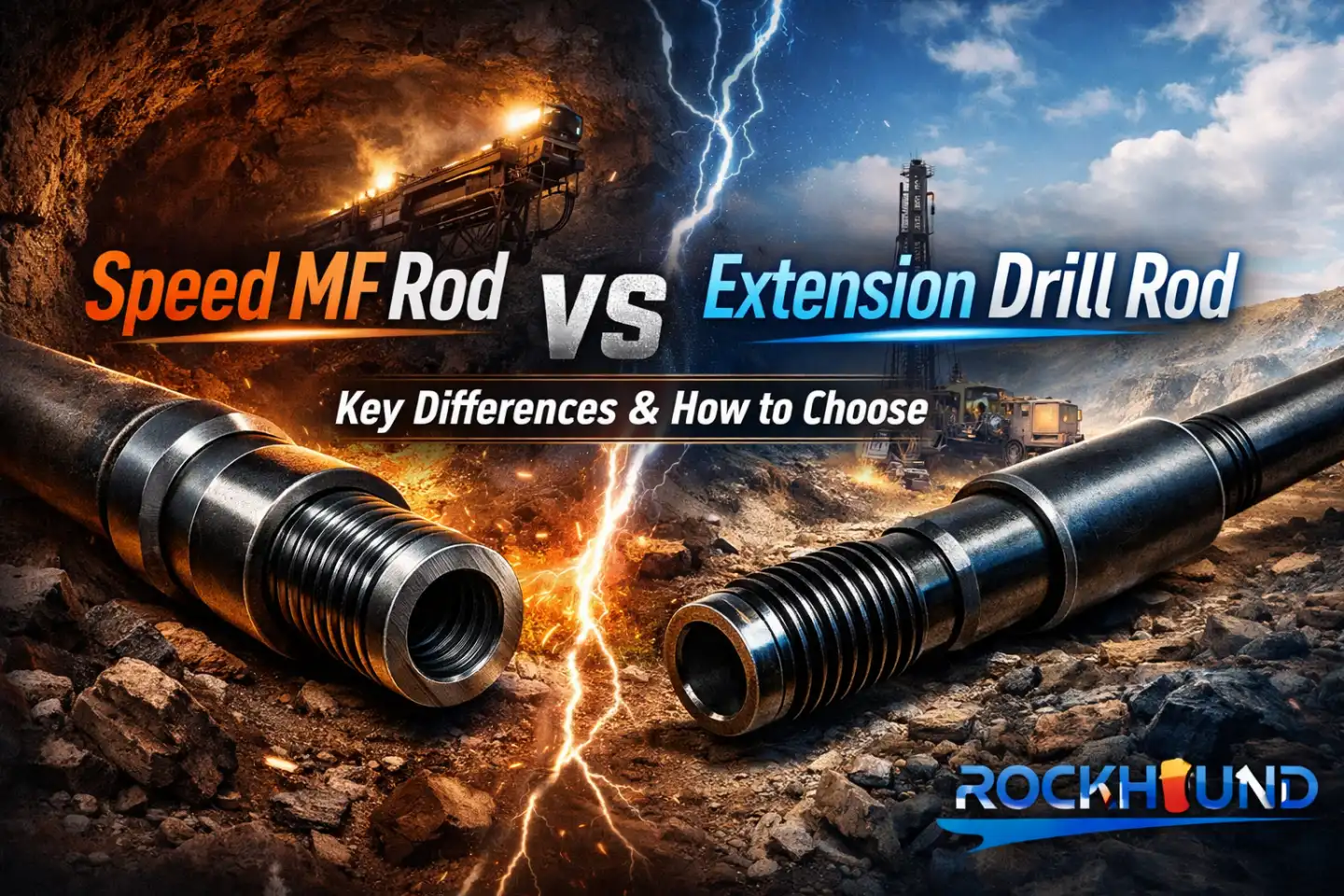
| T45-46mm Speed MF Rod For Long-Hole Drilling | Extension | 1525 1830 |
5′ 6′ |
46 | 1 3/4″ | Rod T45 | 18.2 21.5 |
290-4615-7777 290-4618-7777 |
| T51-52mm Speed MF Rod For Long-Hole Drilling | Extension | 1830 | 6′ | 52 | 2″ | T51 | 26.8 | 290-5218-7878 |
| T51 Extension Round Rod For Long-Hole Drilling | Extension | 1830 | 6′ | 52 | 2″ | T51 | 25.3 | 280-5218-7878 |
| T45 Extension Round Rod For Long-Hole Drilling | Extension | 1525 1838 |
5′ 6′ |
46 | 1 3/4″ | T45 | 16.2 19.5 |
280-4615-7777 280-4618-7777 |
Underground Mining Applications: Drifting and Long-Hole Stoping
Underground mining introduces a fundamentally different set of constraints: limited headroom, restricted rig maneuverability, complex geology, and the need to manage rock mass stability around active excavations. Top hammer technology excels in this environment precisely because of its compact system design and versatility.
Drifting: Development Headings and Tunnel Advance
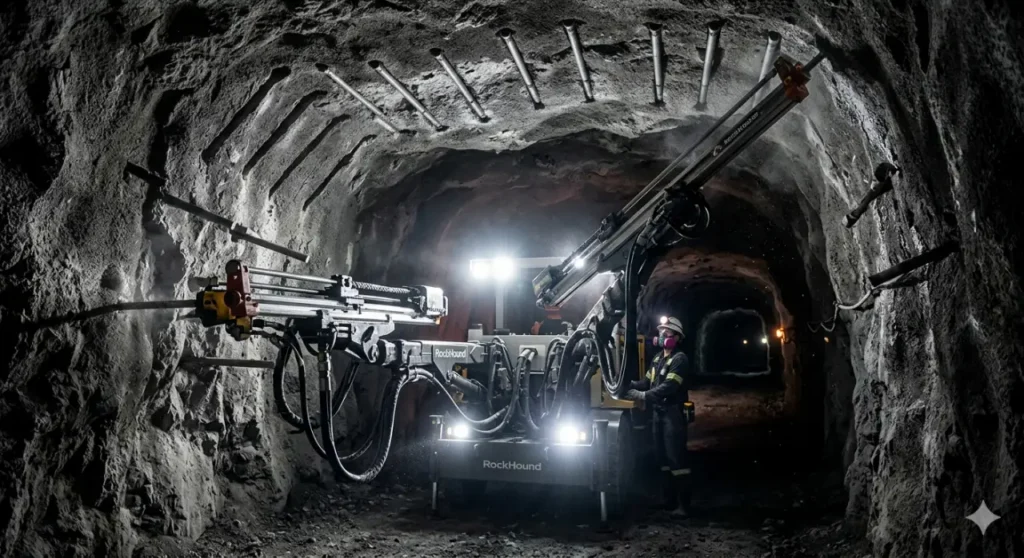
Drifting refers to the drilling and blasting of horizontal (or near-horizontal) development tunnels—ramps, crosscuts, access drifts, and ore drives. This is how miners create the physical infrastructure to reach and extract ore bodies.
Drifting jumbos—multi-boom drill rigs designed for tunnel cross-sections—rely on top hammer drill strings to advance headings efficiently. The compact profile of top hammer components allows full-face drilling in narrow drives (as small as 3.5 m × 3.5 m), which is impractical with larger DTH systems.
In drifting applications, RockHound supplies:
- Drifter rods (integral design, optimized for high-impact horizontal drilling)
- Shank adapters matched to specific drifter models (HD, HC, COP, BBC series)
- Thread button bits in appropriate diameters for the required hole pattern
- Coupling sleeves with precise thread engagement to prevent energy loss
| Drifting | Top Hammer Drilling |
|---|---|
Drifting is essential for tunnel development, including:
|
Top hammer drilling allows:
|
Hard rock development in deep underground mines—where rock competency is high and time-per-meter is the critical KPI—demands drill string components with minimal energy loss at every connection. RockHound tools are machined to ensure maximum energy transfer from piston to bit face.
Long-Hole Stoping: High-Volume Ore Extraction Underground
Long-hole stoping is one of the most productive underground mining methods for bulk ore extraction. It involves drilling long, parallel blast holes (typically 51 mm–102 mm diameter, 10–40 m in length) in a fan or parallel pattern from drill drives above and below an ore slice. The ore column is then blasted in retreat, and broken rock is recovered from drawpoints.
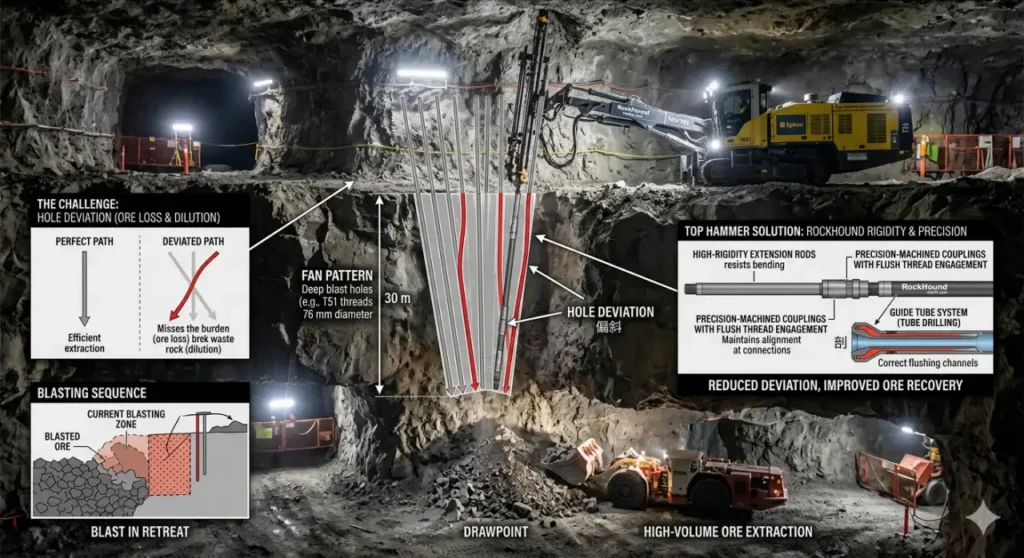
The critical technical challenge in long-hole stoping is hole deviation. Over distances of 15–40 meters, even a small angular error at the collar translates into significant positional error at the toe—causing blast holes to miss their intended burden, leave unblasted ore pillars (ore loss), or blast into waste (dilution).
Top hammer long-hole systems address this with:
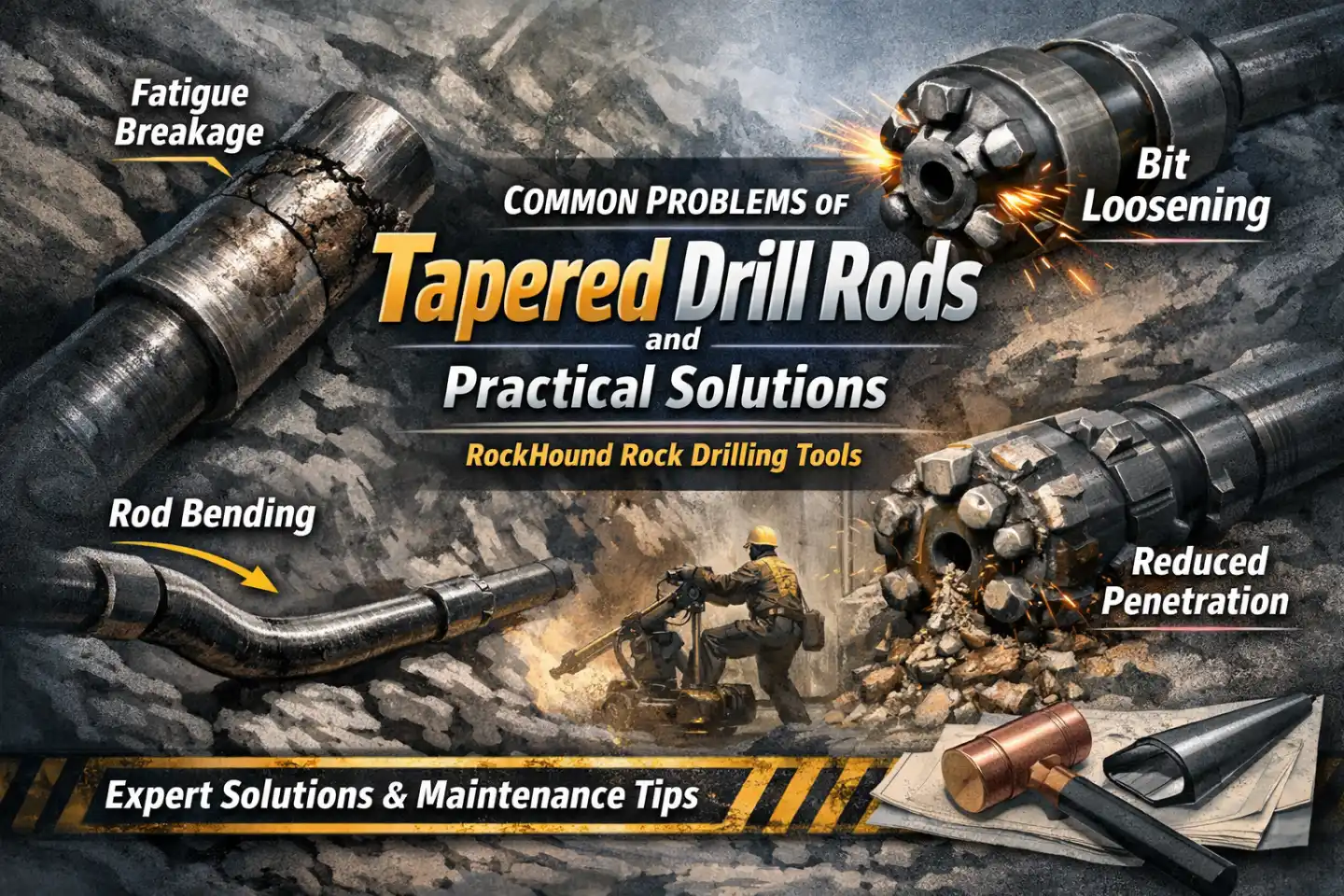
- High-rigidity extension rods designed to resist bending deflection along the full hole length
- Precision-machined couplings with flush thread engagement to maintain alignment at each rod connection
- Guide tube systems (tube drilling) for ultra-long holes where positional accuracy is critical
Correct flushing design to clear cuttings efficiently and prevent differential sticking
RockHound’s long-hole drilling components are specifically designed for T45 and T51 thread systems commonly used on long-hole rigs such as Sandvik DL421 and Epiroc Simba series, delivering reduced deviation and improved ore recovery across stope panels.
Underground Mining Top Hammer Rock Drilling Tools
| Product Name | Type | L | H | Thread | Weight (KG) | Product Code | ||
|---|---|---|---|---|---|---|---|---|
| mm | inch | mm | inch | |||||
| T35 Extension Rod For Mining Long Hole Drilling | Extension | 1220 1525 1830 |
4′ 5′ 6′ |
39 | 1 1/2″ | T35 | 10.4 12.8 15.3 |
290-3912-7575 290-3915-7575 290-3918-7575 |
| R32 MF Rod For Long Hole Drilling | L 915-1830mm | Extension | 915 1220 1525 1830 |
3′ 4′ 5′ 6′ |
32 | 1 1/4″ | R32 | 5.5 7.3 9.0 10.5 |
290-3209-5454 290-3212-5454 290-3215-5454 290-3218-5454 |
| T38-H32-R32 Drifter Rod With Length 3700-4915mm | Drifter | 3700 4305 4915 |
12’1 1/2″ 14’1 31/64″ 16’1 1/2″ |
32 | 1 1/4″ | T38 / R38 / R32 | 23.6 27.5 31.4 |
276-3237-5654 276-3243-5654 276-3249-5654 |
| R38-H35-R32 Drifter Rod For Drilling L 3090–5525 | Drifter | 3090 3700 4305 4915 5525 |
10′ 1 21/32″ 12′ 1 1/2″ 14′ 1 3/64″ 16′ 1 1/2″ 18′ 1 33/64″ |
35 | 1 5/8″ | R38 / R32 | 24.0 28.7 33.7 38.2 43.1 |
276-3530-5654 276-3537-5654 276-3543-5654 276-3549-5654 276-3555-5654 |
| R32-H28-R28 Threaded Drifter Rod For Tunneling | Drifter | 2600 3090 3700 4005 4265 4305 |
8′ 6-3/8″ 10′ 1-5/8″ 12′ 1-5/8″ 13′ 1-43/64″ 13′ 11-1/2″ 14′ 1-31/64″ |
28 | 1 1/8″ | R32 / R28 | 13.0 15.9 18.5 20.5 21.3 21.5 |
276-2826-5453 276-2830-5453 276-2837-5453 276-2840-5453 276-2842-5453 276-2843-5453 |
| T38-H35-T38 MF Drill Rod for Drifting & Tunneling | Drifter | 3700 4305 4915 5525 |
12’1 1/2″ 14’1 3/64″ 16’1 1/2″ 18’1 33/64″ |
35 | 1 5/8″ | T38 | 29.4 34.4 38.9 43.8 |
296-3537-7654 296-3543-7654 296-3549-7654 296-3555-7654 |
| T38 MF Rod For Top Hammer Drilling | Extension | 915 1220 1525 1830 |
3′ 4′ 5′ 6′ |
38 | 1 1/2″ | T38 | 8.3 10.9 13.3 15.8 |
290-3809-7676 290-3812-7676 290-3815-7676 290-3818-7676 |
| T38 Extension Rod for Top Hammer Drilling | Extension | 1220 1525 1830 |
4′ 5′ 6′ |
38 | 1 1/2″ | T38 | 10.0 12.4 14.9 |
280-3812-7676 280-3815-7676 280-3818-7676 |
| T38 Guide Rod | T38 Guide Tube For Top Hammer | Extension | 1220 1525 1830 |
4′ 5′ 6′ |
56 | 2 1/8″ | T38 | 12.6 14.0 17.4 |
200-5612-7676 200-5615-7676 200-5618-7676 |
5 Key Mining Operations Where Top Hammer Tools Are Deployed
Top hammer drilling isn’t limited to blast hole production. It supports the full operational lifecycle of a modern mine:
| Application | Description |
|---|---|
| Production Blasting | Used in both surface & underground mines to create blast holes for primary rock fragmentation. |
| Ore Development | Supports infrastructure creation such as tunnels and access routes through drifting. |
| Long-Hole Stoping | Enables large-scale ore extraction with controlled blasting geometry. |
| Secondary Fragmentation | Breaks oversized rocks that cannot be processed by crushers. |
| Rock Bolting (Ground Support) | Ensures safety by drilling holes for anchor bolts to stabilize underground structures. |
Selecting the Right Top Hammer Tools
Choosing the correct drill string for your specific application requires matching several variables:
| Parameter | Surface Bench Drilling | Underground Drifting | Long-Hole Stoping |
|---|---|---|---|
| Typical Hole Diameter | 76–152 mm | 43–64 mm | 51–89 mm |
| Common Thread System | T45, T51, GT60 | R32, T38, T45 | T45, T51 |
| Rod Type | Extension rods | Drifter rods (MF) | Long-hole rods / tube drilling |
| Key Performance Metric | Penetration rate, gauge retention | Advance rate per round | Hole straightness, deviation control |
| Rig Type | Crawler surface rigs | Drifting jumbos | Long-hole production rigs |
| Proven Expertise | Advanced Engineering |
|---|---|
Proven Expertise (Experience) Our tools are tested in real mining environments, covering both surface & underground applications. | Advanced Engineering (Expertise)
|
Industry Compatibility (Authoritativeness) Compatible with leading drilling rigs such as: • Sandvik | Reliable Performance (Trustworthiness)
|
RockHound’s technical team can assist you in matching thread systems, rod lengths, and bit configurations to your specific rig model and rock type.
Why RockHound? Engineering-Led Performance
RockHound is a B2B supplier of premium top hammer drill string components for surface & underground mining operations globally. Our products are engineered—not just manufactured—with the following design priorities:
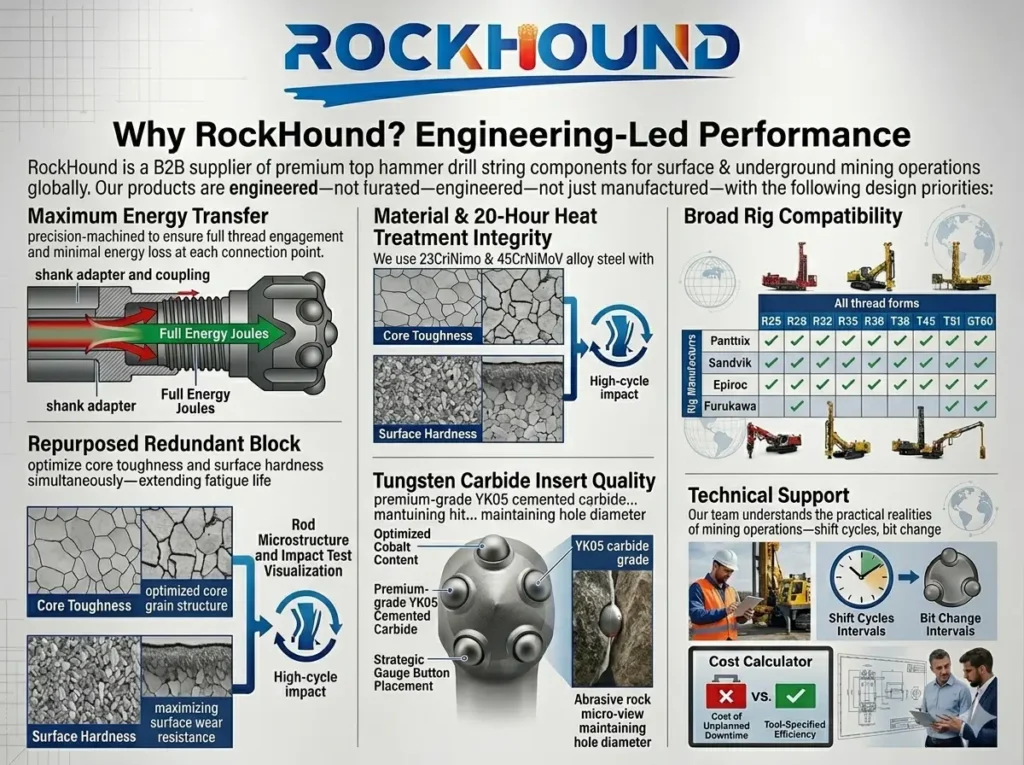
Maximum Energy Transfer
Our shank adapters and couplings are precision-machined to ensure full thread engagement and minimal energy loss at each connection point. Every joule of piston energy should reach the bit face.
Material & 20-Hour Heat Treatment Integrity
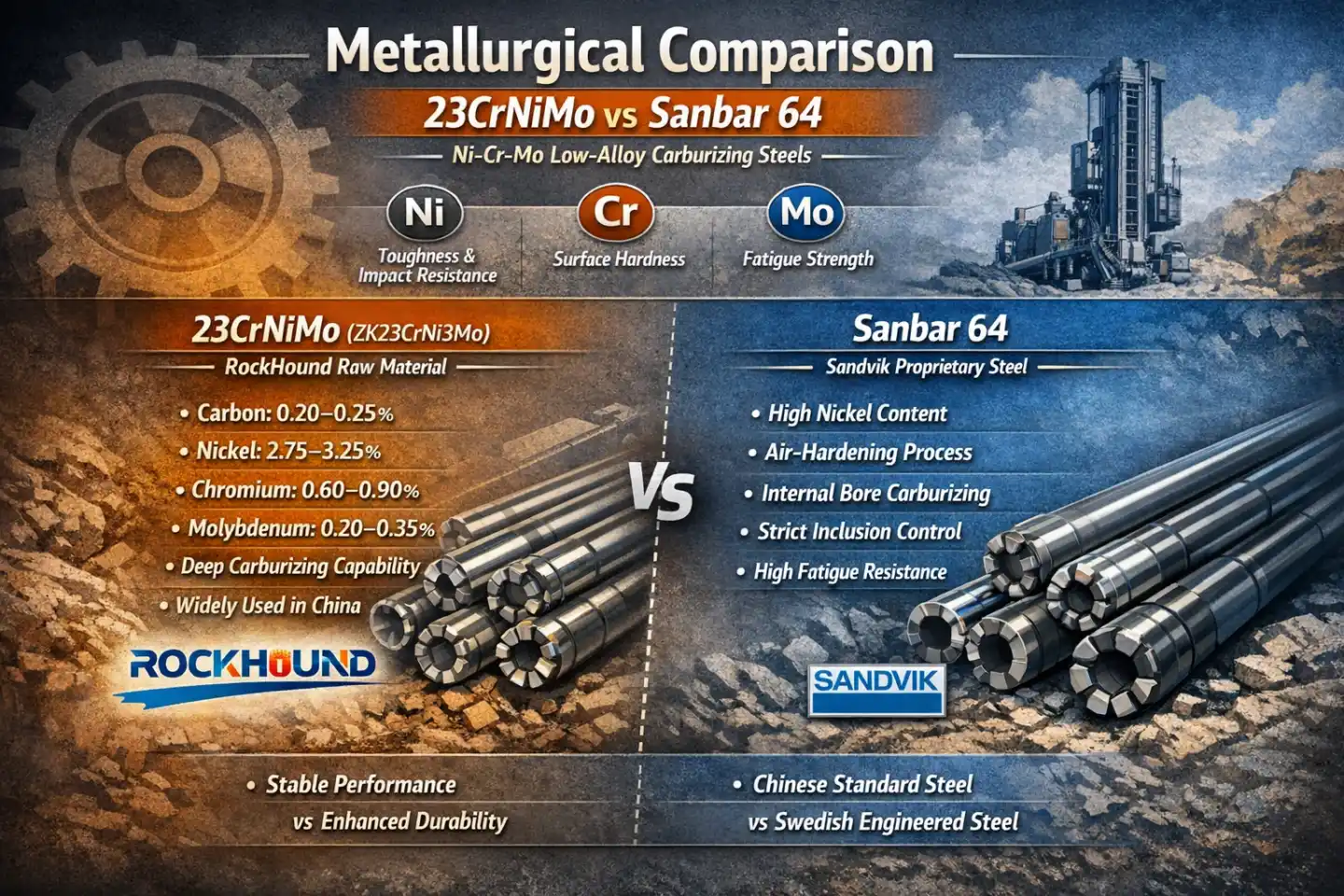
We use 23CriNimo & 45CrNiMoV alloy steel with controlled heat treatment processes that optimize core toughness and surface hardness simultaneously—extending fatigue life in high-cycle impact applications like bench drilling and drifting.
Tungsten Carbide Insert Quality
Our button bits use premium-grade YK05 cemented carbide with optimized cobalt content and binder phase, selected for the specific wear mechanisms of abrasive hard rock. Gauge buttons are positioned and ground to maintain hole diameter through the full service life.
Broad Rig Compatibility
RockHound tools are manufactured to match industry-standard thread forms including R25, R28, R32, R35, R38, T38, T45, T51, and GT60—compatible with major platforms from Sandvik, Epiroc, Furukawa, and other hydraulic drill manufacturers.
Technical Support
Our team understands the practical realities of mining operations—shift cycles, bit change intervals, rod inspection protocols, and the cost of unplanned downtime. We work with procurement and technical teams to specify the right tools for each application.
Conclusion
From bench drilling in open-pit operations to drifting and long-hole stoping in complex underground environments, top hammer drilling tools are the operational backbone of modern mining. Their ability to deliver high penetration rates, accurate hole geometry, and reliable performance across diverse rock conditions makes them the method of choice for mine operators focused on productivity and cost control.
The difference between average and exceptional drilling performance often comes down to tool quality—material grade, machining tolerances, and bit geometry. At RockHound, we build tools engineered for the demands of real mining operations, not just catalog specifications.
Ready to improve your drilling performance?
Visit rhdrill.com to explore our full range of top hammer drilling solutions—or contact our technical team for application-specific recommendations and a custom quote.
FAQ
Top hammer drilling is used for bench drilling, drifting, and long-hole stoping in both surface and underground mining operations.
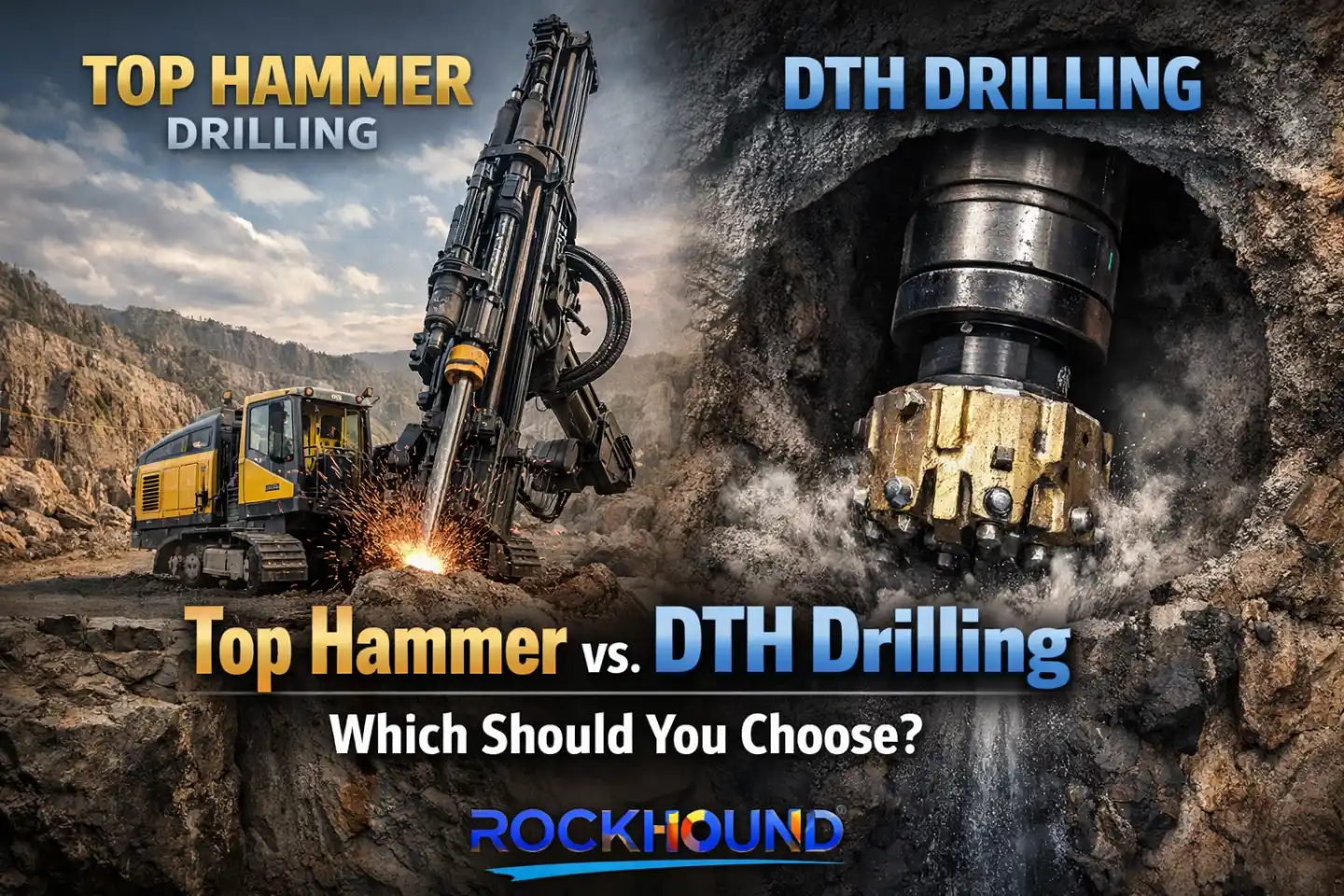
In top hammer drilling, the percussive energy is generated at the surface and transmitted through the drill string to the bit. In DTH drilling, a pneumatic hammer is located at the bottom of the hole, directly behind the bit. Top hammer is generally faster and more energy-efficient for smaller hole diameters (up to ~127–152 mm), making it ideal for bench drilling and drifting. DTH becomes advantageous in larger diameter holes and deeper applications where string energy losses in top hammer systems become significant.
Controlling deviation in long-hole stoping requires:
- Using high-rigidity extension rods specifically rated for long-hole applications;
- Maintaining tight coupling connections with no worn threads that allow angular play;
- Selecting the correct drill bit face angle and flushing design to avoid asymmetric cutting forces;
- Ensuring correct drilling parameters (rotation speed, feed pressure, percussion pressure) are matched to rock conditions;
- Using guide tube or tube drilling systems for holes exceeding 20–25 meters where positional accuracy is critical.
A complete top hammer drill string consists of: a shank adapter (interfaces between the hydraulic rock drill and the drill string), drill rods (extension rods for bench drilling or drifter/MF rods for underground drifting), coupling sleeves (connects rod sections), and a drill bit (typically a threaded button bit with tungsten carbide inserts). Thread type selection (e.g., R32, T38, T45, T51) must match across all components and be compatible with the rig's drifter.
Yes. RockHound tools are designed to be fully compatible with major hydraulic rigs from brands like Sandvik, Epiroc (Atlas Copco), and Furukawa, matching standard industry threads and shank configurations.
The most common thread systems in mining are: R-thread (R25, R28, R32, R35, R38) — rope-profile threads used for smaller, lighter applications such as rock bolting and development work; T-thread (T38, T45, T51) — trapezoidal threads used for medium to large hole sizes in bench drilling and long-hole stoping; and GT60 — a larger trapezoidal thread for high-powered surface rigs drilling large-diameter production holes.
Yes. Top hammer drilling tools are designed for both surface & underground applications. Surface rigs tend to use larger diameter, higher-energy configurations for bench drilling, while underground equipment is optimized for compact footprint and maneuverability in drifting and long-hole stoping operations. The same thread standards apply across both environments, though rod type, length, and bit diameter are selected according to the specific application.
Far far away, behind the word mountains, far from the countries Vokalia and Consonantia, there live the blind texts. Separated they live in Bookmarksgrove right at the coast