Supplier: HEBEI GIMARPOL MACHINERY TECH. Co., Ltd.
Brand: ROCKHOUND
Product: 11° Tapered R32 Button Bits
Evaluation Location: Luzon, Philippines
Evaluation Period: April 13–22, 2026
Report Date: April 22, 2026
Background and Objective
Short-hole drilling in the Philippines’ mining zones puts a lot of pressure on a 32 mm button bit. The rock changes fast — sometimes within a single metre of advance — and the tools need to keep moving without constant stoppages for bit changes or rod cleaning. The Mine Engineering team at the Luzon operation was looking for a 32 mm tapered button bit that could stay productive past 300 metres and handle the site’s mixed formation without incident.
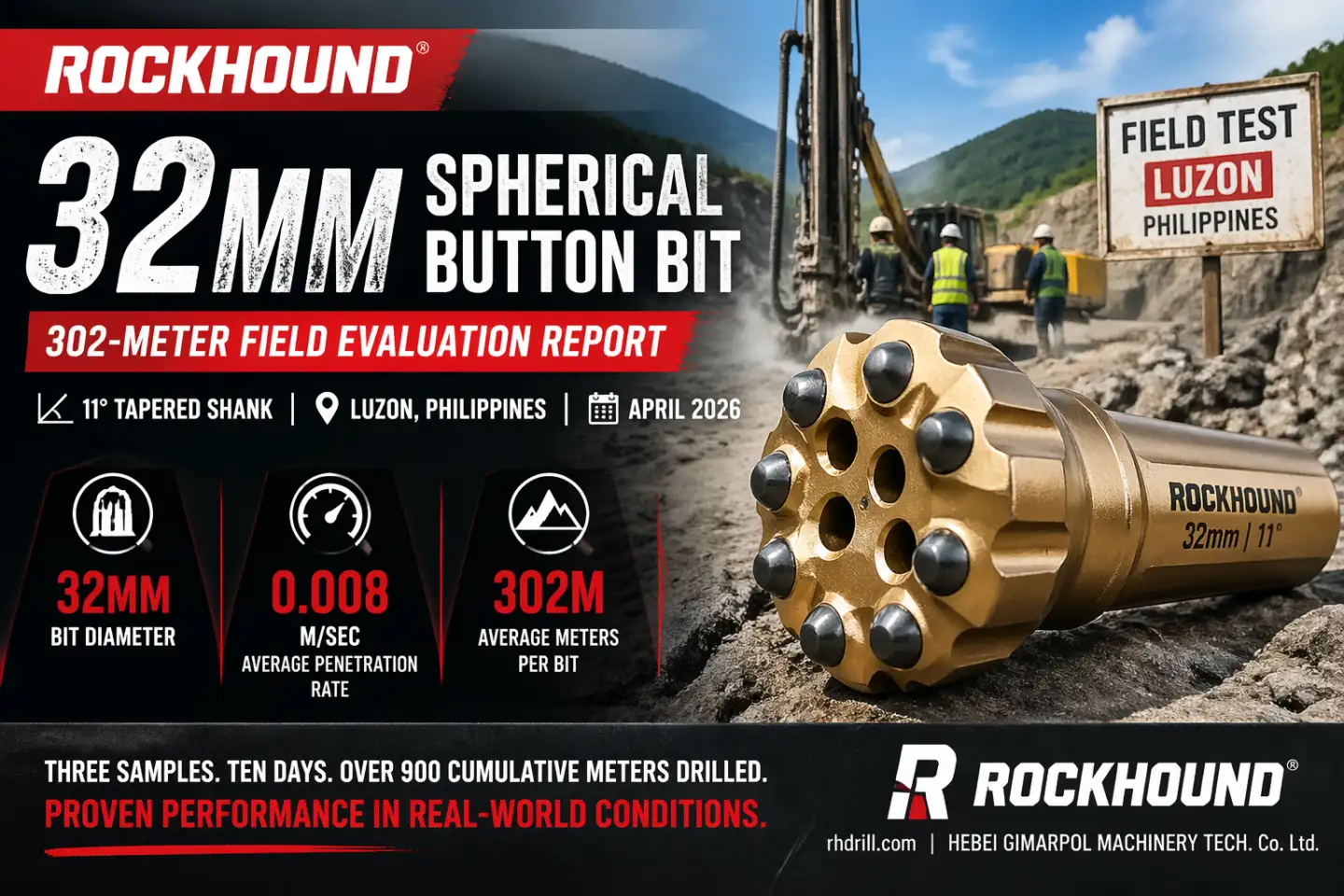
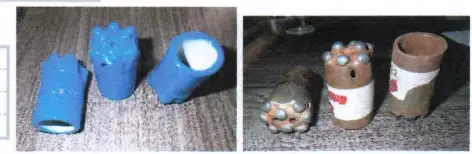
The ROCKHOUND 11° tapered 32 mm spherical button bit, supplied by HEBEI GIMARPOL MACHINERY TECH. Co. Ltd., was put forward for evaluation. The Mine Study Section ran a structured trial from 13 to 22 April 2026 with three independent samples. All three ran on the same pneumatic handheld rock drill and 11° tapered rod. This report covers the full technical parameters, raw field data, performance analysis, metallurgical context, and the engineering team’s recommendation coming out of those ten days.
Geological Environment — Luzon Volcanic Formations
Luzon’s geology is shaped by two volcanic chains. The Western Volcanic Chain is made up of tholeiitic to calc-alkaline rocks — primarily basalt and andesite. The Eastern chain is dominated by high-K calc-alkaline sequences. In mining areas, fresh basaltic flows sit right next to weathered horizons and tuffaceous material, sometimes within centimetres of each other. The site moisture and tropical weathering add another layer: clay-rich saprolite zones appear between the harder units, and that creates a drilling environment that shifts from very hard competent rock to soft, sticky ground within a single drill run.
The table below gives approximate unconfined compressive strength (UCS) values for the main rock units encountered at the evaluation site. These ranges are based on published geomechanics data for Luzon volcanic sequences and are consistent with what the drill operators described in the field log.
| Rock Unit | Characteristic Mineralogy | Typical UCS (MPa) | Drilling Behaviour |
|---|---|---|---|
| Fresh Basalt | Plagioclase, Pyroxene | 150–250+ | Slowest ROP, highest carbide loading |
| Porphyritic Andesite | Amygdaloidal, porphyritic | 100–180 | Variable — large phenocrysts cause uneven stress |
| Tuff / Agglomerate | Fragmental volcanic origin | 50–100 | Moderate ROP, moderate abrasion |
| Weathered Saprolite | Kaolinite, Halloysite, Goethite | < 25 | Fast ROP — flushing clogging risk |
The “significant rock hardness variation every metre of advance” noted in the evaluation report is exactly what you would expect in this geological setting. A bit that can handle that range without premature button loss or taper failure is genuinely earning its keep. Most lab-based wear tests miss this dynamic entirely.
Field Data and Results
| Sample | Total Metres | No. of Holes | Avg. Depth (m) | Penetration Rate (m/s) | vs. 300 m Benchmark |
|---|---|---|---|---|---|
| Sample #1 | 320 m | 181 | 1.77 m | 0.008 m/s | +20 m ✔ |
| Sample #2 | 306 m | 182 | 1.68 m | 0.010 m/s | +6 m ✔ |
| Sample #3 | 281 m | 170 | 1.65 m | 0.007 m/s | −19 m (avg. clears) |
| Average | 302 m | 178 | 1.70 m | 0.008 m/s | Benchmark Met |
Performance Analysis
The spread between the highest and lowest total meterage — 320 m versus 281 m, a gap of 39 m — reflects geological variation across the site rather than inconsistent manufacturing. All three bits came from the same batch and ran on the same equipment, so the 13% difference in output is attributable to where each bit spent its time in the formation. Sample #3 hit the denser, more continuously hard sections; Sample #2 caught a zone with slightly more fractured, competent andesite where impact energy transfers more efficiently.
The penetration rate averaged 0.008 m/s across all samples. That is 0.48 m/min — roughly 28.8 m per hour under continuous drilling. A 1.70 m hole takes approximately 3.5 minutes at this rate. For a pneumatic handheld rock drill working in hard basalt and andesite, this sits in the expected range. You would only see significantly higher rates on this same formation by switching to a hydraulic rig — a different equipment category with different cost structures. Sample #2’s 0.010 m/s (0.60 m/min, or 36 m/hr) represents the upper end possible when ground conditions cooperate.
Sample #3’s 0.007 m/s (0.42 m/min) is the lower end. It ran through sections where continuous hard rock reduced the impact energy available per unit of rock volume. Spherical buttons handle that transition without breaking, but they do drill slower under sustained high-UCS conditions — that is the expected trade-off for choosing the spherical profile over a ballistic design.
Product Specifications
| Technical Specifications: 32 mm Tapered Button Bit | |
|---|---|
| Bit Diameter | 32 mm |
| Taper Angle | 11° |
| Button Profile | Spherical |
| Button Count | 7 inserts |
| Button Layout | 2 face + 5 gauge |
| Flushing — Front | 2 holes |
| Flushing — Side | 3 holes |
| Socket | Hex 22 mm |
| Body Steel | 45CrNiMoV |
| Carbide Grade | YK05 |
| Approx. Weight | ~0.3 kg |
| Samples Tested | 3 pcs |
Why 11° and Why Spherical
The 11° taper angle provides a larger contact surface between bit socket and rod end compared to the shallower 7° angle. That translates to less bit spin under high-torque conditions and more consistent energy transfer from the piston to the rock face. Per Epiroc’s 2025 tapered drill strings brochure, the 11° system is rated for hard to very hard rock in quarrying and heavy-duty handheld applications, covering hole diameters of 32–64 mm. It pairs with Hex 22 mm and Hex 25 mm tapered rods.
Spherical (hemispherical) buttons distribute impact stress over a wider contact area than ballistic or conical profiles. The trade-off is a slightly lower peak penetration rate in soft formations — but in mixed or abrasive rock like the Luzon andesite-basalt sequence, the spherical profile wins on durability. It also re-grinds to its original crown shape cleanly, which keeps cost-per-metre down over a bit’s full service life. The 7-button layout (2 face, 5 gauge) gives the face buttons enough room to fracture the central core while the gauge row protects the hole wall profile.
The 45CrNiMoV body steel and YK05 carbide combination are detailed in the metallurgy section below. For the full heat treatment process that turns this alloy into a drilling tool, see our blog: 20-Hour Heat Treatment in Rock Drilling Tools.
Metallurgy — Body Steel and Carbide
45CrNiMoV Alloy Steel Body
The bit body has two jobs that compete with each other: it must be hard enough to resist surface abrasion from swirling rock cuttings, and tough enough to absorb the repeated shock of the hammer piston without cracking. Standard 42CrMo steel handles one of those jobs well but not both. The addition of Nickel and Vanadium in 45CrNiMoV shifts the balance.
| Element | Content Range | Role in Bit Body Performance |
|---|---|---|
| Nickel (Ni) | 1.30–1.80% | Provides impact toughness — prevents the body from shattering under high-frequency percussive loads. |
| Chromium (Cr) | 0.80–1.10% | Increases hardenability — ensures the steel can be hardened uniformly through the wall thickness. |
| Molybdenum (Mo) | 0.20–0.30% | Prevents temper brittleness — keeps the steel stable after multiple heating and cooling cycles in the field. |
| Vanadium (V) | 0.10–0.20% | Grain refiner — the most important element for fatigue strength and resistance to crack propagation. |
The target mechanical properties after heat treatment are tensile strength ≥ 1,150 MPa and impact toughness ≥ 80 J. Both are necessary to survive the 2,500+ blows per minute that a modern rock drill delivers to the bit shank. A full discussion of how these properties compare to other bit body materials is available in our technical article: Top Hammer Drill Bit Material: 45CrNiMoV & YK05.
20-Hour Heat Treatment and Surface Carburising
ROCKHOUND’s heat treatment cycle for the bit body runs for 20 hours. The process involves gas carburising — carbon is diffused into the steel surface layer at elevated temperatures in a carbon-rich furnace atmosphere. Holding the bits for 20 hours achieves a case-hardened depth of 1.5–2.0 mm. The resulting surface layer reaches 45–50 HRC (martensitic, highly wear-resistant), while the core remains at a lower hardness that absorbs shock. This dual-property structure is what separates a quality bit body from one that either chips on the surface or cracks through the wall.
See the full process breakdown here: Rock Drill Bits Manufacturing Process.
YK05 Tungsten Carbide Inserts
YK05 is a cemented carbide grade formulated for medium-hard to hard rock percussion. Its composition sits at 94–95% tungsten carbide (WC) for hardness and 5–6% cobalt (Co) binder for toughness. The grain size is 2.0 μm — fine enough to distribute stress evenly across the button face and prevent the micro-fractures that lead to chipping. The result is a Transverse Rupture Strength (TRS) of ≥ 2,600 MPa. That figure matters in fractured rock sequences like the Luzon site: when the bit crosses a fissure or a void, the impact loads spike suddenly, and a lower-TRS carbide grade pops buttons at that moment. No button loss was recorded during the Luzon evaluation.
Budget carbide grades like YG8 use coarser grain structures (typically 3–5 μm) and lower cobalt content, which reduces toughness. The difference shows up most clearly in exactly the kind of variable, high-transition ground the evaluation team was working in.
Product Comparison — Market Context
No publicly available head-to-head field-test data for 32 mm 11° tapered button bits exists for the brands below at this specific formation type. All competitor specifications in this table come from verified public sources: official product catalogs, manufacturer websites, and authorized product pages. No independent performance claims are made for any competing product.
| Parameter | ROCKHOUND (GIMARPOL) | Epiroc (11° Tapered Range) | Sandvik (Tapered Bit Line) | Padley & Venables (11° Range) |
|---|---|---|---|---|
| Supplier / Origin | HEBEI GIMARPOL / China | Epiroc Drilling Tools AB / Sweden | Sandvik Mining & Rock Tech. / Sweden | Padley & Venables Ltd / UK |
| Bit Diameter | 32 mm | 32–64 mm (11° range) | 32–33 mm (12° featured) | Available up to 45 mm |
| Taper Angle | 11° | 11° — Hard to very hard rock | 7°, 11°, 12° | 4.8°, 7°, 11°, 12° available |
| Button Profile | Spherical | Spherical, Ballistic, Trubbnos™ | Spherical, Semi-ballistic | Hemispherical, Ballistic |
| Flushing Options | 2 front + 3 side | Multiple models incl. side-only | Flexible per grade | Open face + deep lateral flutes |
| Body Steel | 45CrNiMoV | Proprietary alloy | Improved steel grade (2024 update) | ISO 9001 in-house treatment |
| Carbide Grade | YK05 — TRS ≥ 2,600 MPa | Proprietary Secoroc grades | PowerCarbide® (SH69 option) | Proprietary carbide grade |
| Sustainability | Low-carbon manufacturing | Lower footprint via durability | ≥ 60% recycled carbide | Made in Britain — low logistics |
| Field Data (32mm) | 302 m avg. | Not published for 32 mm | Not published for 32 mm | Not published for 32 mm |
A few points worth calling out directly. Epiroc’s 11° tapered range is the closest structural equivalent to the ROCKHOUND product tested here — same taper angle, same hole size coverage, same application zone. Their Model -40 (side-flush-only) is exactly the configuration the Mine Engineering team is recommending as a next step for ROCKHOUND. Sandvik’s current development focus has shifted toward the 12° 33 mm design with a new bit-rod connection geometry, which does not substitute directly for an 11° application.
ROCKHOUND’s primary differentiator in this table is the traceable, publicly documented field evaluation data — 302 m average, three samples, real Luzon conditions. That is something none of the competing brands has published for this specific bit size and taper configuration.
Maintenance and Best Practices
Hitting 300 metres in volcanic rock is not just about the bit. Operator practice accounts for a significant share of the result. The following four practices come directly from the Luzon evaluation and standard industry guidance for tapered button bit maintenance.
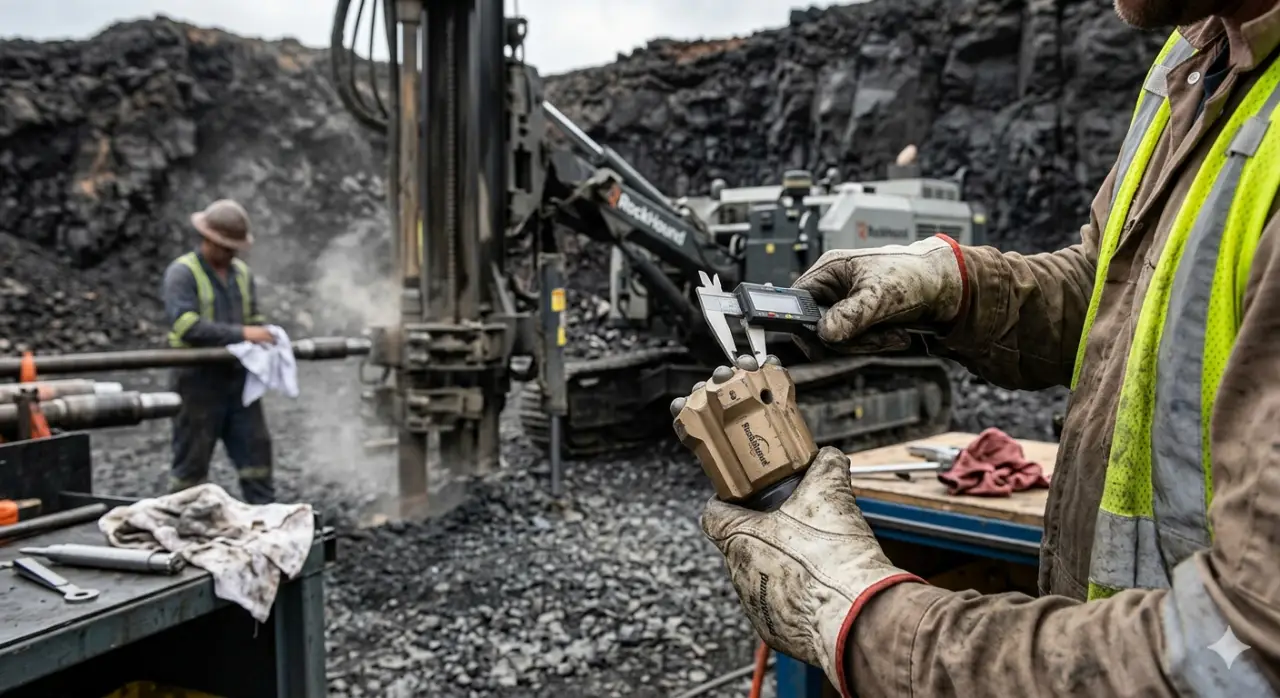
Sharpen gauge buttons before the wear flat reaches one-third of the button diameter. Past that point, the flat face starts reflecting impact energy back up the drill string instead of into the rock. Penetration rate drops, rig stress increases, and the service life of your shank and rod shortens too.
2.Taper Connection Check
The rod must seat into the bit socket to at least 25 mm depth, with ≥ 60% contact across the taper surface. Any wobble or play greater than 0.05 mm at the connection is enough to cause skirt cracking or rod tip wring-off. Wipe both surfaces clean before every connection — clay or grit on the taper face reduces contact area immediately.
Use reduced percussion and low feed pressure when starting each hole. Full power should only go in once the bit face is seated firmly against solid rock. “Dry firing” on uneven or partially supported surfaces is the most common cause of early button ejection — the bit bounces instead of cutting, and the carbide takes impact from the wrong direction.
Verify that air or water pressure is appropriate for the hole depth before each collar. In the Luzon site conditions, increase flushing pressure when soft or muddy sections are encountered — do not rely on gravity alone to bail fines from a wet hole. If the hole appears poorly flushed, clean it manually after each rod length before adding the next.
11° Tapered Button Bits For Rock Drilling
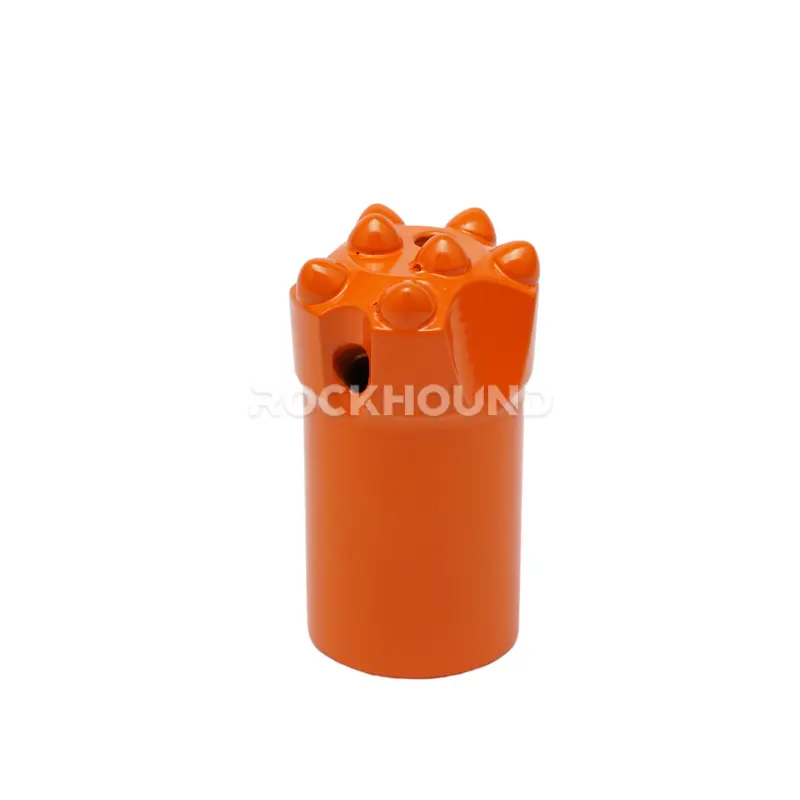
The 11° tapered 32mm button bit is a top hammer drilling tool designed for small-hole percussive drilling in mining, tunneling, and construction. It connects to a 22mm hex tapered rod through an 11-degree interference-fit taper — one of the two modern industry-standard angles alongside 12°.
At 32mm diameter (1 9/16 inch), this bit handles blast hole drilling, rock bolt installation, and secondary rock breaking where heavier equipment cannot reach. It runs on both hydraulic and pneumatic drifters, including handheld drills like the YT24 and YT28.
FAQ
The taper angle is the conical angle of the rod-to-bit connection. At 11°, the contact surface between the bit socket and the rod end is larger than on a 7° connection. That larger surface distributes impact load more evenly and resists the bit spinning on the rod during high-torque cutting. Per Epiroc's 2025 tapered drill strings catalog, the 11° system is rated for hard to very hard rock in quarrying and heavy-duty handheld applications, with a hole diameter range of 32–64 mm. The 7° taper is used on lighter, shallower-hole pneumatic drills; the 12° is used on heavy mechanised rigs in very hard rock. The ROCKHOUND 32 mm bit in this evaluation is purpose-built for the 11° system and the drilling conditions that go with it.
Spherical buttons have a domed crown that spreads impact force over a wider contact zone. In hard, abrasive rock — like the basalt and andesite at the Luzon site — that wider load distribution means the button survives longer before developing a flat wear zone. Ballistic buttons have a sharper, more pointed profile that concentrates energy into a smaller area, which gives a faster penetration rate in softer formations but wears down faster in hard ones. The ROCKHOUND 32 mm bit uses spherical buttons because the evaluation site has variable hardness: the spherical profile handles both the hard basalt zones and the softer saprolite pockets without needing a bit change between ground types.
In dry, competent rock, air exits the front holes at the bit face, picks up freshly crushed cuttings, and carries them up the annulus between the rod and the hole wall. That works well. In plastic, wet ground — wet clay, saprolite, or waterlogged tuff — the front holes exit into material that does not break up cleanly. Instead, the clay packs into the hole opening, blocking the air path. Flushing then falls back to the three side holes only, but the fines at the central bit face have nowhere to go except back up into the tapered rod connection. Removing the front holes and routing all air through the side channels avoids this by creating an annular flow pattern that lifts debris immediately away from the skirt rather than pulling it toward the rod centre.
The general rule: regrind when gauge button wear flats reach one-third of the button's diameter. At that point, the button's domed crown has flattened enough that it is no longer fracturing rock efficiently — it is crushing and sliding instead of punching. Your penetration rate will already be dropping by the time you notice visible flats. If you wait until the buttons are nearly flat, the wasted energy has been travelling back into your drill rig on every impact, adding stress to the shank, coupling, and rod. Earlier regrinding costs one sharpening session; late regrinding can cost a rod.
Yes — the 11° taper is a standardised connection angle across the industry. As long as the socket bore diameter on the bit matches the rod end diameter (Hex 22 mm in this case), the bit will seat correctly on any brand's 11° tapered rod. Before running production, confirm the socket bore and shank diameter match your specific rod by checking both the rod end diameter and the taper bore specification on the bit. HEBEI GIMARPOL's technical team can confirm compatibility if you share the rod part number.
In the Luzon quarry market, yes. A 32 mm tapered button bit that consistently reaches 300 metres before retirement produces a cost-per-metre that procurement teams in this region consider competitive. The specific figure varies with rock type, drill power, operator technique, and whether the bit is reground during its life — all of which the Mine Study Section accounted for in setting the benchmark. In softer rock conditions, the same bit design should comfortably exceed 300 m. In continuous high-UCS hard basalt, some samples may fall short on individual runs, as Sample #3 showed.