
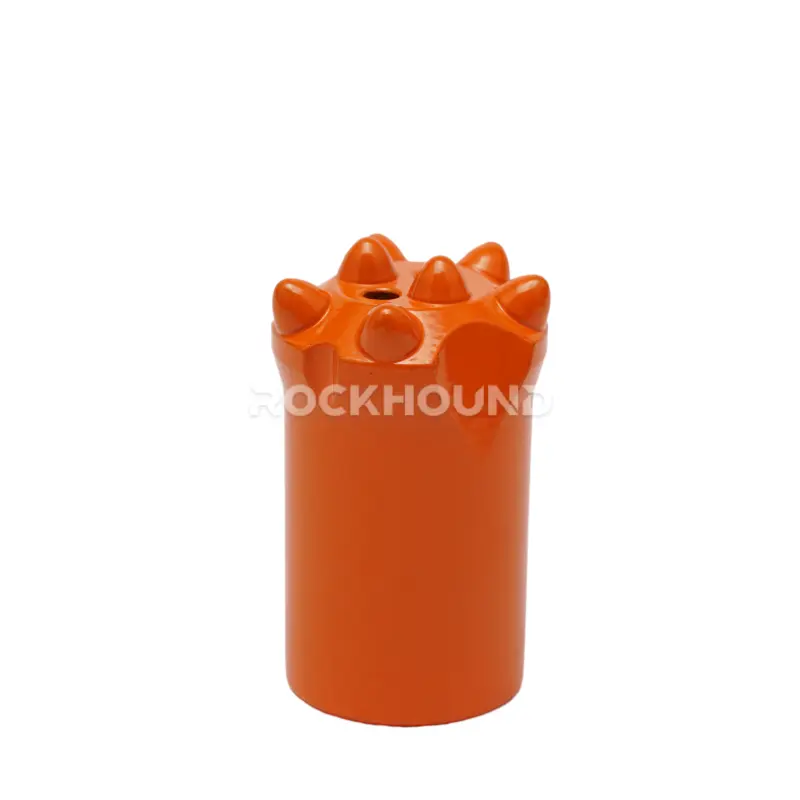
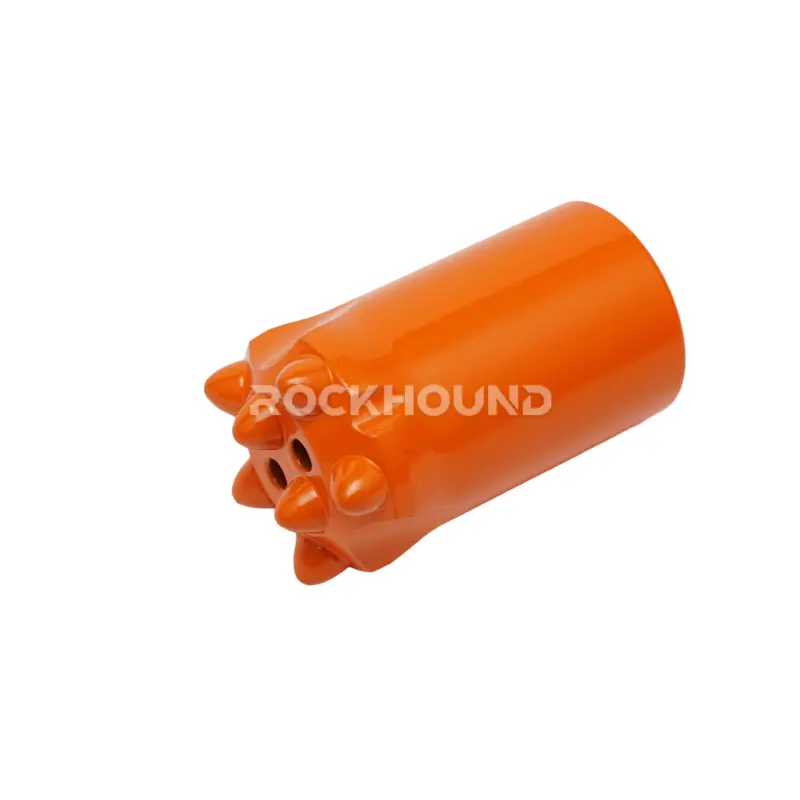
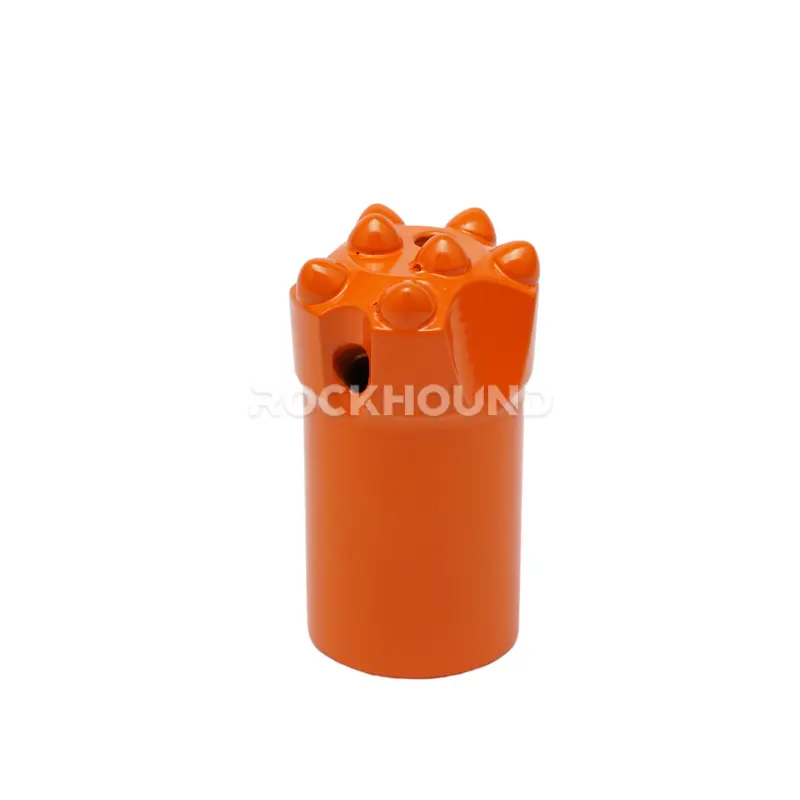
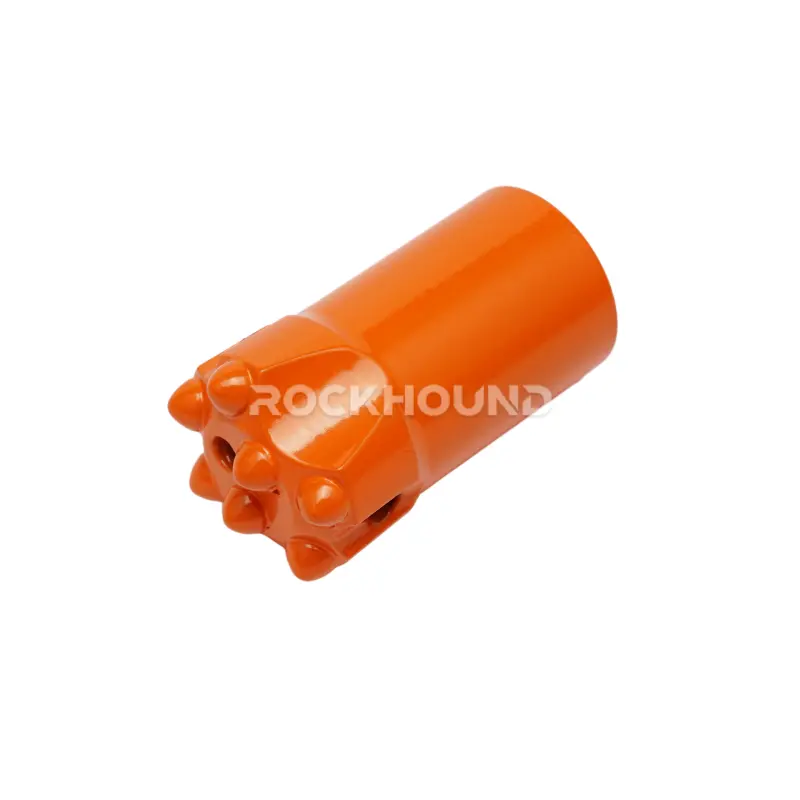
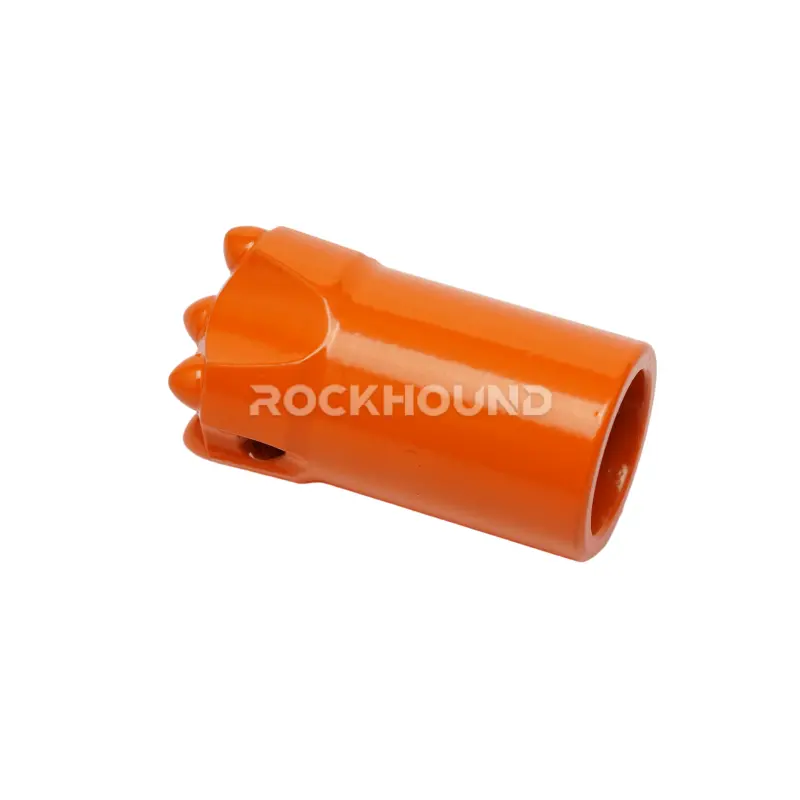
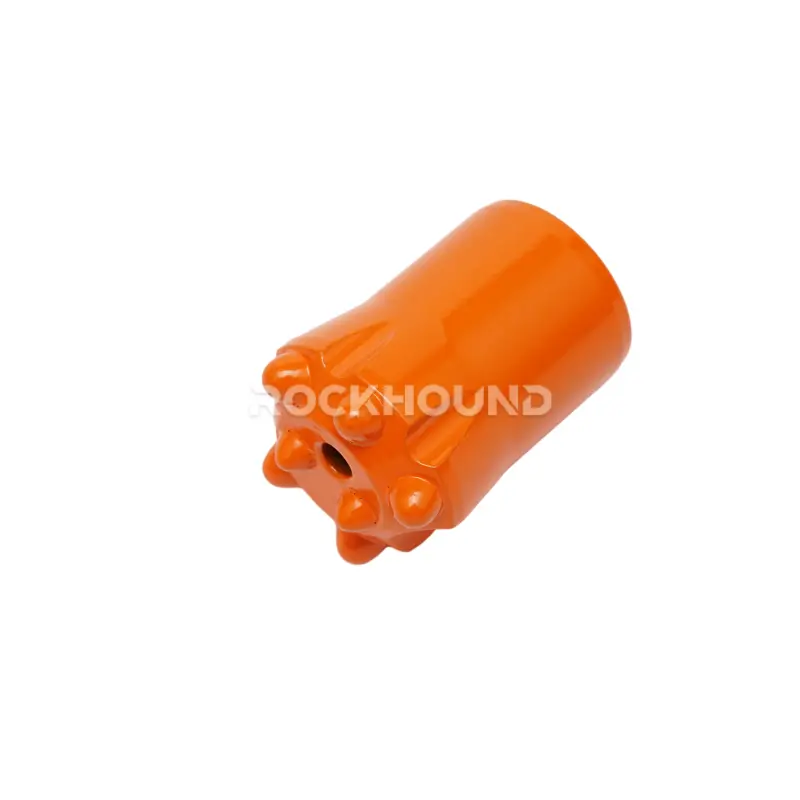
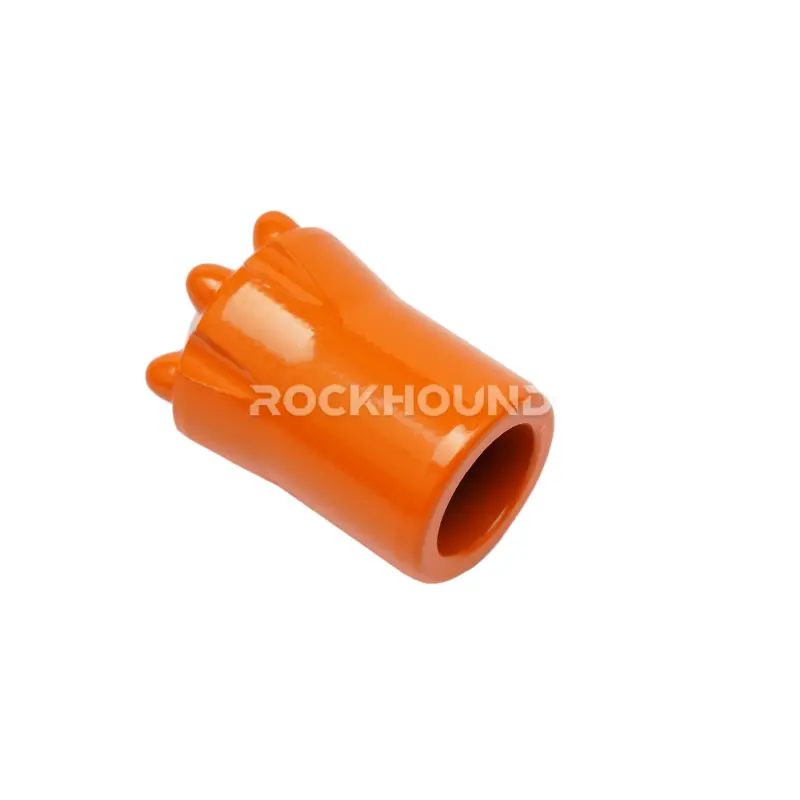
Production Description
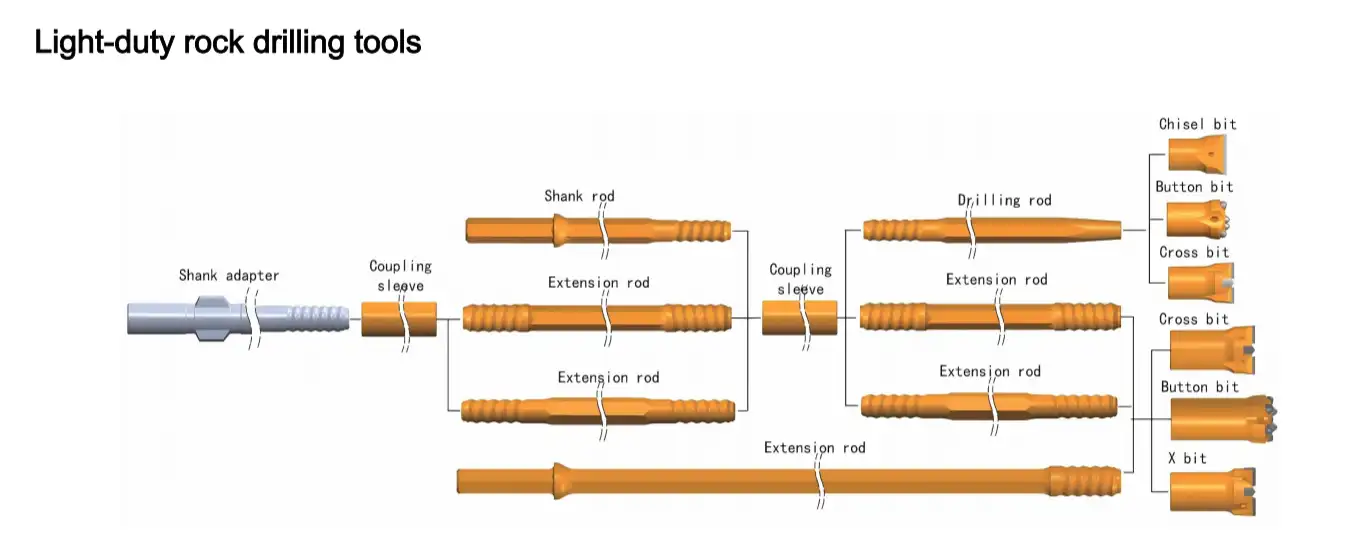
The 11° tapered 32mm button bit is a top hammer drilling tool designed for small-hole percussive drilling in mining, tunneling, and construction. It connects to a 22mm hex tapered rod through an 11-degree interference-fit taper — one of the two modern industry-standard angles alongside 12°.
At 32mm diameter (1 9/16 inch), this bit handles blast hole drilling, rock bolt installation, and secondary rock breaking where heavier equipment cannot reach. It runs on both hydraulic and pneumatic drifters, including handheld drills like the YT24 and YT28.
What separates RockHound’s version from standard market product is the material stack. The body is forged from 45CrNiMoVa alloy steel — not 40Cr or 42CrMo. The cutting buttons are sintered from YK05 cemented carbide. Both materials go through a 20-hour carburizing heat treatment process that produces a hard outer shell over a tough core. That combination is why these bits hold up in granite, basalt, and fractured ground where cheaper bits fail at the taper socket or crack at the button seat.
The 11° taper locks tightly under impact loads, yet one operator with a bit breaker can remove it in under 60 seconds. For shallow holes (2–4 meters), that speed advantage over threaded systems is significant across a full shift.
Key Features
- 45CrNiMoVa Alloy Steel Body — Nickel and molybdenum additions give the body impact toughness above 80 J (Akv), which prevents brittle cracking at the taper socket under high-frequency hammer blows.
- YK05 Tungsten Carbide Inserts — 90.5–91.0 HRA hardness and ≥2600 MPa TRS (Transverse Rupture Strength). Buttons hold a sharp cutting edge longer, especially in medium-hard formations like limestone and sandstone.
- 20-Hour Carburizing Heat Treatment — Creates a 1.5–2.0mm hard case (up to 52 HRC) over a tough core. The case resists abrasive wear; the core absorbs shock. Learn how this process works →
- Precision-Machined Flushing Holes — 1 center + 2 angled side holes direct air or water to eject rock chips from the face. Clean flushing keeps the bit cool and prevents re-crushing of cuttings.
- Multiple Button Configurations — Choose 5, 6, 7, or 8 buttons in spherical or ballistic shape to match your rock type and target ROP.
- OEM Branding Support — Laser marking or deep-physical stamping on the skirt. Logo up to 100×100 mm. Custom colors (black, yellow, zinc-coated silver) available.
Specification
| Taper bit, Button | D | Buttons (No×Size.mm) | Gauge button angle | Taper | Product code | Weight (kg) | ||
|---|---|---|---|---|---|---|---|---|
| mm | inch | Gauge | Centre | |||||
| Button Bit | 41 | 1 9/16 | 5×9 | 2×8 | 40° | 11° | 141-4107-2104 | 0.4 |
Field Test
| Sample | Total Metres | No. of Holes | Avg. Depth (m) | Penetration Rate (m/s) | vs. 300 m Benchmark |
|---|---|---|---|---|---|
| Sample #1 | 320 m | 181 | 1.77 m | 0.008 m/s | +20 m ✔ |
| Sample #2 | 306 m | 182 | 1.68 m | 0.010 m/s | +6 m ✔ |
| Sample #3 | 281 m | 170 | 1.65 m | 0.007 m/s | −19 m (avg. clears) |
| Average | 302 m | 178 | 1.70 m | 0.008 m/s | Benchmark Met |
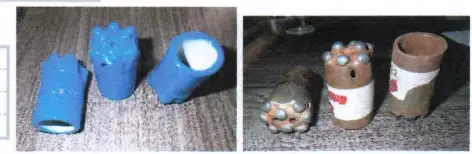
Lorem ipsum dolor sit amet, consectetur adipiscing elit. Ut elit tellus, luctus nec ullamcorper mattis, pulvinar dapibus leo.
How 11° Tapered Button Bit Works
Stress Wave Transmission
A piston inside the rock drill strikes the drill rod. This generates a compressive stress wave that travels through the steel rod at ~5,000 m/s. The wave reaches the 11° tapered connection — an interference fit between rod and bit — and transfers into the bit body with minimal energy loss. If the taper surface is worn or the fit is wrong (e.g., using an 11° bit on a 7° rod), the wave reflects back and can fracture the rod or deform the taper.
Rock Fragmentation
Once the stress wave reaches the bit face, it passes into the YK05 buttons. Each button concentrates the full impact force into a small contact area. This creates three sequential effects:
- Crushing — Rock directly under the button is pulverized into fine dust.
- Fracturing — Radial cracks spread outward from the crushed zone into the surrounding rock.
- Chipping — As the drill string rotates (50–150 rpm), adjacent buttons’ crack networks intersect. Large rock chips break away.
Applications
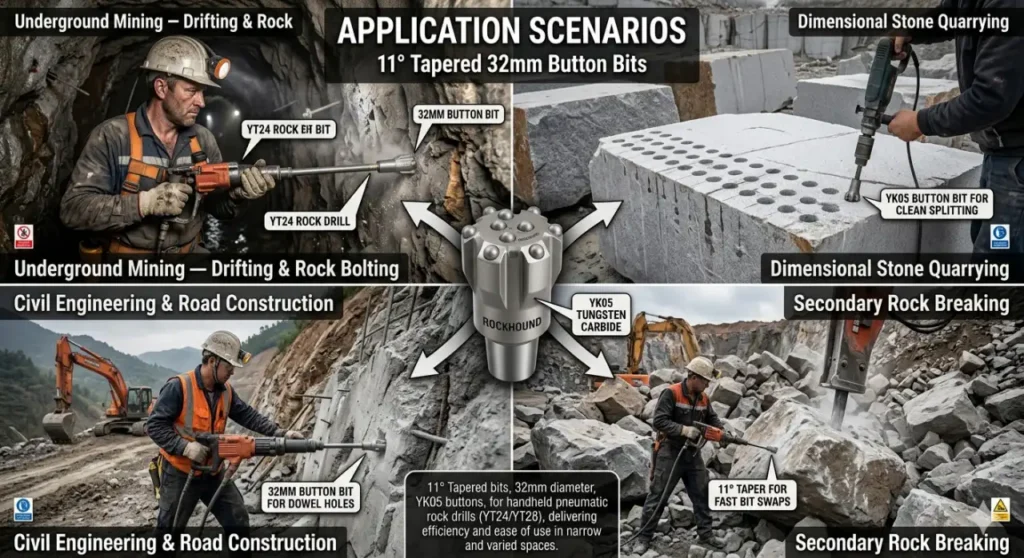
Underground Mining — Drifting & Rock Bolting
The 32mm bit drills blast holes and rock bolt holes in narrow tunnels (drifts). Holes are typically 2–3 meters deep. The tapered system is faster to connect and disconnect than threaded systems at this depth range, which directly reduces shift cycle time.
Dimensional Stone Quarrying
Marble, granite, and limestone quarries drill rows of 32mm holes to split stone along clean lines. YK05 buttons maintain a high ROP across long drilling campaigns, keeping production on schedule without frequent bit changes.
Civil Engineering & Road Construction
On jobsites where heavy rigs cannot access, handheld pneumatic drills (YT24/YT28) paired with 32mm button bits handle light blasting and rebar dowel installation in rock or concrete.
Secondary Rock Breaking
When blasted boulders are too large for the crusher, a 32mm bit drills a charge hole in the boulder for a small explosive or hydraulic splitter. The 11° taper allows fast bit swaps across awkward boulder positions.
How To Choose The Right 11° Tapered 32mm Button Bit
Match Button Shape to Rock Type
| Rock Type | UCS (MPa) | Button Shape | Face Design | Skirt Length |
|---|---|---|---|---|
| Limestone / Shale | < 100 (Soft) | Ballistic | Convex | Short |
| Sandstone | 100–150 (Medium) | Spherical | Flat or Convex | Short |
| Granite / Basalt | > 150 (Hard) | Spherical (YK05) | Flat | Short or Long |
| Fractured Ground | Variable | Spherical | Flat | Long |
Button Count
- 5 buttons — Light formation, maximum penetration speed.
- 7 buttons (2+5) — Most popular for stability in hard rock. Rounder hole, less vibration feedback into the drill string.
- 8 buttons — Hard, abrasive rock where maximum coverage reduces per-button load.
Skirt Length
- Short skirt (50–55 mm) — Faster penetration rate. Use in consistent, competent rock.
- Long skirt (71–80 mm) — Better directional control in fractured or broken ground. Reduces bit wobble.
Maintenance
Button Inspection & Sharpening Schedule
Check buttons after every 20–30 meters of drilling. If a flat wear spot on any button top exceeds 1/3 of the button’s diameter, sharpen before the next run.
How to sharpen: Use a diamond grinding cup matched to the button’s original profile (spherical or ballistic). Do not use steel files or angle grinders — YK05 carbide is harder than steel and requires diamond abrasives. Handheld air grinders with diamond cups are the standard field solution.
When to retire the bit: If the steel body around the button sockets has worn down enough to expose the base of the buttons, the bit risks button pop-out. Retire it even if the buttons still appear sharp.
Bit Removal
Always use a proper bit breaker or knock-off ring to remove the bit from the rod. Never strike the bit face or the carbide buttons directly with a hammer. A single hard blow creates micro-cracks in the YK05 that cause button shattering on the first contact with rock in the next shift.
Storage & Handling
- Store bits on a wooden rack, not in a pile. Metal-on-metal contact chips carbide.
- Inspect the zinc-coated taper socket before each installation. The zinc coating lubricates the initial coupling and prevents fretting corrosion (vibration-induced micro-welding between bit and rod). If the coating is stripped, apply a thin anti-seize compound before coupling.
Oem & Branding Options
RockHound supports full OEM customization for distributors and mining fleets:
- Marking methods: High-precision laser marking or deep-physical stamping on the bit skirt.
- Logo size: Up to 100 × 100 mm.
- Information supported: Batch number, model code, company name, logo.
- Color options: Black oxide, yellow paint, zinc-coated silver — useful for fleet identification in low-light underground environments.
- MOQ: Contact our sales team for OEM minimums and lead times.
FAQ
An 11° tapered button bit drills small-diameter holes in rock for blasting, rock bolt installation, and secondary breaking. The 11-degree taper refers to the angle of the connection between the bit and the drill rod. At 32mm diameter, this bit is used in underground mines, quarries, and civil construction sites where handheld or light hydraulic drills are the primary equipment.
Both are modern high-impact standards. The 11° taper locks with slightly more radial pressure, giving better energy transfer from rod to bit at high blow rates (above 3,000 bpm). The 12° taper removes marginally faster. In practice, the choice depends on your drill rod system — always match the bit taper exactly to the rod taper. Mixing taper angles causes immediate mechanical failure.
Yes. The YT24 and YT28 are common handheld pneumatic drills that use 22mm hex tapered rods and accept 32mm tapered button bits. The 32mm diameter is the standard small-bore size for this equipment class.
Button pop-out happens when the steel body around the carbide button sockets erodes faster than the buttons themselves. The main causes are: insufficient water flushing (which overheats the body), dry drilling, and continuing to use a bit past its recommended retirement point. The YK05 buttons in RockHound bits have ≥2600 MPa TRS, so they rarely fracture first — it is almost always body wear that triggers this failure mode.
Sharpen when any button's flat wear scar exceeds 1/3 of the button diameter. Retire the bit when:
- the steel body around button sockets is visibly eroded
- Any button has chipped deeply on the carbide face
- The tapered socket shows deformation or "mushrooming" that prevents a proper fit on the rod.
Use a bit breaker or knock-off ring. Never strike the carbide buttons or bit face directly — this creates fractures in the YK05 that destroy the buttons immediately. If the bit is severely stuck, a slide-hammer style knock-off tool is the correct equipment. An 11° tapered bit should release with one firm impact from a proper breaker; if it does not, the taper socket may be corroded or deformed and should be inspected before reuse.