
Description
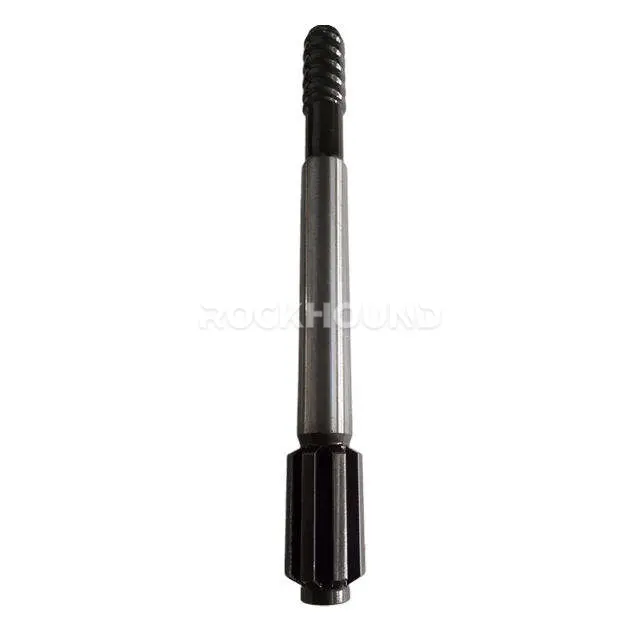
RockHound’s PR123 Shank Adapter was built with exactly that pressure in mind. Machined from certified 23CrNiMo low-alloy carburizing steel and put through a full 20-hour vacuum carburizing cycle, each adapter delivers a surface hardness of 58–62 HRC over a 1.5–2.0 mm effective case depth, backed by a tough 38–42 HRC core that absorbs thousands of percussive blows per minute without fatigue cracking. The result isn’t just a replacement part — it’s a direct upgrade path for operations where OEM parts have become scarce or prohibitively expensive.
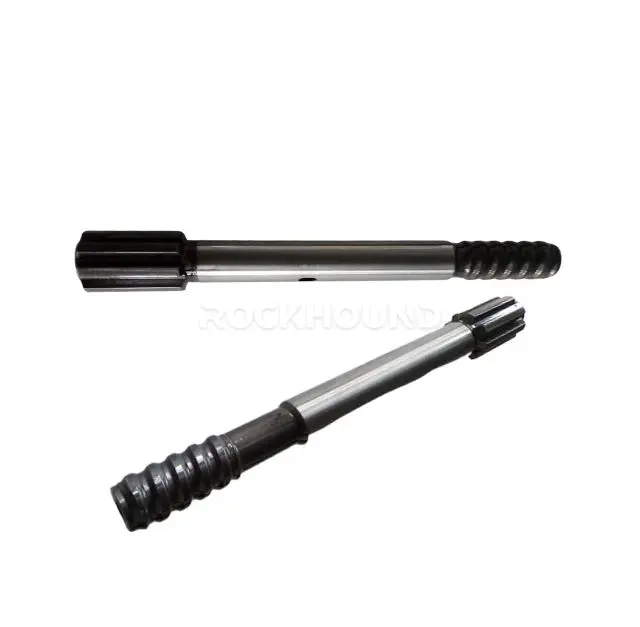
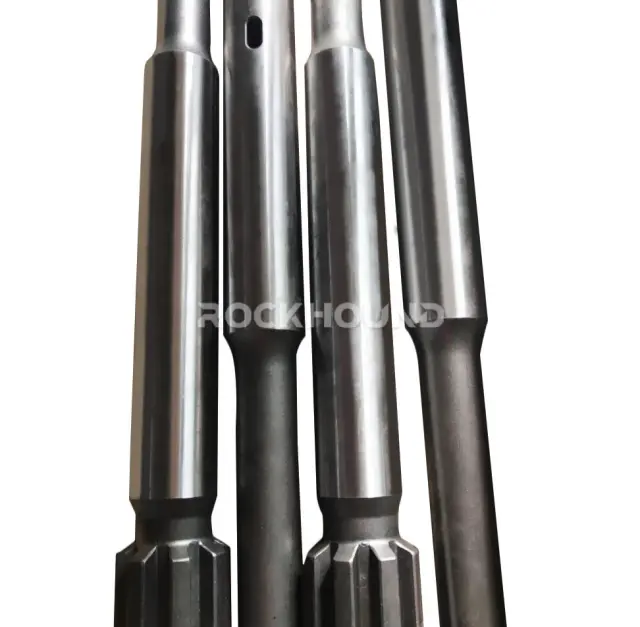
Available in R32, R38, T38, and T45 thread profiles, with body lengths of 381 mm and 446 mm, these shanks are 100% dimensionally interchangeable with original Gardner Denver specifications and are field-proven across underground mining, tunneling, and quarry applications worldwide.
Interested in how 23CrNiMo compares to Sandvik’s Sanbar 64 at a metallurgical level? Read our detailed breakdown: Rock Drill Rod Material Comparison: 23CrNiMo vs Sanbar 64
Features
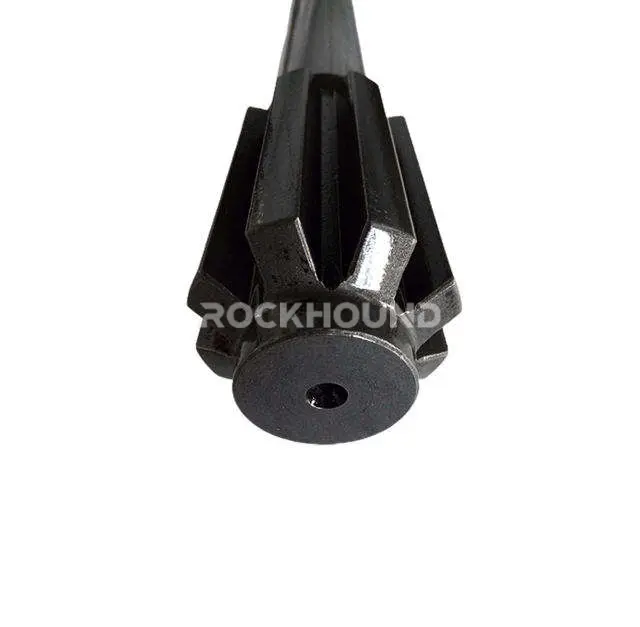
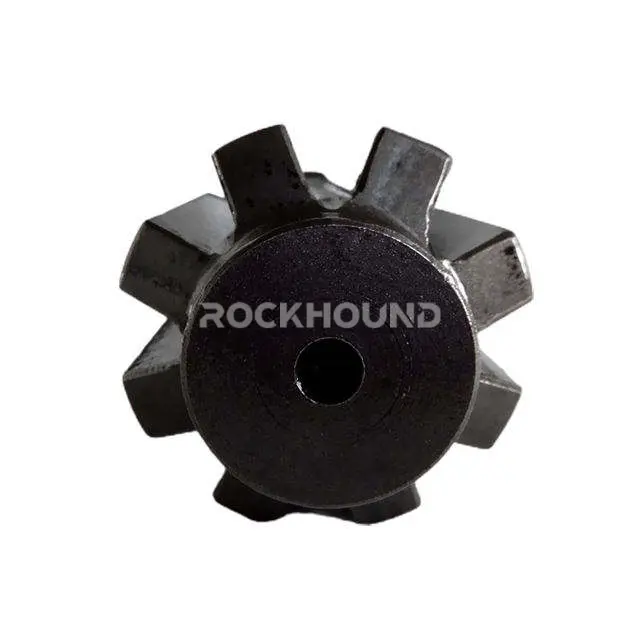
4-Spline Body — precision-ground to tight tolerances for full engagement with the PR123 rotation bushing; minimizes backlash and spline wear
58–62 HRC Case Hardness — resists spline flaking, thread galling, and striking face deformation under continuous service
38–42 HRC Core Toughness — enough ductility to absorb shock without catastrophic cracking; especially relevant in the PR123’s independent rotation design where torsional and percussive loads are applied simultaneously
14.3 mm Through-Flush Channel — smooth internal bore finish minimizes turbulence and stress concentration; compatible with water, air, or foam flushing media
Precision Thread Geometry — R32, R38, T38, and T45 profiles machined to ISO/IRMA standards; thread run-out and flank angle verified to prevent heat seizure under cyclic loading
Custom Branding Available — laser etching or pneumatic marking up to 100 × 100 mm logo area on the shank body (non-wear zone); no effect on fatigue life
Specification
| L (mm) | D (mm) | Thread | Product Code | Weight (kg) |
|---|---|---|---|---|
| 381 | 45 | R32 | 474-4538-5154 | 3.4 kg |
| 381 | 45 | R38 | 474-4538-5156 | 3.6 kg |
| 381 | 45 | T38 | 474-4538-5176 | 3.7 kg |
| 381 | 45 | T45 | 474-4538-5177 | 3.9 kg |
| 446 | 45 | T38 | 474-4544-5176 | 5.2 kg |
Applicable Drifter: Gardner Denver PR123 (4.5″ bore, independent rotation) Flushing Hole Diameter: 14.3 mm Spline Count: 4
Competitor Cross-Reference (Verified Models)
| Brand | Model / Part Reference | Thread Options | Notes |
|---|---|---|---|
| Sandvik | Shank adapters for comparable 45mm class drifters | R32, T38, T45 | Sanbar 64 steel; 0.6–1.2 mm case depth |
| Epiroc | COP/BBC series — GD-class compatible range | T38, T45 | Industry standard; premium pricing |
| Gardner Denver | 474-4538-5154 / 5156 / 5177 / 5176 | R32, R38, T38, T45 | OEM standard; often listed as obsolete / limited availability |
| RockHound | RH-GD series (referenced above) | R32, R38, T38, T45 | 100% interchangeable; 23CrNiMo + 20-hr carburizing; best cost-per-meter value |
Note: Gardner Denver PR123 OEM parts have been widely reported as difficult to source or discontinued through standard supply channels. RockHound maintains full inventory and ships globally with short lead times.
Applications
The PR123 is a heavy independent rotation drifter — and the shank adapter’s duty cycle reflects that. Here’s where these parts earn their keep:
Underground Long-Hole Mining — sublevel stoping and long-hole production drilling where consistent penetration rates directly affect blast geometry and ore recovery
Raise Boring & Winze Development — high-torque independent rotation makes the PR123 well-suited for raise work; torsional fatigue resistance of 23CrNiMo is critical here
Tunnel Face Drilling — consistent energy transmission across all holes in a round maintains parallel hole alignment and reduces overbreak
Quarry Bench Drilling — paired with air track equipment for medium-depth production holes in hard rock formations
Infrastructure Construction — road cuttings, dam abutments, and foundation excavation in variable geology
See the full structural breakdown: What is a Shank Adapter? Structure and Function
How to Choose / Select
1. Confirm the thread standard that matches your drill string:
- R32 — lighter applications, shorter hole depths, entry-level top hammer setups
- R38 — versatile mid-range thread; widely used in general underground development
- T38 — current industry mainstream for the PR123; stronger thread form than R38 for higher torque
- T45 — deeper holes, harder rock, or where bit bending stiffness is a priority
2. Select the correct length:
- 381 mm covers the majority of PR123 installations
- 446 mm is used where additional distance between the drill steel collar and the drifter front head is required (check your rig setup carefully before ordering)
3. Assess your geology:
- In extremely hard rock (high Protodyakonov coefficient), specify the RockHound 20-hour carburizing grade — spline life will be measurably longer compared to standard-process alternatives
4. Check your rotation bushing condition first: If the PR123’s rotation bushing has worn beyond 1 mm clearance, no shank — regardless of grade — will perform correctly. Replace worn bushings before installing new shanks.
Extended selection and maintenance guide: Shank Adapter: Function, Work, Choose & Maintenance
How to Maintain
A shank adapter’s service life isn’t fixed — it’s largely determined by how the surrounding system is maintained. Here’s what the highest-performing operations actually do:
- Never run dry. The PR123’s mist lubrication system must be functioning before each shift. The striking face and spline zone require a continuous oil film. Without it, galling begins within minutes on hard rock.
- Grease the thread connection every time a rod change is made. Use a purpose-formulated thread compound — not general grease. Bare threads in an active heat zone will micro-weld and seize.
- Inspect the striking face weekly. Early signs of “mushrooming” (material flow around the face perimeter) indicate a piston hardness mismatch or excessive blank firing. Address the root cause before fitting a new shank.
- Check and replace rotation bushings proactively. A worn bushing forces the shank into eccentric motion, and fatigue cracks develop at the spline root within hours. The bushing costs far less than a seized adapter or damaged piston.
- Store vertically or on dedicated racks. Never allow shanks to sit in pooled water or contact acidic drainage — even passive corrosion pitting creates fatigue initiation sites. Apply rust-preventive oil to all machined surfaces before storage.
Custom Branding / OEM Marking
RockHound supports B2B customers who supply these tools under their own brand. We offer:
- Laser etching — high-definition, permanent, no material removal beyond surface treatment
- Pneumatic marking — fast cycle time for high-volume runs
- Max logo area: 100 × 100 mm, positioned on the shank body in the non-contact zone
- No impact on hardness profile, fatigue rating, or dimensional tolerances
Contact us for OEM volumes, packaging options, and lead time.
FAQ
Yes — 100%. All critical dimensions, including spline geometry, striking face diameter, thread profile, and overall length, are machined to the original Gardner Denver PR123 specification. These parts are direct drop-in replacements. No modification to the drifter or drill string is required.
R-series threads (R32, R38) use a rounded thread form, while T-series (T38, T45) use a trapezoidal profile. T-series threads are mechanically stronger under torque-heavy conditions and have largely replaced R-series in modern underground drilling. T45 provides higher bending resistance than T38, making it the preferred choice for longer drill strings or harder formations.
Service life varies with rock hardness, lubrication discipline, and percussion settings. In well-maintained systems drilling medium-hard rock, a quality shank adapter should reach 400–700 hours before requiring replacement. RockHound's 20-hour carburizing grade consistently achieves the upper range of this window. Poorly lubricated systems or worn rotation bushings can cut service life by 50% or more, regardless of shank grade.
Yes, with thread selection being the primary variable. T38 is the most versatile across both environments. For surface bench drilling with longer drill strings, T45 is recommended for additional column stiffness. The shank adapter body and heat treatment specification are identical across both use cases.
Several OEM part numbers for the PR123 are listed as obsolete or difficult to source through standard distribution channels. RockHound was developed specifically to address this supply gap — our PR123-compatible shank adapters are in stock, available in all thread sizes, and ship globally with competitive lead times.