
Description
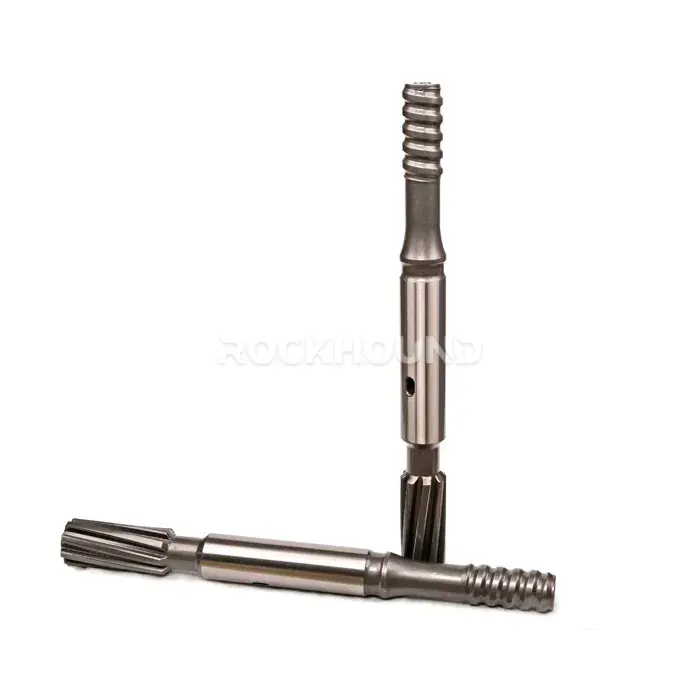
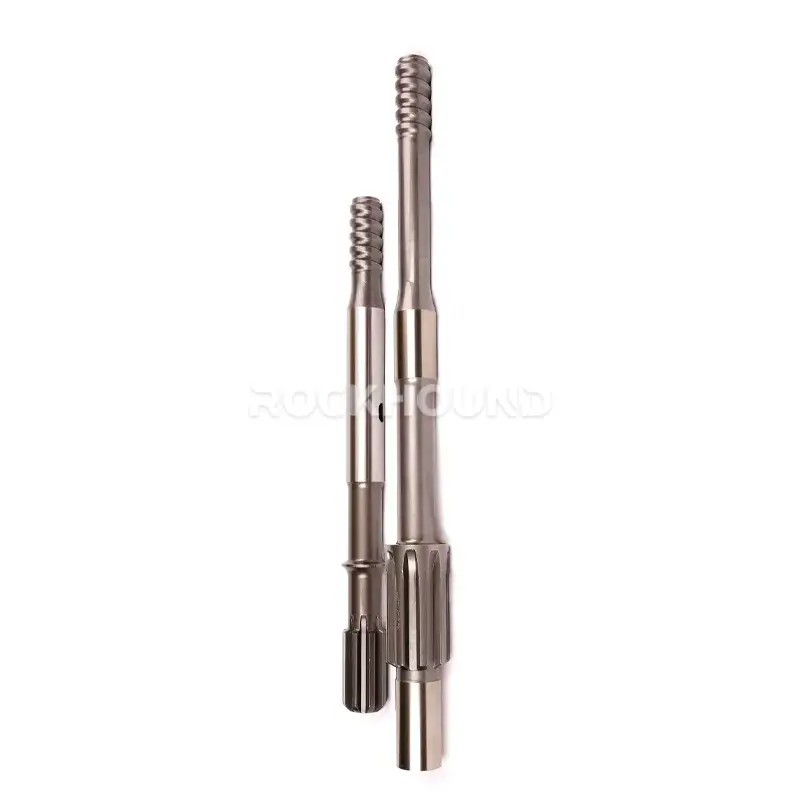
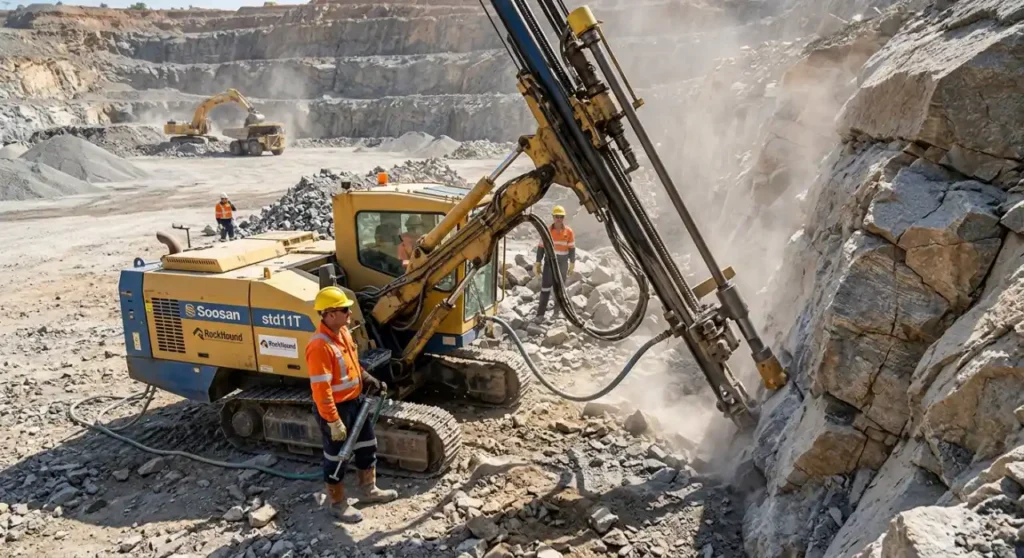
RockHound’s Soosan std11T shank adapter is built specifically for that environment. We manufacture it from 23CrNiMo alloy steel — a chromium-nickel-molybdenum grade chosen for its combination of deep hardenability, core toughness, and resistance to fatigue crack initiation under cyclic shock loading. Then we run a full 20-hour carburizing heat treatment — roughly double the industry average — to push the hardened case to 1.5–2.5 mm depth and achieve a surface hardness of HRC 58–60 while keeping the core ductile enough to absorb impact without brittleness.
The result is a direct-fit replacement for the Soosan std11T (TD45/TD51 drifter) that threads on like an OEM part, runs like a premium aftermarket upgrade, and costs significantly less than either.
Features
- 20-Hour Carburizing Process — Extended heat treatment cycle produces a 1.5–2.5 mm hardened case, generating compressive residual stress that counteracts tensile fatigue loads and resists “mushroom-top” deformation at the striking face. Learn more about our production process.
- Surface Hardness HRC 58–60 / Core 38–44 HRC — The hard exterior resists spline and thread wear; the tough core absorbs shock without fracture.
- Precision CNC Machining — Spline profiles, water-hole diameter, and thread geometry are held to tight tolerances across every batch, ensuring smooth fit into the TD45/TD51 rotation chuck with no excessive play.
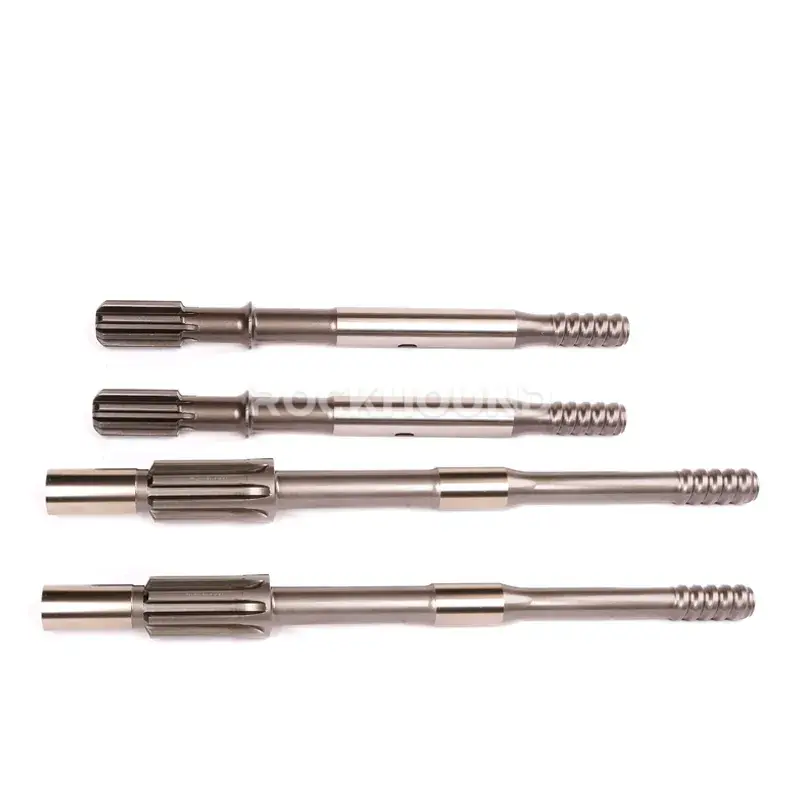
- 8-Spline Drive Profile — Optimized for Soosan TD series rotation bushings; maximises torque contact area and minimises fretting wear at the chuck interface.
- 100% OEM-Interchangeable — Drop-in replacement requiring zero modification. Compatible thread standards also allow pairing with Epiroc, Sandvik, and Robit drill rods of equivalent thread size.
- Custom Logo Marking — Laser engraving available up to 100 × 100 mm on the shank body. Ideal for B2B distributors and fleet-asset management.
Specification
| Model | Drill / Drifter | Thread | L (mm) | D (mm) | Product Code | Weight (kg) |
|---|---|---|---|---|---|---|
| Soosan std11T Shank | std11T / TD45 | T38 | 620 | 56 | 496-5662-5176 | 7.4 |
| Soosan std11T Shank | std11T / TD45 | T45 | 620 | 56 | 496-5662-5177 | 8.2 |
| Soosan std11T Shank | std11T / TD45 | T51 | 620 | 56 | 496-5662-5178 | 8.5 |
| Soosan std11T Shank | std11T / TD45 | R38 | 638 | 56 | 496-5663-5156 | 7.6 |
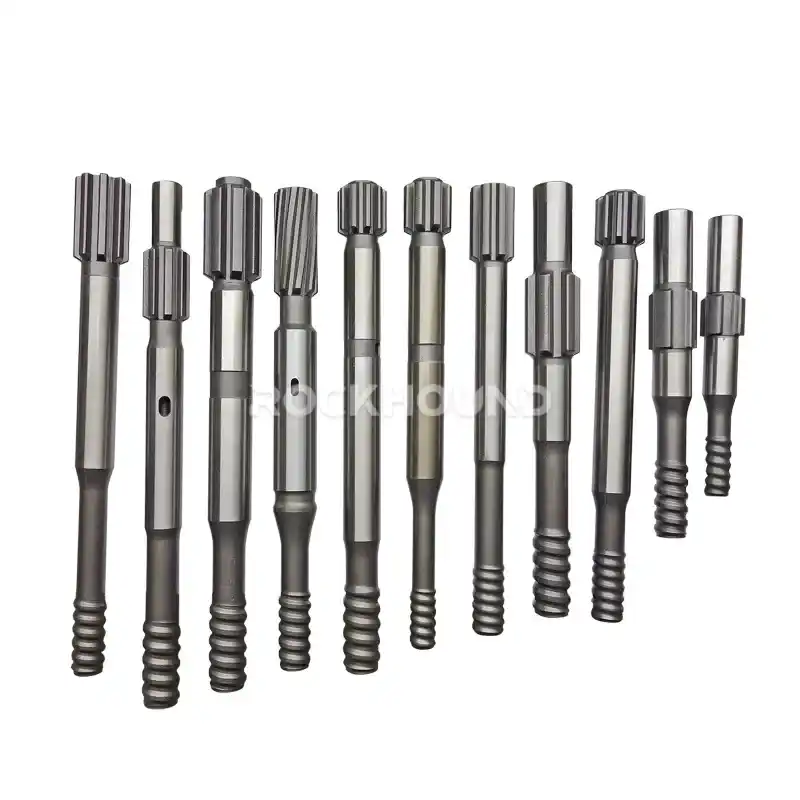
| Soosan std11T Shank (Extended) | std11T / TD45 | T38 | 650 | 56 | 496-5665-5176 | 7.6 |
Non-standard lengths and thread combinations available on request.
Brand Comparison
Genuine interchangeability matters when a drill shift runs 24 hours. Here’s how RockHound stacks up against alternatives used on equivalent top hammer drill systems:
| Brand | Compatible Drifter | Material / Process | Interchangeability | Price Level | Notes |
|---|---|---|---|---|---|
| Soosan OEM | TD45 / TD51 | Standard carburizing steel | 100% | High | Reference benchmark; high per-piece cost |
| Epiroc | COP 1238 / 1440 | Vacuum-hardened alloy | Partial (thread-matched) | Very High | Premium quality; long lead times |
| Sandvik | HL710 / RD525 | Sanbar 23 / Sanbar 64 | Partial (thread-matched) | Very High | Excellent fatigue life; brand-locked ecosystem |
| RockHound | std11T TD45 / TD51 | 23CrNiMo + 20 Hr Carburizing | 100% direct fit | Competitive | OEM-spec performance; 15–25% lower cost-per-metre |
RockHound is not positioned as a “cheap copy.” Our 23CrNiMo + extended carburizing specification deliberately targets the same performance envelope as OEM while offering procurement flexibility and B2B branding support that factory-direct channels rarely provide.
Applications
- Quarry Bench Drilling — std11T paired with T45 or T51 shanks handles 76–115 mm blast hole patterns in granite, basalt, and limestone.
- Tunnel Face Drilling — R38 and T38 variants suit the compact drifter geometry on the std11T tunnel configuration for face drilling and bolt-hole work.
- Civil & Infrastructure — Foundation anchoring, road-cut slope reinforcement, and utility trench boring where angled drilling demands a reliable shank-to-rod connection under variable load direction.
How It Works
Understanding the shank adapter’s role helps you specify the right one. See the full structural breakdown here.
- Impact Transmission — The piston strikes the shank’s flat striking face; a compressive stress wave propagates down through the drill rod to the bit. Energy transfer efficiency depends directly on the dimensional fit between piston and shank end geometry.
- Rotation Transfer — The rotation bushing engages the shank’s spline section, driving the entire drill string at controlled RPM while the piston continues to strike — simultaneously.
- Flushing Channel — Compressed air or water passes through the central bore, carrying cuttings up the annulus and cooling the bit face.
The shank adapter is the only component in the top hammer drill system that experiences all three load types at once, every second of operation. That’s why material and heat treatment matter so much.
How to Choose
Full selection guidance: Shank Adapter — Function, Work, Choose & Maintenance
- Thread size — T38 suits smaller hole diameters (64–76 mm) and lighter rock. T45 is the most common choice for mid-range hard rock. T51 handles the highest torque loads and largest hole diameters. R38 offers a rounded-shoulder thread profile preferred in some tunnelling conventions.
- Spline count — Confirm the TD45/TD51 rotation chuck is configured for 8-spline drive before ordering.
- Length — Standard 620 mm covers most quarry configurations. The 638 mm (R38) or 650 mm (T38 extended) versions provide additional compliance in fractured or abrasive formations where vibration isolation matters.
- Rock type — In highly abrasive silica-rich rock, specify T45 or T51 for heavier connection strength and longer thread life.
Maintenance
- Lubrication at Installation — Apply a dedicated rock drill grease to splines and thread before every installation. Dry running accelerates spline wear and generates heat that degrades surface hardness.
- 40-Hour Inspection Cycle — Check the striking face for flatness. A depression or “mushroom” deformation exceeding 1 mm signals the shank is near end of life. Replace immediately to protect the drifter piston — far more expensive than the shank itself.
- Thread Condition — Blue or purple heat discoloration on the thread collar indicates thermal damage and material property loss. Retire the shank.
- Chuck Alignment — Periodically verify the drill boom mount bolts are torqued correctly. An off-centre chuck generates asymmetric spline loading, accelerating wear on one side of the shank profile.
- Storage — Coat unused shanks in rust-inhibiting oil. Store horizontally in a dry environment to prevent corrosion fatigue from surface pitting.
For bulk orders or technical inquiries, contact our engineering team at rhdrill.com.
FAQ
Premature failure is often caused by "Empty Hitting" (percussing without rock contact), insufficient lubrication leading to thermal cracks on the splines, or severe bending stress from misaligned rods. RockHound’s 23CrNiMo material is specifically chosen to resist these abnormal stresses.
Look for "mushrooming" or pitting on the striking face, or if the spline thickness has worn down by more than 1/3 of its original size. Overheating (bluish discoloration) is also a sign that the material properties have degraded.
Absolutely. Our threads (T45, T51) strictly follow international ISO standards. As long as the thread type matches, RockHound shanks will connect perfectly with Epiroc, Sandvik, or Robit rods without stripping or air leakage.
Yes, we offer laser marking (up to 100*100mm). This is ideal for B2B distributors and large-scale mining rental companies for asset tracking and brand visibility.
Yes. Scientific data shows that a 20-hour cycle increases the effective hardening layer depth by approximately 40%, significantly boosting the fatigue limit in high-impact environments.