Table of Contents
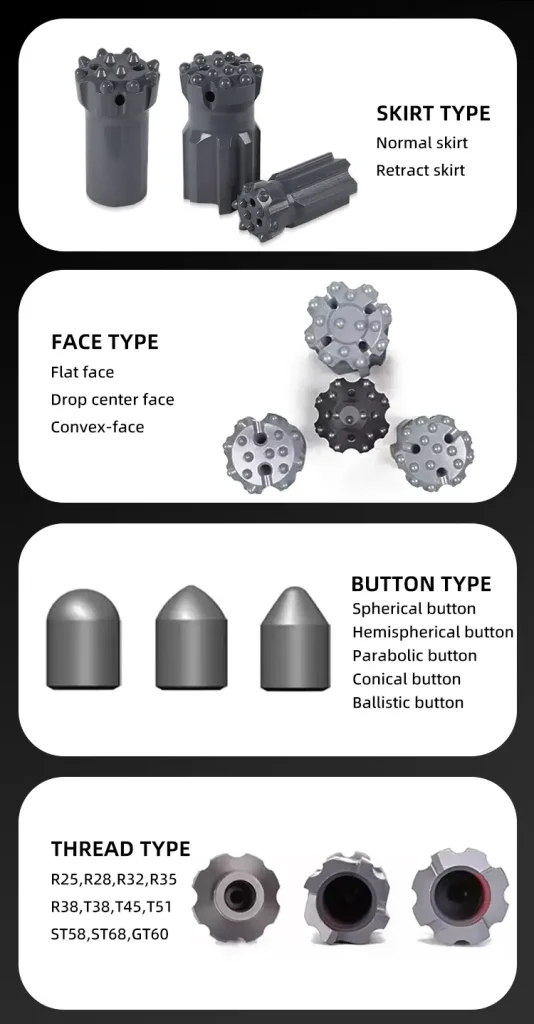
Top hammer button bits are classified by four main parameters: thread type (determines rig compatibility), face design (controls hole straightness), carbide button shape (balances penetration rate against wear resistance), and skirt/body design (affects retrieval in broken ground). Most drilling operations stock 4–8 standard combinations selected based on rock type, hole depth, and rig specification.
Manufacturers like Sandvik, Epiroc, and RockHound offer dozens of configurations across these four axes — there is no single fixed number of “types.” Understanding the classification logic, however, gives you a reliable framework for selecting the right bit for any formation, whether you are benching granite in an open-pit quarry or developing a cross-cut underground.

1. By Thread Type — The Primary Compatibility Parameter
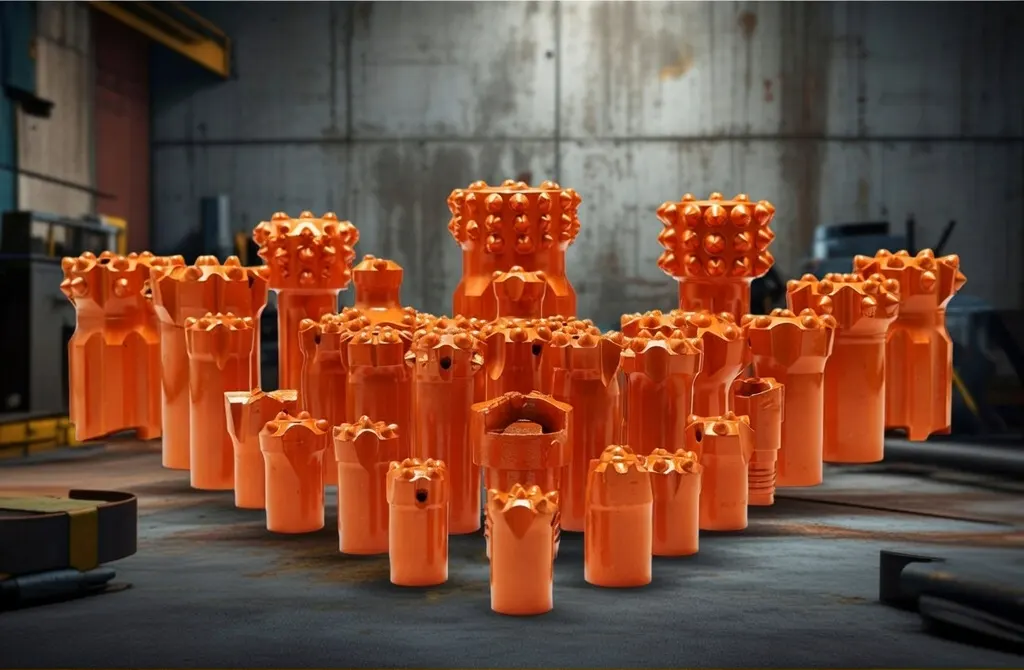
Thread type is the most operationally critical classification because it determines mechanical compatibility with your drill rods and rock drill. A mismatched thread means zero energy transfer regardless of how well-chosen the face or button profile is. Most manufacturers offer 10–15 major thread types for top hammer bits, covering diameters from 28 mm to 152 mm.
R-series (rope thread) connections are standard for smaller-diameter, lighter-duty applications such as bolting, tunneling, and short-hole drifting. T-series (trapezoidal thread) connections are designed for medium to heavy production drilling where higher percussive energy demands a more robust joint. GT- and ST-series extend this into deep longhole and high-production mining where energy transfer efficiency and thread longevity are critical.
| Thread Type | Typical Diameter Range | Primary Application |
|---|---|---|
| R25 | 28–45 mm | Rock bolting, small tunneling, narrow vein mining, light-duty roof support |
| R28 | 32–51 mm | Drifting, medium holes, development headings, general short-hole drilling |
| R32 | 38–64 mm | Bench drilling, general mining, quarrying, medium-depth production holes |
| R/T35 | 45–76 mm | Medium bench drilling, longhole stoping, underground mining applications |
| R38 | 51–89 mm | Production drilling, large-scale benching, tunneling, high-volume quarrying |
| T38 | 64–102 mm | Bench drilling and tunneling, high-torque applications, medium to large holes |
| T45 | 76–127 mm | Heavy quarrying, large-scale blasting, open-pit mining, high-penetration needs |
| T51 | 89–152 mm | Large production holes, deep bench drilling, demanding surface mining operations |
| ST58 / ST68 | 102–152 mm+ | Deep longhole drilling, sub-level caving, high-strength requirements in hard rock |
| GT60 | 102–152 mm+ | High-performance mining and tunneling, extreme torque and energy transfer, advanced jumbo drilling |
Selection note: Always match thread type to both your rock drill’s shank adapter specification and the target bit diameter. Running an undersized thread on a high-power drill accelerates thread wear and risks joint failure at depth.
2. By Face Design — Controls Hole Straightness and Flushing Efficiency
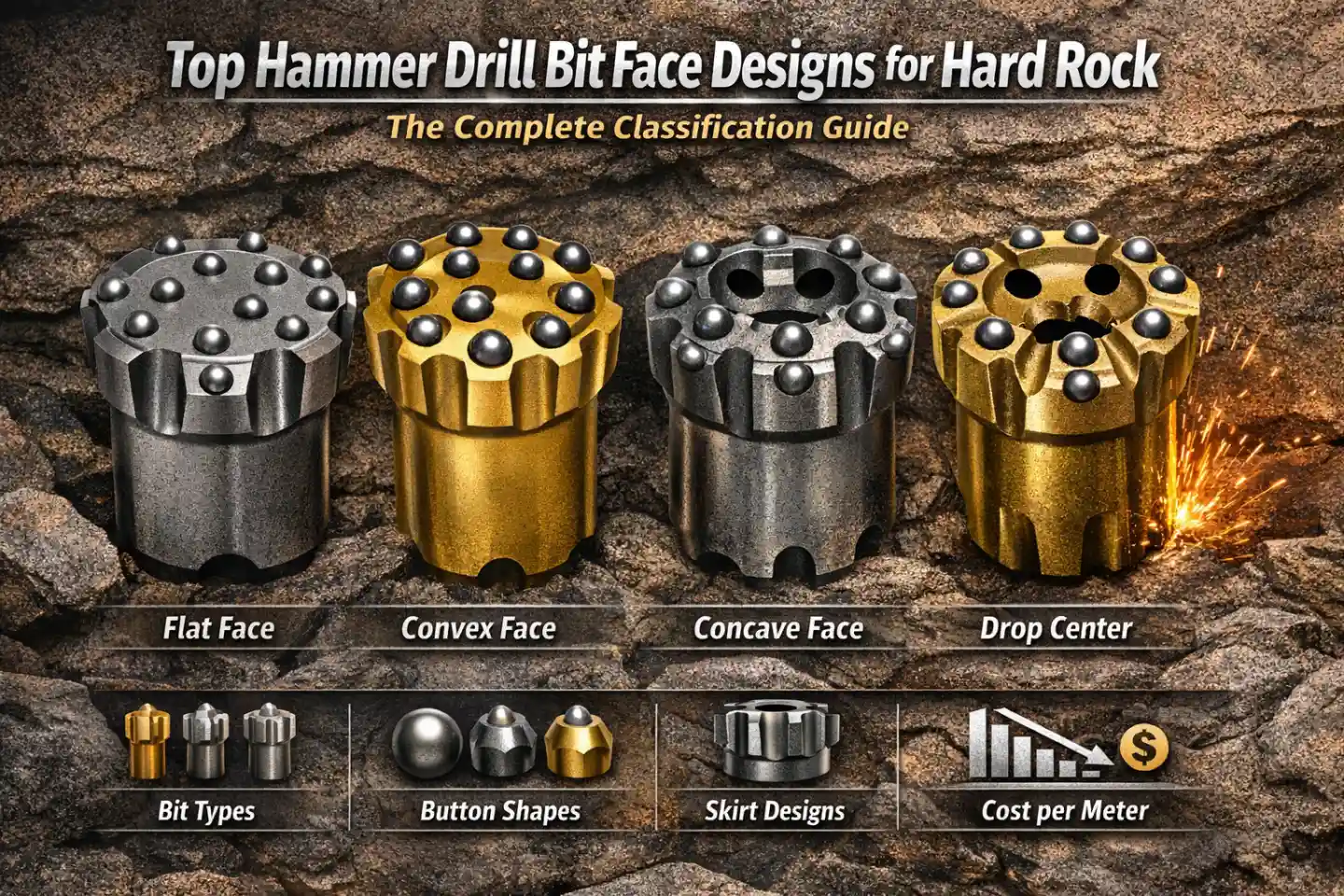
The face is the front geometry of the bit body, distinct from the carbide insert profile. Face design governs how the bit centers itself at collar, how cuttings are evacuated, and how much deviation accumulates over hole depth. There are four primary face designs in commercial use.
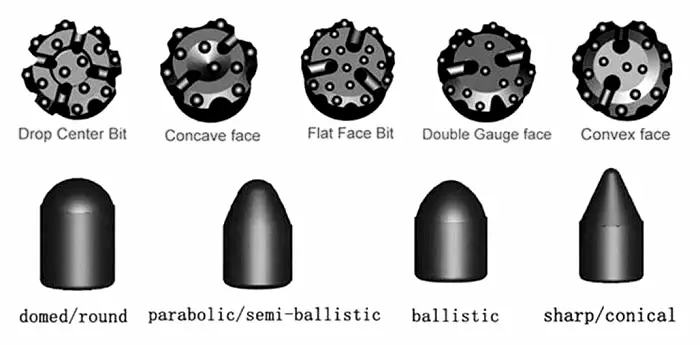
Drop Center (Concave Face)
The center of the face is recessed below the gauge buttons, creating a centering effect as the bit engages the rock. This geometry produces superior hole straightness and flushing efficiency in hard, competent rock. It is the preferred choice for long-hole drilling (typically >10 m) where deviation control is critical, and for quarrying applications where blast pattern accuracy directly affects fragmentation quality.
In granite bench drilling, T45 drop-center bits with spherical buttons typically maintain deviation below 1% of hole depth under proper rotation (50–70 RPM) and adequate flushing pressure (6–8 bar).
Dome (Convex Face)
A rounded, outward-projecting face that concentrates percussive energy at the center of contact, delivering the highest rate of penetration (ROP) in soft to medium-hard rock. The trade-off is reduced centering stability — dome-face bits are more prone to deviation in fractured or heterogeneous formations. Best suited to short holes in uniform geology where speed is the priority.
Flat Face
A planar face geometry that distributes impact energy evenly across all buttons. Commonly used in medium-hard, uniform formations where a balance of penetration rate and straightness is required. Note that flat face and drop center are distinct geometries and should not be used interchangeably in specifications.
Reaming Face
Typically dome-shaped with an enlarged gauge diameter, designed for borehole enlargement rather than primary drilling. Used in raise boring, pre-reaming for casing insertion, and applications where a pilot hole needs to be opened to final diameter.
| Face Design | Best Formation | Primary Advantage | Key Limitation |
|---|---|---|---|
| Drop center (concave) | Hard, competent rock | Superior hole straightness; excellent flushing and cuttings removal in fractured or competent formations | Moderate ROP compared to convex/dome in softer, uniform rock |
| Dome (convex) | Soft to medium-hard, uniform rock | Highest ROP; fast collaring and rapid initial penetration | Prone to deviation and wandering in fractured or inconsistent zones |
| Flat face | Medium-hard, uniform rock | Balanced energy distribution; good all-around performance | Less effective centering and hole straightness than drop center in hard rock |
| Reaming | Borehole enlargement / reaming operations | Maintains gauge during widening; preserves hole diameter accuracy | Not optimized for primary drilling or initial penetration |
3. By Button Shape (Carbide Insert Profile) — The Speed vs. Wear Resistance Trade-off
The carbide button profile is the single most influential factor in the bit’s drilling performance and service life. Button shape determines how compressive and tensile stress fractures the rock beneath each impact, and how the carbide withstands abrasive wear between reginds.
Rock hardness for button selection is best assessed using the Protodyakonov hardness coefficient (f-value) or Uniaxial Compressive Strength (UCS, MPa). The Mohs scale, while widely known, is a mineral hardness index and does not translate reliably to drillability — it is not the appropriate reference for bit selection.
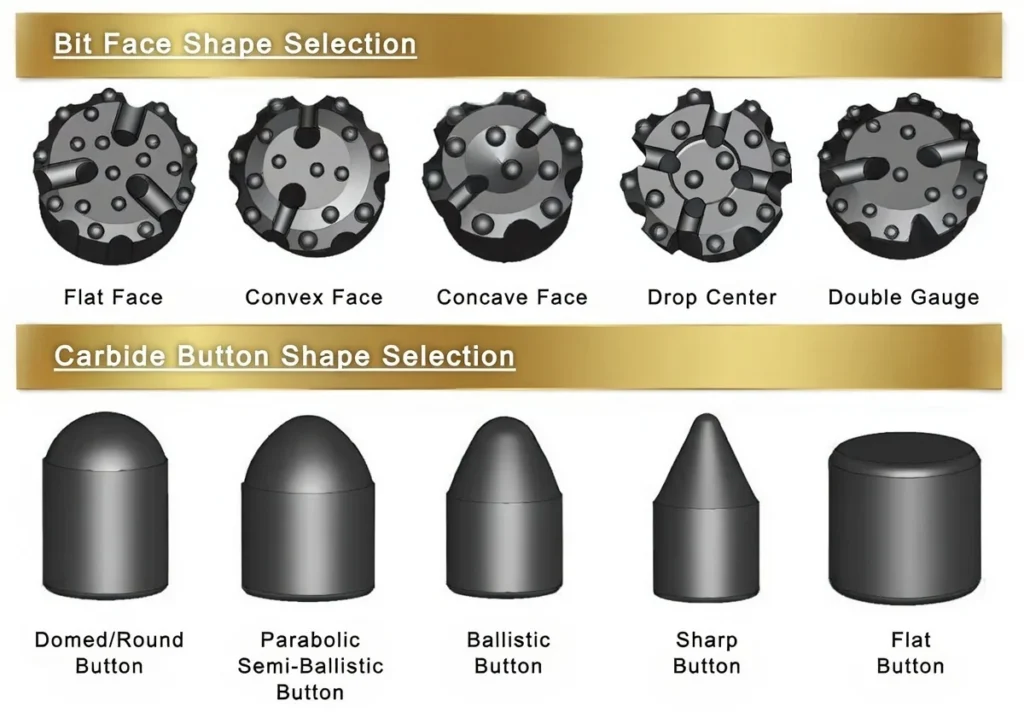
Spherical (Dome/Round) Buttons
Fully rounded carbide inserts that present maximum contact area to the rock face. This geometry distributes impact stress broadly, reducing the stress concentration at the button tip and dramatically improving wear resistance in highly abrasive formations. Spherical buttons are the standard choice for granite, quartzite, iron ore, and any formation with UCS above 180 MPa (f > 12 on the Protodyakonov scale).
The trade-off is a lower instantaneous ROP compared to more pointed profiles — the rounded tip does less focused fracturing per blow.
Ballistic (Semi-Ballistic / Parabolic) Buttons
A pointed, ogive-shaped profile that concentrates percussive energy at a small contact area. This produces significantly higher ROP in soft to medium-hard rock (UCS < 150 MPa, f ≤ 10) by fracturing rock more aggressively per blow. The sharper geometry, however, means less carbide material at the tip, making ballistic buttons more susceptible to wear and micro-chipping in abrasive conditions.
Conical (Sharp / Tapered) Buttons
The most aggressive profile, with a near-pointed tip that maximizes fracturing force per impact. Suitable for very hard formations where carbide toughness is less of a constraint, or alternatively for very soft formations where formation hardness is the bottleneck. Conical buttons are the most fragile of the three profiles under high side-loading or in fractured rock where impact angles vary.
Mixed-Profile Configurations (Ballistic Face + Spherical Gauge)
Many production bits combine button profiles within a single face — ballistic inserts on the center and inner rows for ROP, spherical inserts on the gauge row where abrasive wear is highest. This is a practical optimization for variable or transitional geology rather than a discrete “type,” but it is worth specifying explicitly when ordering for mixed formations.
| Button Profile | Hardness Range (UCS / f-value) | Key Strength | Key Weakness |
|---|---|---|---|
| Spherical | >180 MPa / f > 12 | Maximum wear resistance; longest service life in highly abrasive rock | Lower ROP; less aggressive fracturing per blow |
| Ballistic (semi-ballistic) | 80–150 MPa / f ≤ 10 | High ROP; excellent fracturing efficiency in softer to medium formations | Faster wear in abrasive rock; shorter intervals between regrinds |
| Conical | Extremes (very hard or very soft) | Superior initial fracturing; maximum energy focus at tip for hard rock penetration | Most fragile; prone to chipping under variable impact angles or side-loading |
| Mixed-profile (ballistic face + spherical gauge) | Mixed / transitional geology | Balanced: combines fast penetration with improved gauge wear resistance | Performance depends on exact mix; may not excel in uniform extreme conditions |
4. By Skirt and Body Design — Stability and Retrieval in Difficult Ground
The skirt (body) of the bit affects how it behaves during withdrawal — particularly in fractured, blocky, or water-bearing ground where the borehole can collapse around the bit during drilling.
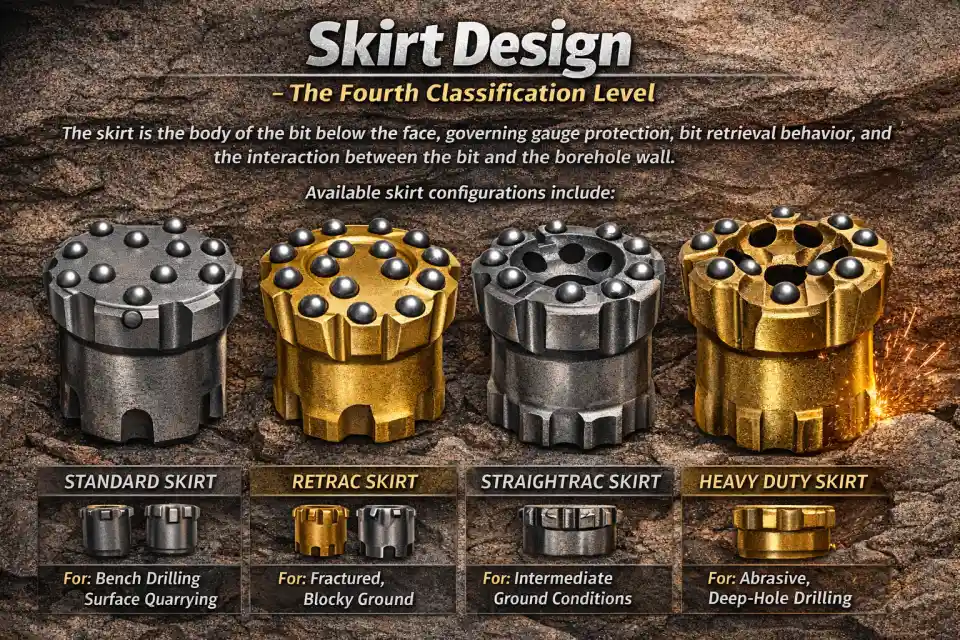
Standard Skirt
A straight, parallel body profile matched to the nominal hole diameter. Appropriate for stable, competent rock where borehole collapse is not a risk. The simplest geometry, lowest cost, and fastest penetration in ideal conditions.
Retrac Skirt
Retrac bits feature rear-facing carbide buttons positioned on the skirt behind the main cutting face. These buttons ream the borehole wall during the withdrawal stroke, preventing the bit from becoming lodged in zones of local collapse or overbreak. This design is particularly important in underground development and production drilling in fractured or water-bearing formations, where stuck bits are a significant cause of downtime and rod loss.
A common misconception is that “retrac” refers to a mechanically retractable bit — it does not. The term refers specifically to the back-reaming button geometry on the skirt.
Guide (Heavy-Duty) Skirt
A reinforced body with additional carbide protection on the skirt face, designed for highly abrasive conditions or where the bit must maintain gauge in formations with significant lateral hardness variation. Used in coarser-grained abrasive rock types where body wear is a more common failure mode than button wear.
| Skirt Design | Best Conditions | Key Benefit |
|---|---|---|
| Standard | Stable, competent rock | Lowest cost; highest rate of penetration (ROP) in ideal, non-fractured ground conditions |
| Retrac | Fractured, blocky, or collapsing formations | Prevents stuck bit incidents; enables safe withdrawal and reaming in unstable or loose ground |
| Guide / Heavy-Duty | Highly abrasive formations with coarse rock fragments | Extends bit body life; maintains gauge protection and reduces wear in extreme abrasive environments |
Standard Product Categories in Commercial Use
Based on the four classification axes above, the following bit types represent the most commonly stocked configurations in mining, quarrying, and construction drilling:
Standard Button Bits
The general-purpose configuration: dome or semi-ballistic buttons on a flat or dome face with a standard skirt. Designed for medium to hard rock in stable conditions where a balanced trade-off between penetration rate and bit life is required. The most widely used bit type across surface mining and bench drilling.
| Parameter | Specification |
|---|---|
| Button shape | Dome or semi-ballistic |
| Face design | Flat or dome |
| Skirt | Standard |
| Primary applications | Surface bench drilling, road cutting, general construction; ideal for medium-hard rock formations with good flushing and straight hole requirements |
Retrac Button Bits
The preferred configuration for underground development, production drilling in fractured rock, and any application where borehole stability is poor. The rear-facing skirt buttons ream the borehole wall on withdrawal, reducing the risk of bit loss and enabling faster cycle times in difficult ground.
| Parameter | Specification |
|---|---|
| Button shape | Dome or spherical (depending on formation hardness and abrasiveness) |
| Face design | Drop center or dome |
| Skirt | Retrac (rear-facing reaming buttons for enhanced gauge protection) |
| Primary applications | Underground development, tunneling, fractured or collapsing formations; ideal for unstable ground where reaming stability and reduced jamming are critical |
Drop Center Button Bits
Optimized for long, straight holes in hard, competent rock. The concave face geometry produces superior centering on contact, reduces deviation over depth, and improves cutting evacuation. The combination of drop center face and spherical buttons is a standard configuration for quarry production drilling in granite and similar formations.
| Parameter | Specification |
|---|---|
| Button shape | Spherical (most common) or dome |
| Face design | Drop center (concave) |
| Skirt | Standard or retrac depending on ground conditions |
| Primary applications | Long-hole quarrying, production drilling in hard competent rock |
Ballistic Button Bits
Configured for maximum ROP in soft to medium-hard formations (UCS 80–150 MPa). The ballistic button profile delivers aggressive fracturing per blow. Best suited to limestone, softer sandstone, and similar formations where wear rate is secondary to penetration speed.
| Parameter | Specification |
|---|---|
| Button shape | Ballistic (semi-ballistic / parabolic) |
| Face design | Dome or Flat |
| Skirt | Standard |
| Primary applications | Fast drilling in softer formations; high-volume surface quarrying, aggregate production, road construction, and medium-hard rock bench blasting where high penetration rate (ROP) is prioritized over maximum bit life |
Spherical Button Bits
Designed for maximum service life in highly abrasive rock. The fully spherical insert geometry distributes wear uniformly across the button surface, extending grinding intervals significantly compared to ballistic profiles in equivalent formations. The standard configuration for granite, quartzite, iron ore, and other high-abrasion targets.
| Parameter | Specification |
|---|---|
| Button shape | Fully spherical |
| Face design | Drop center (preferred) or flat |
| Skirt | Standard or retrac |
| Primary applications | Granite, quartzite, iron ore; any formation with UCS > 180 MPa |
Specialized and Premium Configurations
Beyond standard catalog configurations, leading manufacturers offer optimized variants for specific high-demand applications:
- Autobit (Sandvik) — Extended grinding intervals engineered for automated and mechanized longhole drilling, where bit changes require stopping an automated rig cycle.
- Powerbit (Epiroc) — Advanced carbide treatment and body geometry for high-frequency percussive drilling in demanding production environments.
- Top Center / Speedbit — Raised center button configuration for faster, more accurate collaring and improved hole straightness at the start of the hole.
- RockHound Heavy-Duty / High-Performance Series — Thicker body walls and larger-diameter carbide inserts for high-volume quarry production where body integrity is as critical as button wear resistance.
How to Select the Right Top Hammer Button Bit
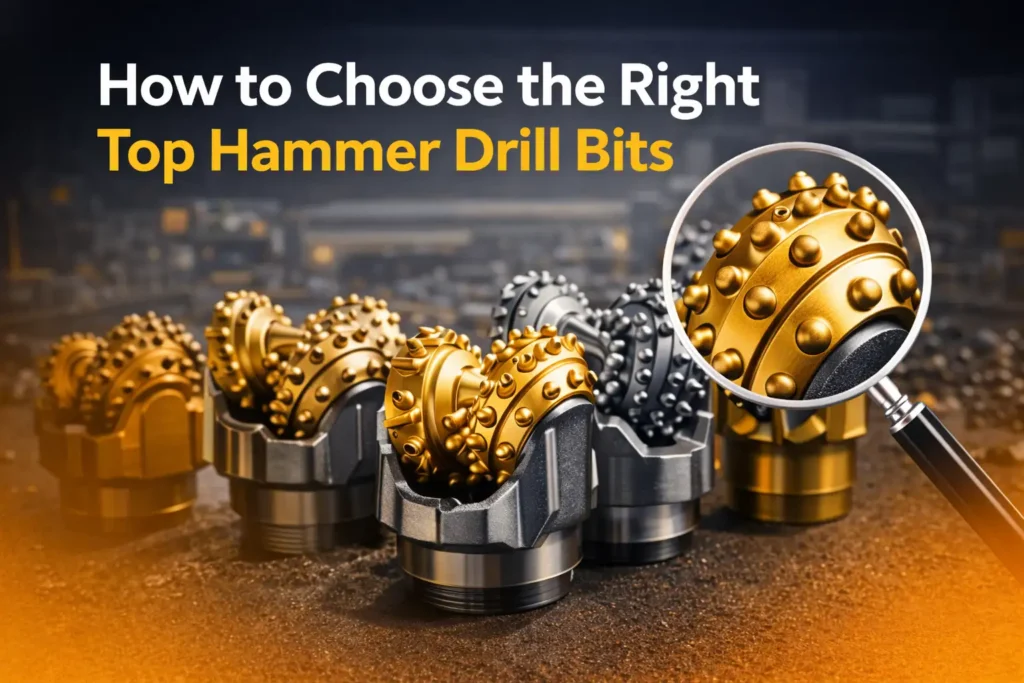
Selection is a process of matching four parameters to your drilling conditions. Work through the following decision sequence:
Step 1 — Establish rock hardness. Determine the UCS of your target formation (from geotechnical data, lab testing, or historical drilling performance). This determines your button profile: spherical for UCS > 180 MPa, ballistic for UCS < 150 MPa, mixed-profile for transitional zones.
Step 2 — Assess borehole stability. If your formation is fractured, blocky, or water-bearing, specify a retrac skirt. In stable, competent ground, a standard skirt is appropriate and lower cost.
Step 3 — Determine hole depth and straightness requirements. For holes deeper than 10 m, or wherever blast pattern accuracy is critical, specify a drop center face. For short holes where ROP is the priority, a dome or flat face is acceptable.
Step 4 — Match thread type to your drill and rod string. Confirm the shank adapter specification on your rock drill and select the corresponding thread series. Running the wrong thread series risks energy loss, premature thread wear, and joint failure.
| Factor / Rock Condition | Recommended Configuration – Top Hammer Button Bits |
|---|---|
| Soft to medium-hard rock (UCS < 150 MPa) | Ballistic buttons, dome or flat face, standard skirt |
| Hard, competent rock (UCS 150–180 MPa) | Dome / spherical buttons, drop center face, standard skirt |
| Very hard and abrasive rock (UCS > 180 MPa) | Spherical buttons, drop center face, standard or retrac skirt |
| Fractured / unstable / collapsing ground | Any button profile, retrac skirt (mandatory) |
| Long holes (>10 m), deviation-sensitive | Drop center face, spherical buttons, retrac skirt |
| Short, high-speed surface drilling | Ballistic buttons, dome face, standard skirt |
| Underground development | Spherical or dome buttons, drop center or dome face, retrac skirt |
Summary: The Four-Axis Framework
There is no single correct answer to “how many types of top hammer button bits exist” because the answer depends on which classification axis you apply. The practical framework is:
Thread type determines rig compatibility — non-negotiable and selected first. Face design determines hole quality — drop center for straightness, dome for speed. Button shape determines the wear-vs-penetration trade-off — spherical for abrasion resistance, ballistic for ROP. Skirt design determines retrieval safety — retrac wherever ground stability is uncertain.
A well-specified bit is defined by all four parameters simultaneously. For example: a T45 spherical drop-center retrac is a complete specification — T45 thread, spherical buttons, drop-center face, retrac skirt — targeted at hard abrasive rock in a production bench application with marginal ground stability. That level of specificity is what separates a productive drilling program from one that burns through bits.
Field results vary depending on formation consistency, drill parameters, flushing conditions, and operator practice. For a bit recommendation specific to your rock type, hole diameter, thread size, and rig model, contact RockHound’s technical team with your ground characterization data and drilling objectives.
Related Reading:
Note: The classification framework in this article reflects current commercial practice across mining, quarrying, and construction drilling. Technical parameters are drawn from manufacturer specifications and field application data. Individual results will vary based on formation and operating conditions.
FAQ
There isn't one fixed number because button bits are modular. Manufacturers like RockHound offer dozens of configurations by mixing and matching four main categories:
Thread Type: Compatibility with your drill rod (e.g., R32, T45).
Face Design: How the bit hits the rock (e.g., Drop Center, Convex).
Button Shape: The profile of the carbide inserts (e.g., Spherical, Ballistic).
Skirt Design: The body shape for stability or retrieval (e.g., Standard, Retrac).
Thread selection depends on the hole diameter and the scale of the job:
R-Series (R25, R28, R32): Ideal for small holes (28–64 mm), drifting, and tunneling.
T-Series (T38, T45, T51): Best for medium to large production holes (64–152 mm) in quarrying and bench drilling.
GT/ST Series (GT60, ST68): Designed for high-performance, large-scale mining and deep long-hole drilling.
Drop Center (Concave): Choose this for hole straightness. It features a recessed center that helps the bit stay on track. It is excellent for medium-hard rock and offers superior flushing.
Convex (Dome): Choose this for speed. It has a rounded face for aggressive penetration in soft-to-medium rock, though it may "wander" (deviate) in very hard formations.
It is a balance between service life and penetration rate (ROP):
Spherical (Round): The most durable shape. Use these for very hard, abrasive rock like Granite or Iron Ore. They drill slower but resist chipping and wear.
Ballistic (Parabolic): These are pointed and aggressive. Use these for soft-to-medium rock to achieve maximum drilling speed. Note that they wear out faster in abrasive ground.
A Retrac (Retractable) bit is essential for unstable, fractured, or collapsing ground. Unlike a standard bit, a Retrac bit has a tapered body with rear-facing cutting buttons. This allows the bit to "drill its way back out" of the hole if the rock collapses behind it, preventing jammed tools and lost equipment.
| Bit Type | Best Rock Condition | Key Advantage |
| Standard | Stable, Medium-Hard | General purpose, balanced performance. |
| Retrac | Fractured / Loosening | Prevents jamming; easy retrieval in "bad" ground. |
| Drop Center | Hard / Competent | Superior hole straightness and flushing. |
| Ballistic | Soft to Medium-Hard | Highest penetration rate (ROP). |
| Spherical | Very Hard & Abrasive | Maximum wear resistance and service life. |