
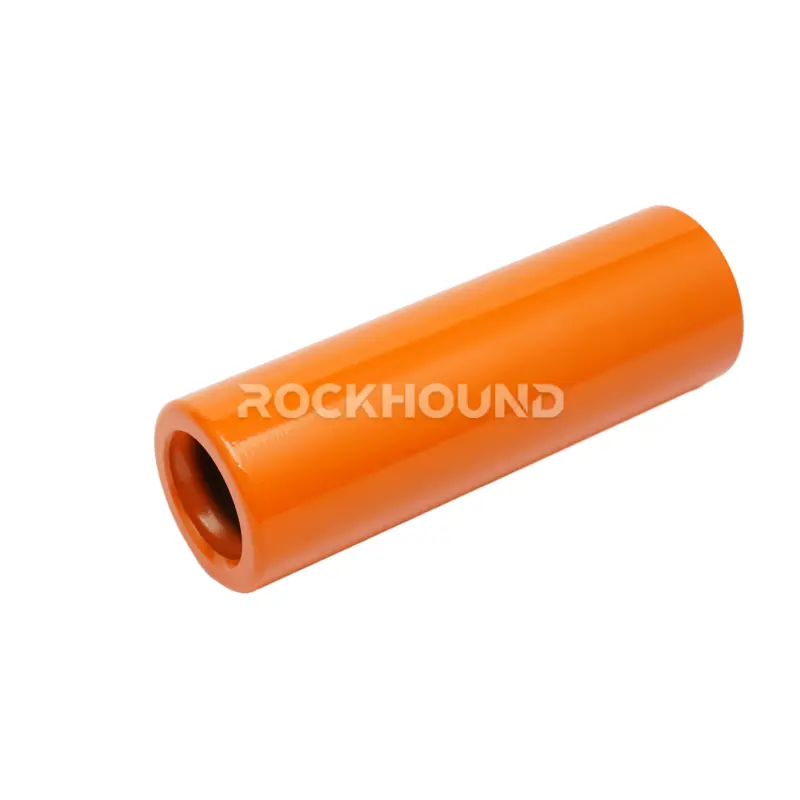
Description
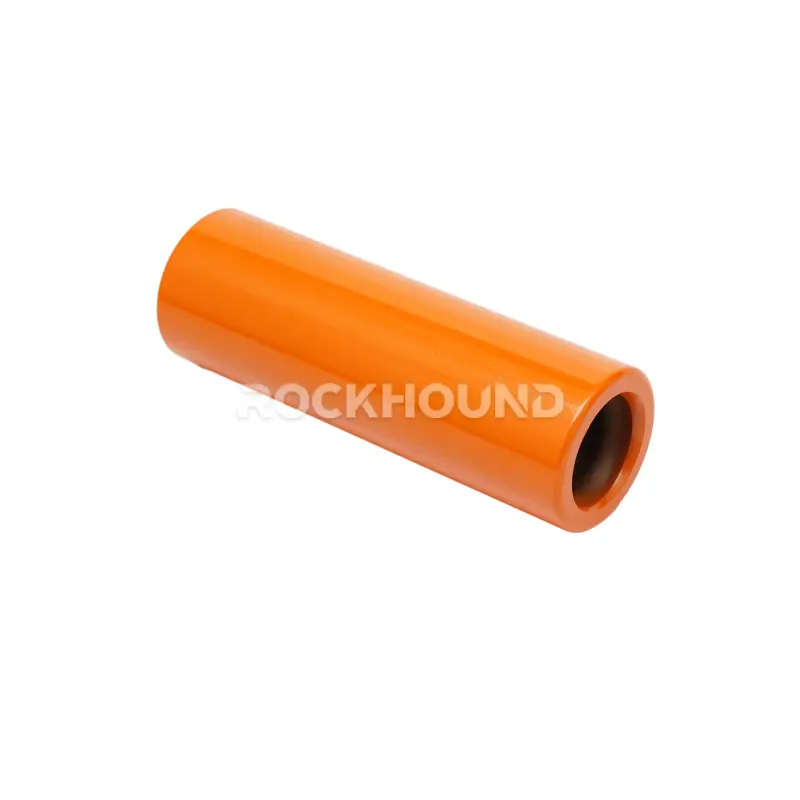
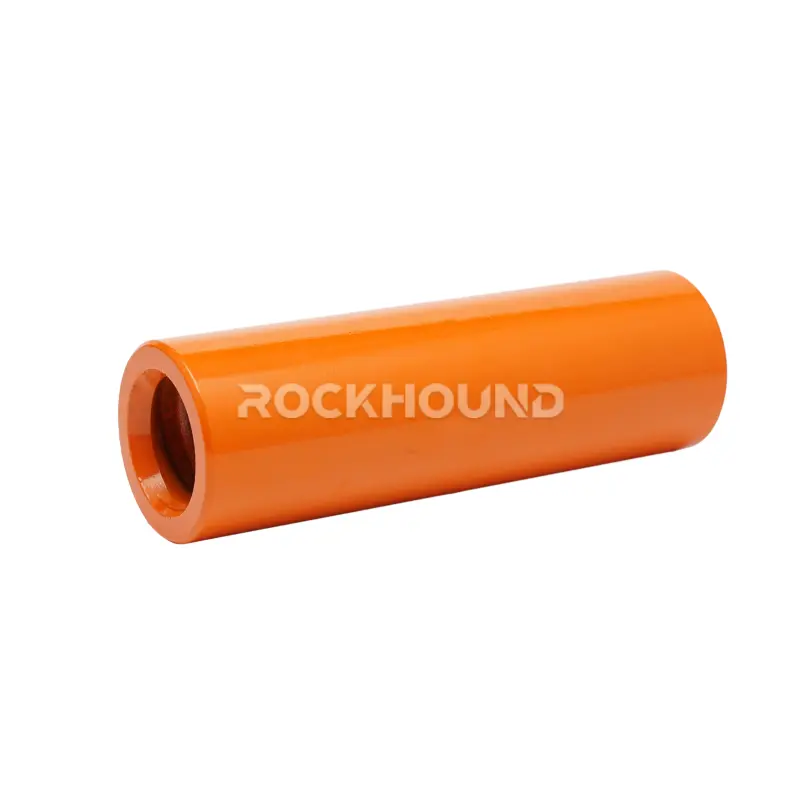
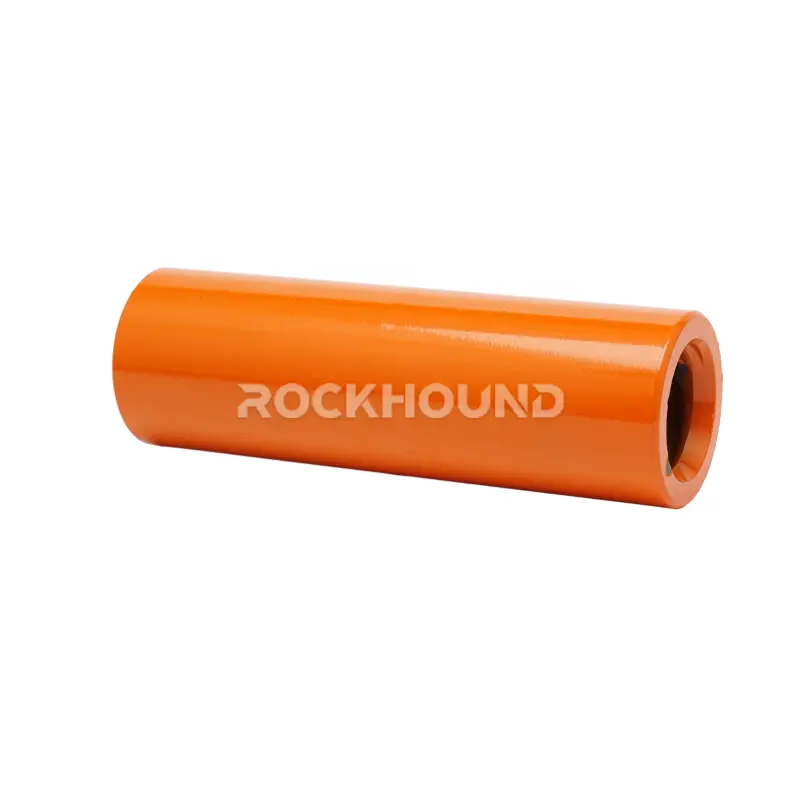
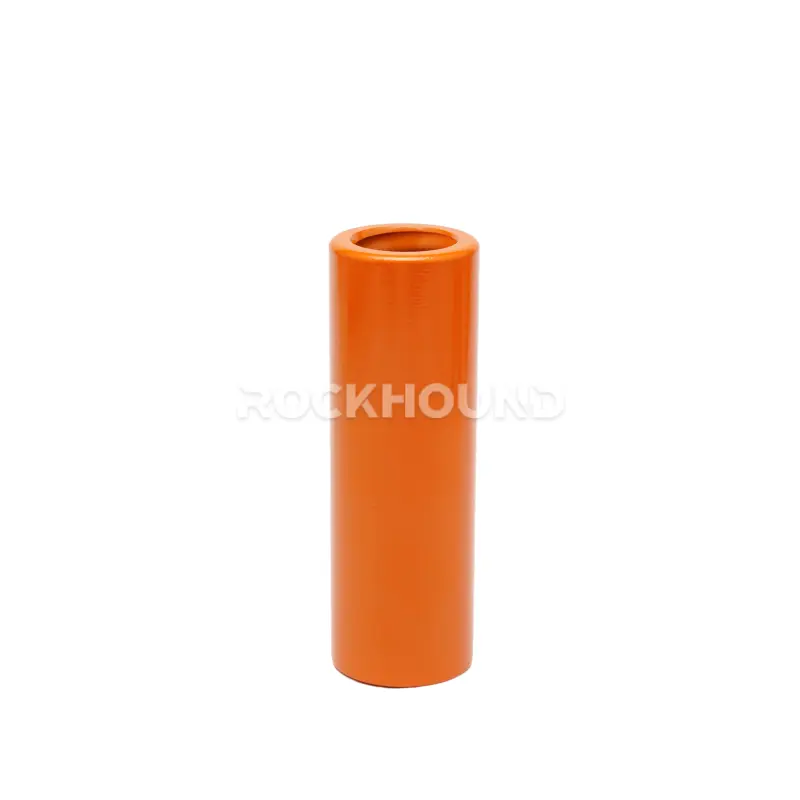
RockHound T45 Coupling Sleeves are precision-machined connectors that form the mechanical backbone of your top hammer drill string. Their core function is to transmit percussive shock energy and rotational torque from the shank adapter through each successive drill rod — with minimum energy loss — to the bit face.
The T45 designation refers to the thread standard: a tapered, buttress-profile thread with a 45 mm nominal shank diameter, governed by international rock drilling standards (compatible with Atlas Copco, Sandvik, and Furukawa thread geometries).
RockHound offers two primary configurations within the T45 series:
Middle Stop (Bridged) Coupling Sleeves
The Middle Stop design incorporates a machined internal bridge at the center of the sleeve bore. This bridge physically separates the two entering drill rod ends, ensuring:
- Equal thread engagement length from both ends
- Prevention of rod-to-rod metal contact, which would create stress concentration and energy reflection
- Uniform stress wave propagation along the entire drill string length
Middle Stop sleeves are the standard choice for consistent, long-hole drilling where string stability is paramount.
Reduction Coupling Sleeves
Reduction sleeves feature asymmetric internal threads on each end — one end machined to the larger thread standard, the opposite end to the smaller. This allows controlled transitions between different rod diameters or thread families within a single drill string. Common use cases include:
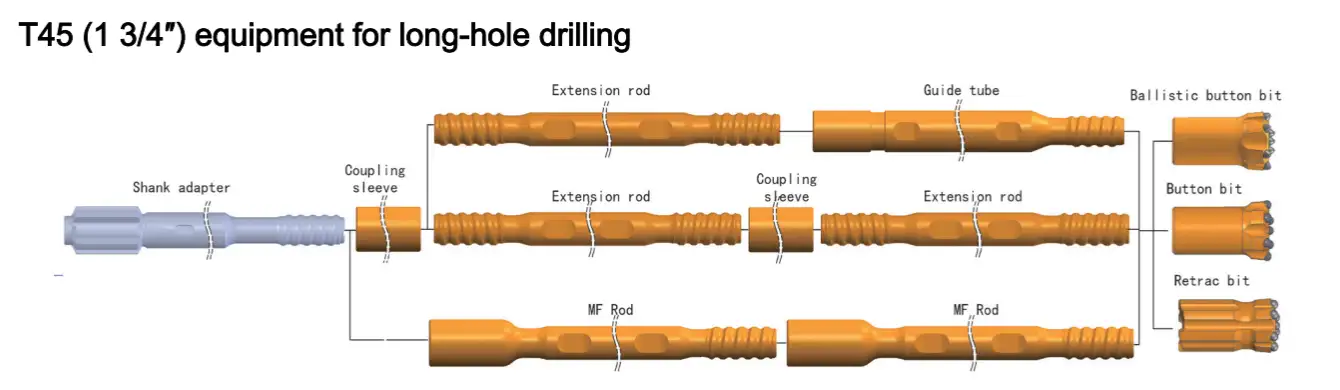
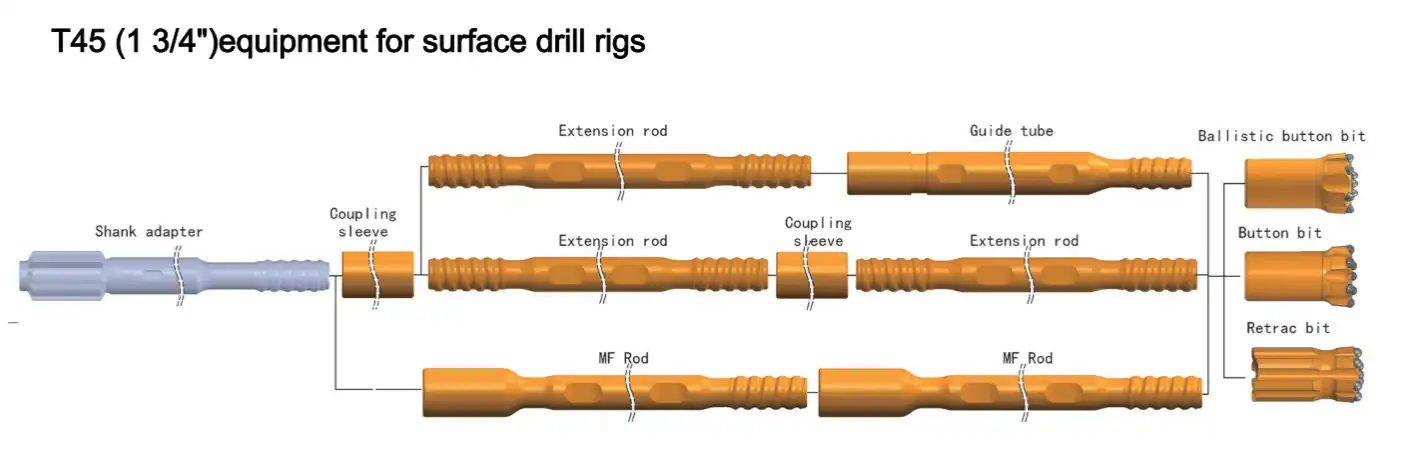
- Transitioning from a T45 shank adapter down to T38 extension rods
- Connecting T38 rods to R38 or R32 (rope thread) rod systems
- Adapting to specific bit shanks or specialty anchor rod dimensions
All RockHound reduction sleeves maintain the same wall thickness geometry as their straight counterparts, preserving structural integrity at the transition zone.
Key Features
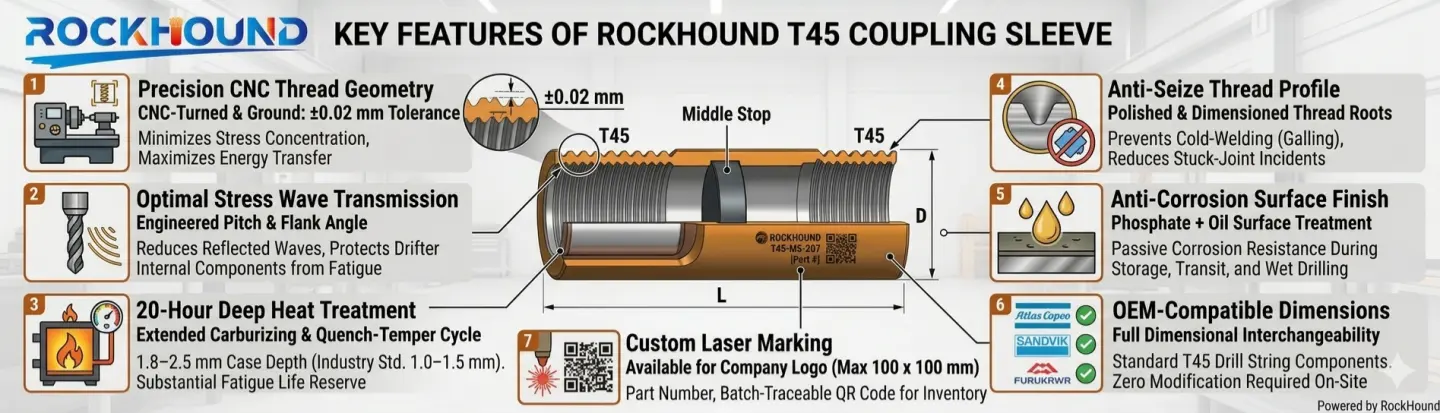
- Precision CNC Thread Geometry: All T45 threads are CNC-turned and ground to ±0.02 mm tolerance, minimizing contact stress concentration and maximizing energy transfer efficiency at each coupling joint.[Rock Drill Coupling Sleeve Manufacturing Process]
- 20-Hour Deep Heat Treatment: Our extended carburizing and quench-temper cycle achieves a case depth of 1.8–2.5 mm — substantially deeper than the industry standard 1.0–1.5 mm, providing a greater fatigue life reserve.
- Anti-Seize Thread Profile: Thread roots are polished and dimensioned to prevent cold-welding (galling) under the combined effects of heat, rotation, and axial load — reducing stuck-joint incidents and unplanned downtime.
- Optimal Stress Wave Transmission: Engineered thread pitch and flank angle reduce reflected stress waves back into the drill — protecting drifter internal components from cumulative fatigue damage. See: What is Shank Adapter Structure and Function.
- OEM-Compatible Dimensions: Full dimensional interchangeability with Atlas Copco, Sandvik, and Furukawa standard T45 drill string components — zero modification required on-site.
- Anti-Corrosion Surface Finish: All coupling sleeves receive a phosphate + oil surface treatment post-heat treatment, providing passive corrosion resistance during storage, transit, and wet drilling operations.
Technical Specifications
All data calibrated against RockHound production records and field measurements.
| Type | Thread | L (mm) | L (inch) | D (mm) | D (inch) | Product Code | Weight (kg) |
|---|---|---|---|---|---|---|---|
| Middle Stop | T45 | 207 | 8′ 1/16″ | 66 | 2 5/8″ | 302-6620-7777 | 3.2 |
| Reduction | T45 / T38 | 207 | 8′ 1/16″ | 66 | 2 3/8″ | 303-6620-7776 | 3.2 |
| Reduction | T45 / T51 | 207 | 8′ 1/16″ | 66 | 2 3/8″ | 303-6620-7778 | 3.2 |
| Reduction | T38 / T45 | 207 | 8′ 1/16″ | 66 | 2 3/8″ | 303-6620-7677 | 3.2 |
| Reduction | R38 / T45 | 207 | 8′ 1/16″ | 66 | 2 3/8″ | 303-6620-5677 | 3.2 |
Applications
RockHound T45 Coupling Sleeves are engineered for demanding environments where coupling joint failure is not an option:
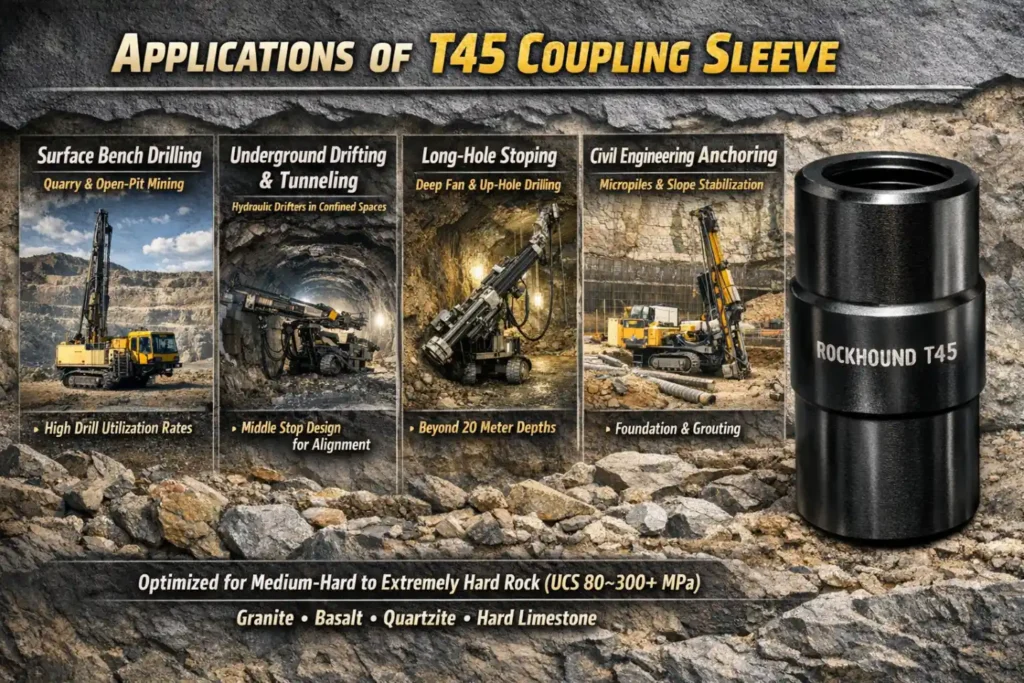
- Surface Bench Drilling — Quarry production blasting and open-pit mining; high drill utilization rates demand consistent coupling performance across multiple shifts.
- Underground Drifting & Tunneling — Confined-space drilling with high-powered hydraulic drifters (e.g., Atlas Copco COP series, Sandvik RD series); the Middle Stop design excels in maintaining drill string alignment in inclined headings.
- Long-Hole Stoping (Underground Mining) — Fan drilling or upholes beyond 20 meters; deep holes amplify the consequences of coupling failure, making material quality a critical selection factor.
- Civil Engineering Anchoring & Grouting — Foundation micropile drilling and slope stabilization where rod string transitions (reduction sleeves) are frequently required.
- Geotechnical & Exploration Drilling — Applications requiring thread-family transitions between top hammer and DTH (down-the-hole) systems.
- Optimized for medium-hard to extremely hard rock formations (UCS 80–300+ MPa), including granite, basalt, quartzite, and hard limestone.
How to Select the Right T45 Coupling Sleeve
Selecting the incorrect coupling sleeve is one of the most common causes of premature drill string failure. Follow this decision framework:
Step 1 — Confirm Thread Compatibility Match both ends of the coupling sleeve to the exact thread standards on your shank adapter and drill rods. Mixing T-thread (tapered) and R-thread (rope/parallel) ends without a dedicated reduction sleeve will result in immediate joint failure.
- If your entire string uses T45 rods → select Middle Stop T45 (302-6620-7777)
- If connecting a T45 shank to T38 extension rods → select Reduction T45/T38 (303-6620-7776)
- If your extension rods are R38 rope-thread → select Reduction T38/R38 (303-5519-7656) or R38/T38 (303-5519-5676) depending on thread orientation
Step 2 — Match Sleeve Diameter to Drifter Power Class
| Drifter Power Class | Recommended D (mm) | Sleeve Type |
|---|---|---|
| Light (< 10 kW) | 55 | T38-series reduction sleeves |
| Medium (10–18 kW) | 66 | T45 Middle Stop or Reduction |
| Heavy (> 18 kW) | 66+ | T45 Middle Stop (preferred for straight strings) |
Higher-power drifters generate greater axial impulse loads. The larger 66 mm outer diameter provides more wall cross-section to absorb these loads without deformation.
Step 3 — Evaluate Drilling Depth
- Holes < 15 m: Either Middle Stop or Reduction sleeves perform reliably.
- Holes 15–30 m: Middle Stop sleeves strongly recommended throughout the majority of the string to maintain alignment and minimize lateral string vibration.
- Holes > 30 m: Use Middle Stop sleeves exclusively except at intentional diameter-transition points; consult RockHound technical support for string optimization.
Step 4 — Consider Rock Hardness & Abrasiveness
In highly abrasive formations (e.g., quartzite, pegmatite), outer sleeve wear accelerates. Prioritize sleeves with the full 66 mm D for additional wear reserve. For wet or acidic groundwater environments, verify anti-corrosion surface finish is intact before each shift.
For a deeper understanding of how coupling sleeves interact with the full drill string, see our guide: Shank Adapter: Function, Work, Choose & Maintenance.
Maintenance Guidelines
Proper coupling sleeve maintenance directly extends service life and prevents unplanned downtime. Follow these field-proven protocols:
Before Each Drill Shift
- Clean all thread surfaces with a wire brush to remove cuttings, dried grease, and mineral deposits.
- Visually inspect threads for chipped crests, flattened roots, or signs of galling (metal transfer / seizure marks).
- Apply a fresh coat of high-temperature, extreme-pressure (EP) thread grease rated for ≥ 200°C — specifically formulated for percussive drilling applications. Standard automotive grease is not sufficient.
During Operation
- Monitor coupling area for unusual heat generation (discoloration to blue or straw-yellow indicates temperatures exceeding 280°C — a sign of excessive impact energy or mis-aligned drilling).
- Check for coupling loosening after the first 30 minutes of drilling on new or re-used connections.
- Never use a hammer or pipe wrench to force a stuck coupling — this permanently deforms thread geometry. Use a dedicated hydraulic uncoupling device.
Scheduled Inspection (Every 250–500 Drill Metres)
- Measure outer diameter (D) at the center of the sleeve with a vernier caliper. Replace the sleeve if wear exceeds 10% of nominal D (i.e., below 59.4 mm for 66 mm sleeves; below 49.5 mm for 55 mm sleeves).
- Inspect thread pitch diameter using go/no-go gauges where available.
- Check for longitudinal cracks using dye penetrant or magnetic particle inspection (MPI) for critical long-hole applications.
Storage
- Store unused sleeves in a dry, covered environment. Apply a light oil coating to all thread surfaces for sleeves stored > 30 days.
- Do not stack sleeves directly on bare concrete — use wooden pallets or rubber matting to prevent surface corrosion at contact points.
- Explore More: Top Hammer Coupling Sleeve:Uses,Types & Choose
OEM & Custom Laser Marking
RockHound supports your brand identity and supply chain traceability through precision fiber laser marking services on all coupling sleeves:
- Maximum Logo Size: 100 mm × 100 mm
- Marking Data Options: Company logo, part number, heat batch number, production date code, and traceable QR code
- Marking Depth: Non-structural surface marking — does not compromise wall thickness or stress concentration
- Minimum Order Quantity: Available for OEM branding programs — contact RockHound sales for volume qualification
Custom marking is applied post-heat treatment and pre-surface finishing to ensure marking permanence throughout the sleeve’s full service life.
Related Production
FAQ
A T45 Coupling Sleeve is a hollow, externally cylindrical steel connector with internally threaded bores at each end, machined to the T45 top hammer standard. Its role in the drill string is to transmit percussive shock waves and rotational torque between the shank adapter and successive extension rods — or between two extension rods — without energy loss or joint slippage. Without a properly functioning coupling sleeve, the full impact impulse generated by the drifter cannot reach the drill bit, resulting in reduced penetration rates and accelerated wear on all connected components.
A Middle Stop sleeve has identical thread specifications at both ends (e.g., T45/T45) and features a machined internal bridge at the midpoint of the bore. This bridge prevents the two entering rod ends from contacting each other, ensuring equal thread engagement and uniform stress wave propagation. A Reduction sleeve has different thread specifications at each end (e.g., T45 on one side, T38 or R38 on the other), allowing the driller to transition between rod diameters or thread families within a single string. Reduction sleeves do not typically include a middle bridge, as the differing bore geometries already define distinct engagement zones.
23CrNiMo delivers a superior combination of case-hardening depth, core toughness, and high-cycle fatigue resistance compared to the more commonly used 42CrMo or plain carbon steels. The Nickel content in 23CrNiMo specifically improves low-temperature impact resistance — critical for underground or cold-climate drilling — while the Molybdenum suppresses temper brittleness that can cause catastrophic fracture in standard alloy steels under repeated shock loading. For top hammer coupling sleeves subjected to 40–60 Hz impact cycles, this material difference translates to a measurable extension in service life, reducing the cost-per-metre drilled.
Yes. RockHound T45 Coupling Sleeves are manufactured to international top hammer thread standard dimensions, ensuring full mechanical interchangeability with T45 drill string components from Atlas Copco, Sandvik, Furukawa, and other major OEM manufacturers. Thread pitch, taper angle, flank geometry, and outer diameter all conform to published OEM specifications. No adapters, modifications, or special tools are required for integration into existing drill strings.
Service life depends on rock hardness, drifter power, drilling depth, and maintenance discipline. As a field guideline: inspect outer sleeve diameter every 250–500 drill metres. Replace immediately if outer diameter wear exceeds 10% of nominal size, if threads show significant pitting or chipped crests, if the sleeve surface shows blue discoloration (heat damage), or if any longitudinal cracking is detected. Well-maintained sleeves in medium-hard rock with a properly greased string typically last 3,000–6,000 drill metres, though highly abrasive formations may reduce this significantly.
Reduction sleeves are specifically designed for diameter or thread-family transition points — they are not intended to replace Middle Stop sleeves throughout a uniform-diameter drill string. While structurally robust, reduction sleeves produce a slight asymmetry in the stress wave transmission profile due to the differing bore geometries at each end. For the majority of connections in a straight T45 string, Middle Stop sleeves provide more consistent energy transfer and longer service life. Use reduction sleeves only at the specific transition points your drilling configuration requires.
Use a high-temperature, extreme-pressure (EP) thread grease specifically formulated for percussive rock drilling applications. The grease should be rated to withstand sustained temperatures of at least 200°C and must contain anti-galling additives (typically molybdenum disulfide or copper-based compounds). Standard automotive or general-purpose lubricating greases are not suitable — they break down rapidly under the combined heat, vibration, and axial load of top hammer drilling, leading to galling, thread seizure, and difficult uncoupling. Apply grease to clean, dry threads before every connection.