Table of Contents
In rock drilling, your drill string performs only as well as each component within it. Selecting the correct tapered drill rod is not simply a matter of machine compatibility — it directly determines percussive energy transfer efficiency, borehole straightness, and the service life of your tapered drill bits.
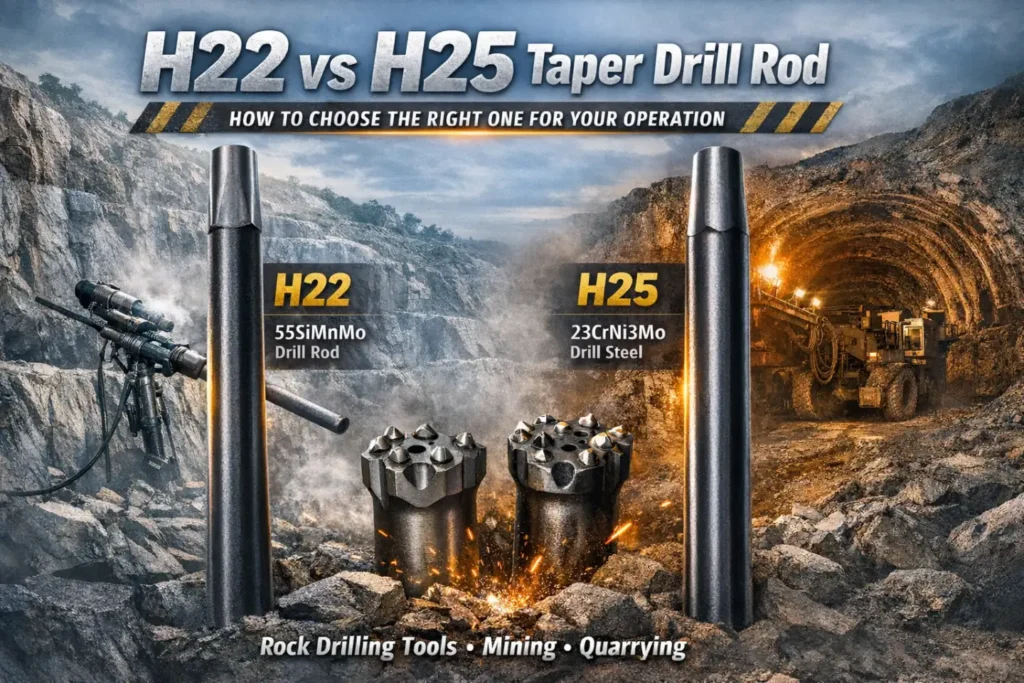
The two most widely used dimensional standards in the industry are the H22 and H25 tapered drill rods. Though visually similar, these two specifications are engineered for distinctly different geological and operational conditions. Choosing the wrong one results in premature shank failure, reduced penetration rates, and unnecessary downtime on site.
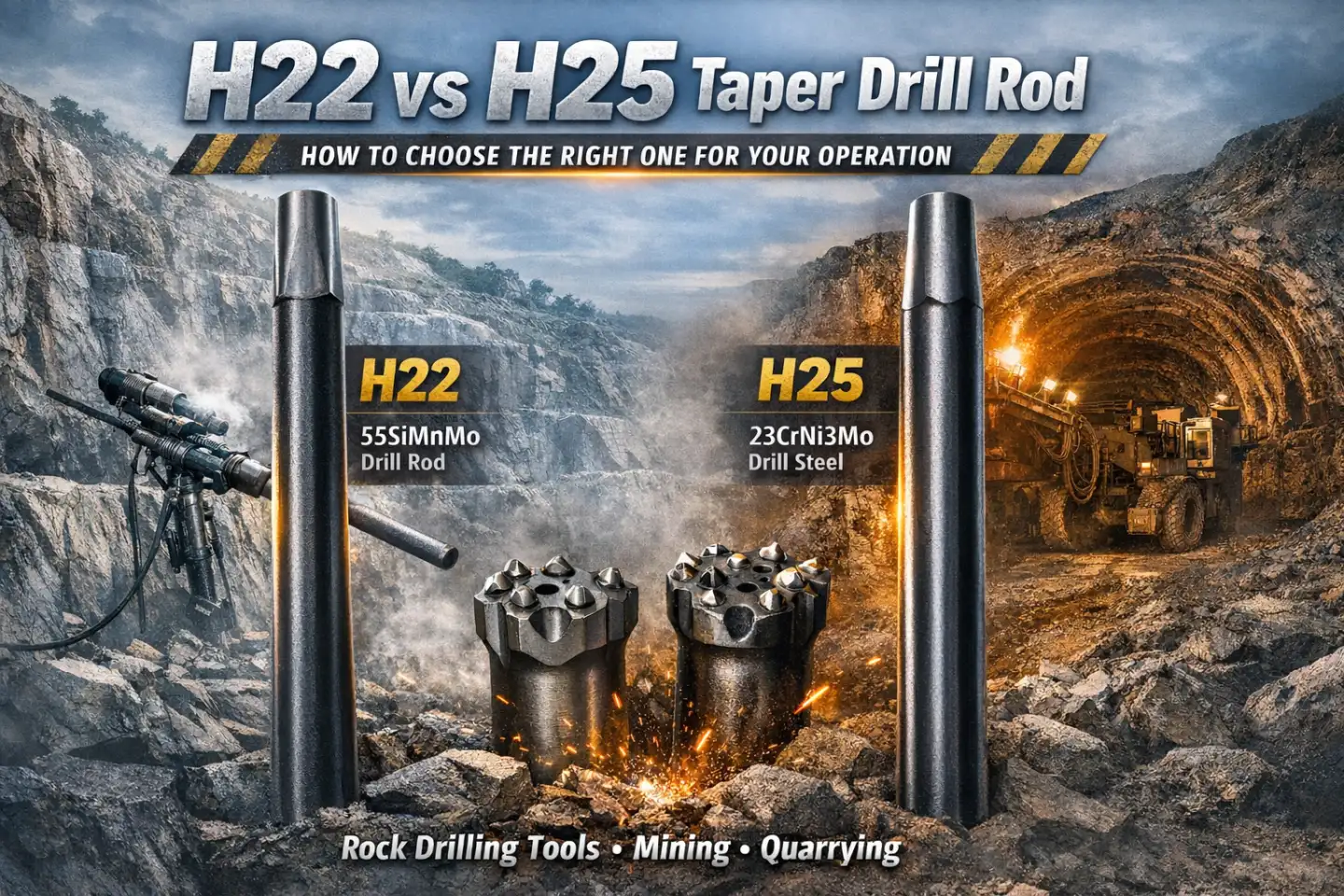
At RockHound, our tapered drill rods are manufactured in two premium alloy steel grades — 23CrNi3Mo and 55SiMnMo — each offering a distinct performance profile suited to different drilling environments. Understanding both the dimensional specification (H22 vs H25) and the material grade is essential to making the right tooling decision.
This guide provides a clear, technically accurate comparison to help drilling engineers, procurement teams, and site supervisors select with confidence.
What Is a Tapered Drill Rod?
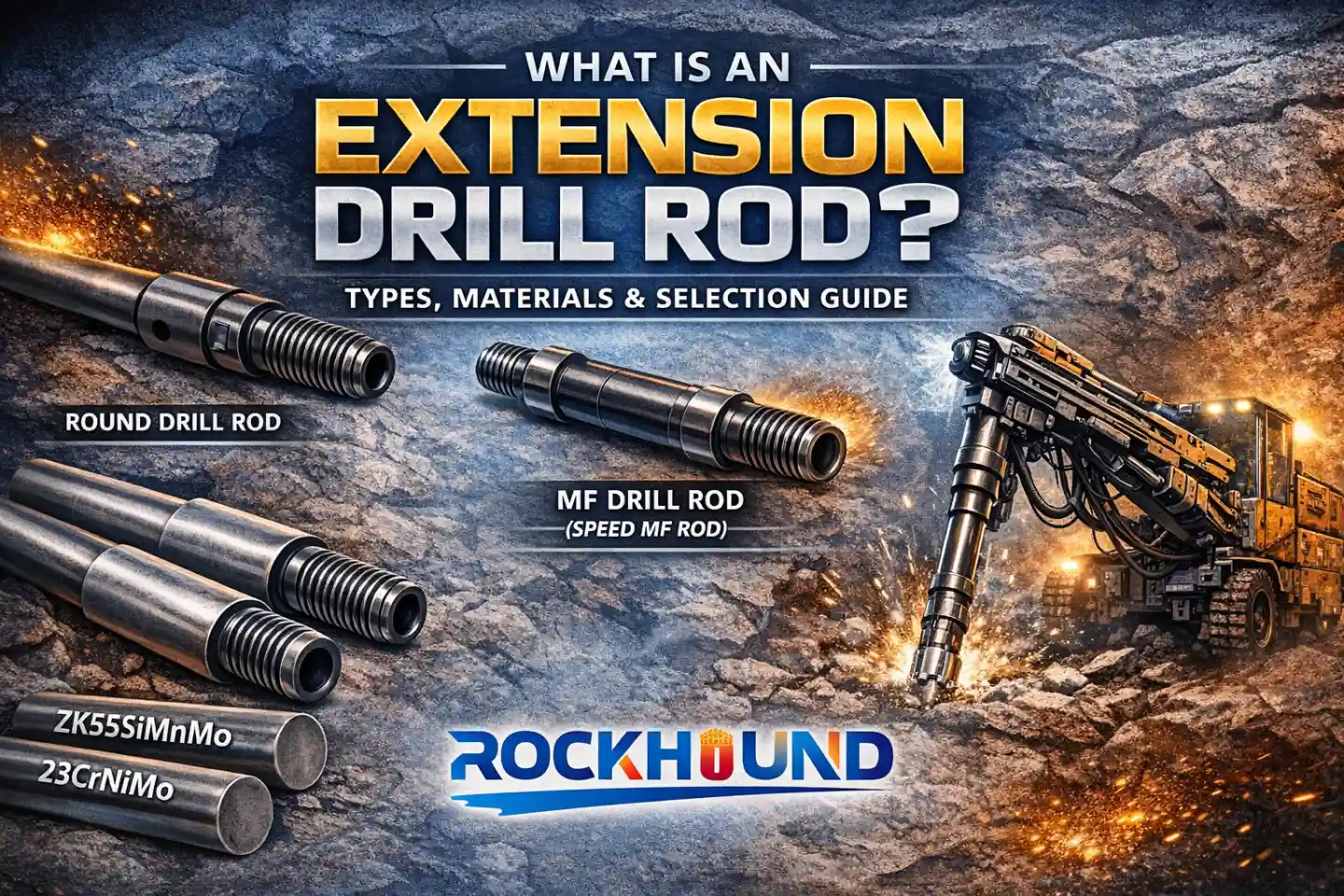
A tapered drill rod — also referred to as tapered drill steel — is a hollow hexagonal steel bar used in conjunction with handheld or air-leg pneumatic rock drills (such as the YT24 or YT28). Unlike threaded coupling systems (R25, R32, T38), tapered rods rely on a precision-ground taper shank connection — typically at 7°, 11°, or 12° — to seat and retain the drill bit.
The taper connection is inherently self-tightening: each percussive blow from the rock drill forces the bit deeper onto the rod taper during the impact cycle, creating a secure mechanical lock that can be released quickly in the field without specialized tooling.
Key Advantages of the Tapered System
- High percussive energy transfer efficiency for light-to-medium duty drilling cycles
- Rapid bit change capability without threaded couplings or wrenches
- Lower unit cost compared to fully threaded extension rod systems
- Proven reliability across quarrying, tunneling, and surface mining applications
RockHound Drill Rod Steel Grades: 23CrNi3Mo vs 55SiMnMo
Before comparing H22 and H25 dimensions, it is important to understand the two alloy steel grades that RockHound uses in rod manufacturing. The material grade determines how the rod absorbs and transmits percussive energy, resists fatigue cracking, and withstands torsional stress — all of which are independent of the rod’s hexagonal size.
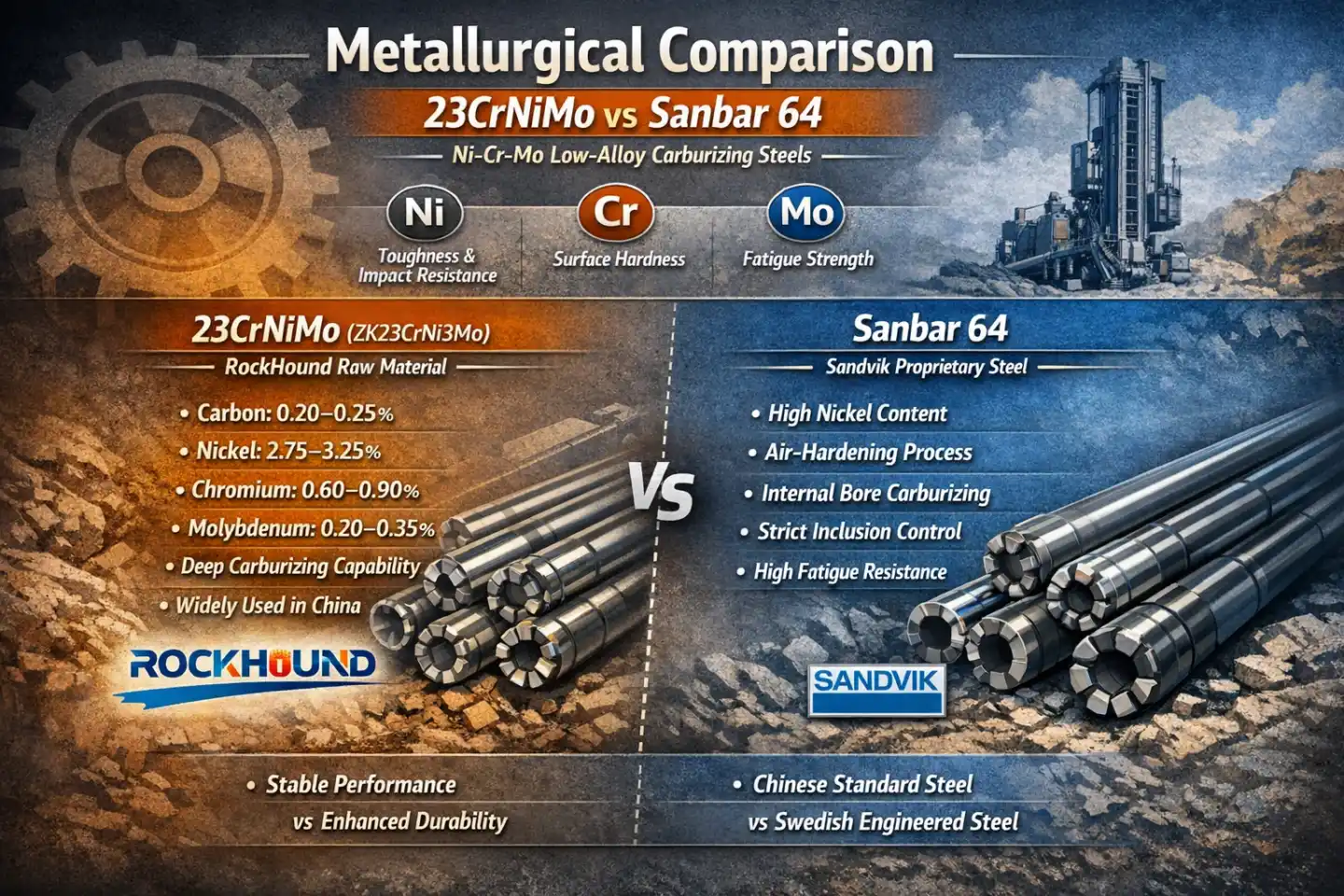
23CrNi3Mo — Chromium-Nickel-Molybdenum Alloy Drill Steel
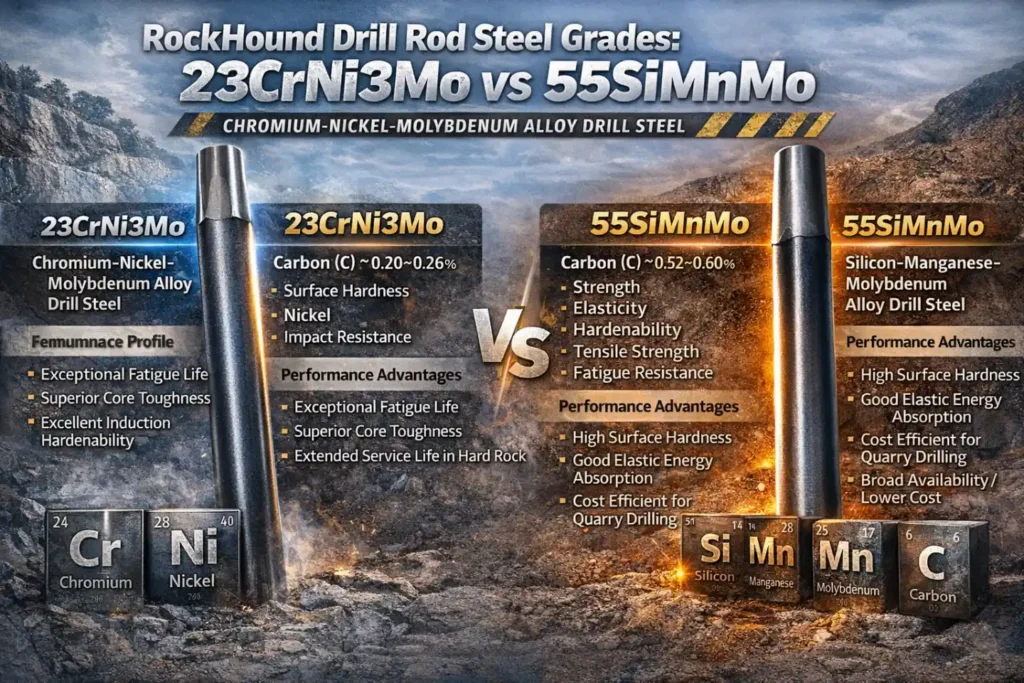
23CrNi3Mo is a low-carbon, high-alloy steel in the chromium-nickel-molybdenum family. It is widely recognized as the premium-grade material for high-performance drill rods in demanding mining environments.
Material Composition Profile
- Carbon (C): ~0.20–0.26% — Low carbon content enables superior toughness and weldability
- Chromium (Cr): Provides surface hardness and corrosion resistance
- Nickel (Ni): Significantly enhances core toughness and impact resistance at depth
- Molybdenum (Mo): Improves hardenability and resistance to high-temperature fatigue
Performance Advantages
- Exceptional fatigue life: The Ni-Mo alloying delivers outstanding resistance to dynamic fatigue cracking — the primary failure mode in percussion drilling
- Superior core toughness: High impact toughness across the rod body prevents brittle fracture under high-frequency blow loading
- Excellent induction hardenability: Allows the outer surface to be hardened to high Rockwell values while maintaining a tough, ductile core — ideal for the compressive stress profile of percussive rods
- Extended service life: Particularly in deep-hole applications and hard rock formations where rod stress cycles are highest
- Consistency under thermal cycling: Maintains mechanical properties even under the heat generated by high-output pneumatic drills
Limitations
- Higher material cost: The nickel content makes 23CrNi3Mo more expensive per unit than standard alloy grades
- Lead time sensitivity: Sourcing high-grade Ni-alloy steel billet can be subject to supply chain variability
- Best matched to high-stress applications: In soft rock environments with light drills, the premium properties of 23CrNi3Mo may not be fully utilized, making it an over-specification for budget-sensitive projects
RockHound Recommendation: 23CrNi3Mo is the preferred grade for H25 rods deployed in hard rock mining (granite, quartzite, iron ore), deep borehole applications, and operations using high-output drills (YT27/YT28/YT29) where fatigue life is the primary performance driver.
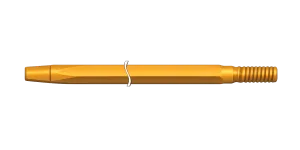
55SiMnMo — Silicon-Manganese-Molybdenum Alloy Drill Steel
55SiMnMo is a medium-to-high carbon, silicon-manganese-molybdenum spring steel alloy. It is a cost-effective and widely proven material for tapered drill rods used in light-to-medium duty drilling operations.
Material Composition Profile
- Carbon (C): ~0.52–0.60% — Higher carbon content provides strong hardness and wear resistance
- Silicon (Si): Enhances strength, elasticity, and resistance to decarburization during heat treatment
- Manganese (Mn): Improves hardenability and increases tensile strength
- Molybdenum (Mo): Refines grain structure and improves fatigue resistance
Performance Advantages
- High surface hardness: The elevated carbon and silicon content allows the rod to achieve excellent hardness after heat treatment, offering strong resistance to abrasive wear at the shank and rod body
- Good elastic energy absorption: Silicon content gives the steel a spring-like behavior, enabling the rod to absorb and transmit percussive energy effectively in short-hole applications
- Cost efficiency: Significantly lower alloy cost than 23CrNi3Mo, making it the practical choice for high-volume procurement or projects with tighter tooling budgets
- Adequate toughness for light-duty cycles: Performs reliably when matched with appropriate drill weight and rock hardness
- Wide availability: Silicon-manganese alloy steels are broadly available globally, reducing lead times and sourcing risk
Limitations
- Lower impact toughness compared to Ni-alloy grades: The higher carbon content reduces ductility, making 55SiMnMo more susceptible to brittle fracture under extreme dynamic loading
- Reduced fatigue life in deep or hard rock applications: Under sustained high-frequency percussion in hard rock (f ≥ 12), 55SiMnMo rods exhibit faster fatigue crack initiation at stress concentration points (shank transition zone)
- Less suitable for high-output drills: Pairing 55SiMnMo rods with heavy pneumatic drills operating at peak blow energy increases the risk of premature shank failure
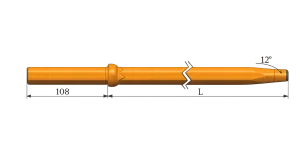
RockHound Recommendation: 55SiMnMo is ideally suited for H22 rods used in quarrying, dimensional stone cutting, and shallow blast hole drilling in soft-to-medium rock (f ≤ 8), where its cost efficiency and adequate fatigue performance deliver strong value.
Steel Grade Comparison at a Glance
| Property | 23CrNi3Mo | 55SiMnMo |
|---|---|---|
| Carbon Content | Low (~0.23%) | Medium-High (~0.55%) |
| Core Toughness | Excellent | Moderate |
| Surface Hardness | High | High |
| Fatigue Life | Superior | Adequate |
| Impact Resistance | Very High | Moderate |
| Brittleness Risk | Low | Moderate (in extreme loading) |
| Cost | Premium | Cost-Effective |
| Best Matched Rod | H25 | H22 |
| Recommended Rock (f-value) | f = 10–18 | f ≤ 8 |
| Best Drill Type | YT27, YT28, YT29 | YT24, Light Jackhammers |
Discover Reading:Taper Drill Rod Manufacturing Process
H22 Tapered Drill Rod: Technical Overview
The H22, designated by its 22 mm hexagonal cross-section (measured across flats), is the standard lightweight option within the RockHound tapered drill steel range.
Specifications
| Parameter | Detail / Specification |
|---|---|
| Hex Size | 22 mm (across flats) |
| Standard Shank Dimensions | 22 mm × 108 mm |
| Recommended Steel Grade | 55SiMnMo |
| Flushing Hole Diameter | 6–8 mm (center bore) |
| Applicable Taper Angles | 7°, 11°, 12° |
| Standard Lengths | 800 mm – 3,600 mm |
Ideal Application Conditions
The H22 rod is optimized for soft to medium-hard rock formations — limestone, slate, sandstone, and soft shale — with a Protodyakonov hardness coefficient (f-value) of f ≤ 8. Its reduced cross-sectional mass makes it the preferred choice for operator-controlled handheld drilling, where minimizing tool weight is critical to reducing fatigue during sustained vertical or horizontal drilling shifts.
Primary industries: quarrying, dimensional stone processing, secondary breaking, shallow blast hole drilling.
Field Note: RockHound H22 rods in 55SiMnMo deliver the optimal balance of cost efficiency and field performance for quarrying operations where portability and rapid bit change are the operational priority.
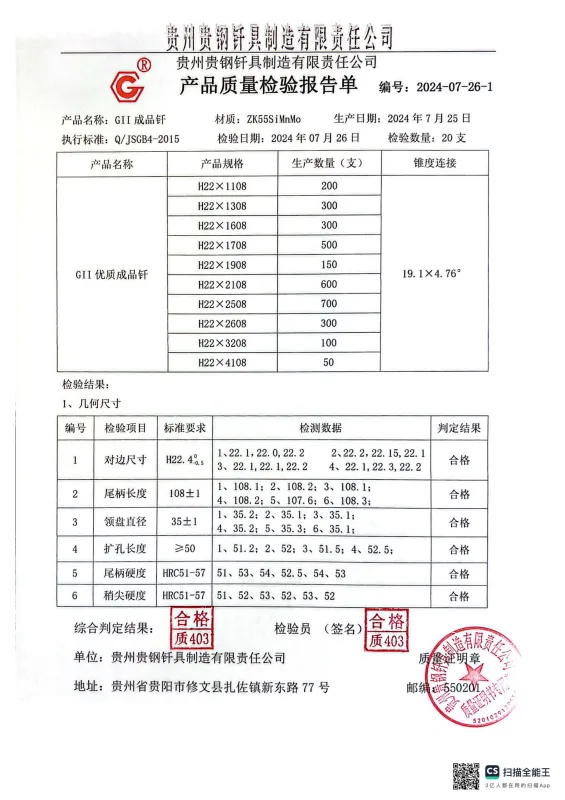
H22 Tapered Drill Rod Certification
H25 Tapered Drill Rod: Technical Overview
The H25, designated by its 25 mm hexagonal cross-section, is the heavy-duty product in the RockHound tapered drill rod range, engineered for high-impact, high-torque drilling environments.
Specifications
| Parameter | Detail |
|---|---|
| Hex Size | 25 mm (across flats) |
| Standard Shank Dimensions | 25 mm × 108 mm / 25 mm × 159 mm |
| Recommended Steel Grade | 23CrNi3Mo |
| Flushing Hole Diameter | 8–10 mm (center bore) |
| Applicable Taper Angles | 7°, 11°, 12° |
| Standard Lengths | 800 mm – 4,800 mm |
Ideal Application Conditions
The H25 rod is engineered for medium-hard to very hard rock formations — granite, basalt, quartzite, and iron ore — with a Protodyakonov hardness coefficient of f = 10 to f = 18. Its larger cross-section delivers significantly greater torsional rigidity and bending resistance, enabling the rod to handle the aggressive blow energy of heavier pneumatic rock drills without buckling, rod whip, or premature shank fatigue.
Primary industries: hard rock mining, underground tunneling, surface blast hole drilling, iron ore and granite extraction.
Field Note: RockHound H25 rods in 23CrNi3Mo are engineered to maximize service life in the most demanding hard rock environments — reducing per-meter drilling costs by extending rod change intervals significantly.
H22 vs H25: Full Specification Comparison
| Feature | H22 (RockHound) | H25 (RockHound) |
|---|---|---|
| Hex Cross-Section | 22 mm | 25 mm |
| Recommended Steel Grade | 55SiMnMo | 23CrNi3Mo |
| Bending Resistance | Moderate | High |
| Torsional Rigidity | Standard | Enhanced |
| Rock Hardness (f-value) | f ≤ 8 | f = 10–18 |
| Optimal Drilling Depth | Up to 4–5 m | 5–12 m |
| Percussive Energy Range | Light-duty drills | Heavy / high-output drills |
| Compatible Rock Drills | YT24, light jackhammers | YT27, YT28, YT29 |
| Fatigue Life | Good (55SiMnMo) | Superior (23CrNi3Mo) |
| Cost per Unit | Lower | Higher |
| Typical Industry | Quarrying, stone cutting | Mining, tunneling, hard rock blasting |
Critical Compatibility Factor: Taper Angle Matching
Regardless of rod size or steel grade selected, the taper angle of the rod must precisely match the taper angle of the drill bit. This is a non-negotiable compatibility requirement.
Mismatching taper angles — for example, mounting a 7° tapered bit onto an 11° rod — results in incomplete bit seating, loss of percussive energy transfer, accelerated shank wear, and risk of in-hole bit detachment during retraction.
Standard Taper Angles
- 7° Taper: The most widely adopted global standard. Delivers the optimal balance between bit retention force and field removal ease. Recommended for the majority of mining and quarrying applications.
- 11° / 12° Taper: Applied in harder rock conditions or deeper blastholes where a more aggressive seating angle is required to prevent bit loss during rod withdrawal.
Always verify the taper specification on both the rod shank and the drill bit collar before deployment.
How to Choose: 3 Decisive Questions
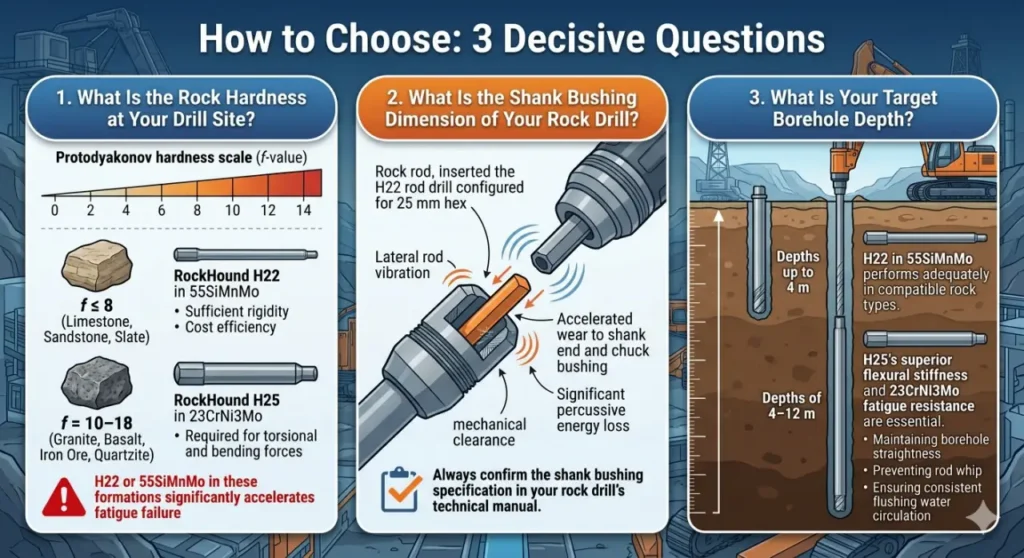
1. What Is the Rock Hardness at Your Drill Site?
Use the Protodyakonov hardness scale (f-value) as your primary selection criterion:
- f ≤ 8 (Limestone, Sandstone, Slate): RockHound H22 in 55SiMnMo delivers sufficient rigidity and cost efficiency.
- f = 10–18 (Granite, Basalt, Iron Ore, Quartzite): RockHound H25 in 23CrNi3Mo is required to withstand the torsional and bending forces inherent in hard rock conditions. Deploying H22 or 55SiMnMo in these formations significantly accelerates fatigue failure.
2. What Is the Shank Bushing Dimension of Your Rock Drill?
Your rock drill’s chuck and shank bushing are machined to a specific hex size. Inserting an H22 rod into a drill configured for 25 mm hex creates mechanical clearance within the chuck, causing:
- Lateral rod vibration during each impact cycle
- Accelerated wear to the shank end and chuck bushing
- Significant percussive energy loss per blow
Always confirm the shank bushing specification in your rock drill’s technical manual before placing a rod order.
3. What Is Your Target Borehole Depth?
- Depths up to 4 m: H22 in 55SiMnMo performs adequately in compatible rock types.
- Depths of 4–12 m: The H25’s superior flexural stiffness combined with the fatigue resistance of 23CrNi3Mo is essential for maintaining borehole straightness, preventing rod whip, and ensuring consistent flushing water circulation to the bit face.
Summary: RockHound Selection Guide
The H22 vs H25 decision — paired with the correct steel grade — is not about which rod is universally superior. It is about matching both the dimensional specification and the material grade to your specific geological and operational requirements.
Choose RockHound H22 (55SiMnMo) when:
- Rock hardness is f ≤ 8
- Operator mobility and reduced tool weight are key priorities
- Drilling depth is within 4 meters
- Your rock drill is rated for light-duty output (YT24 class)
- Project budget requires cost-optimized tooling
Choose RockHound H25 (23CrNi3Mo) when:
- Rock hardness is f = 10 or above
- Operation involves hard rock mining, tunneling, or deep blast hole drilling
- Drilling depth exceeds 4–5 meters
- You are operating heavy-duty pneumatic drills (YT27/YT28/YT29)
- Maximum service life and lowest cost-per-meter are the performance priorities
Deploying the correctly specified RockHound tapered drill rod — both in dimensional standard and steel grade — reduces tooling costs, lowers rod failure rates, and maximizes your drilling productivity per shift.
Need help selecting the right RockHound tapered drill rod for your site conditions?
Contact our technical team with your rock type, drill model, and target depth — we’ll specify the right combination of rod dimension and steel grade for your operation.
Related Production
H19 Drill Rod
H22 Drill Rod
H25 Drill Rod
FAQ
23CrNi3Mo is a low-carbon, nickel-chromium-molybdenum alloy steel offering superior core toughness and fatigue life — ideal for hard rock and deep-hole applications. 55SiMnMo is a medium-high carbon silicon-manganese alloy offering strong surface hardness and cost efficiency, best suited to light-to-medium duty drilling in softer formations.
Only if both components share an identical taper angle (e.g., 7° on both). Note that H25 rods have a larger body diameter, so ensure the bit's gauge diameter provides sufficient annular clearance for effective cuttings flushing during the drill cycle.
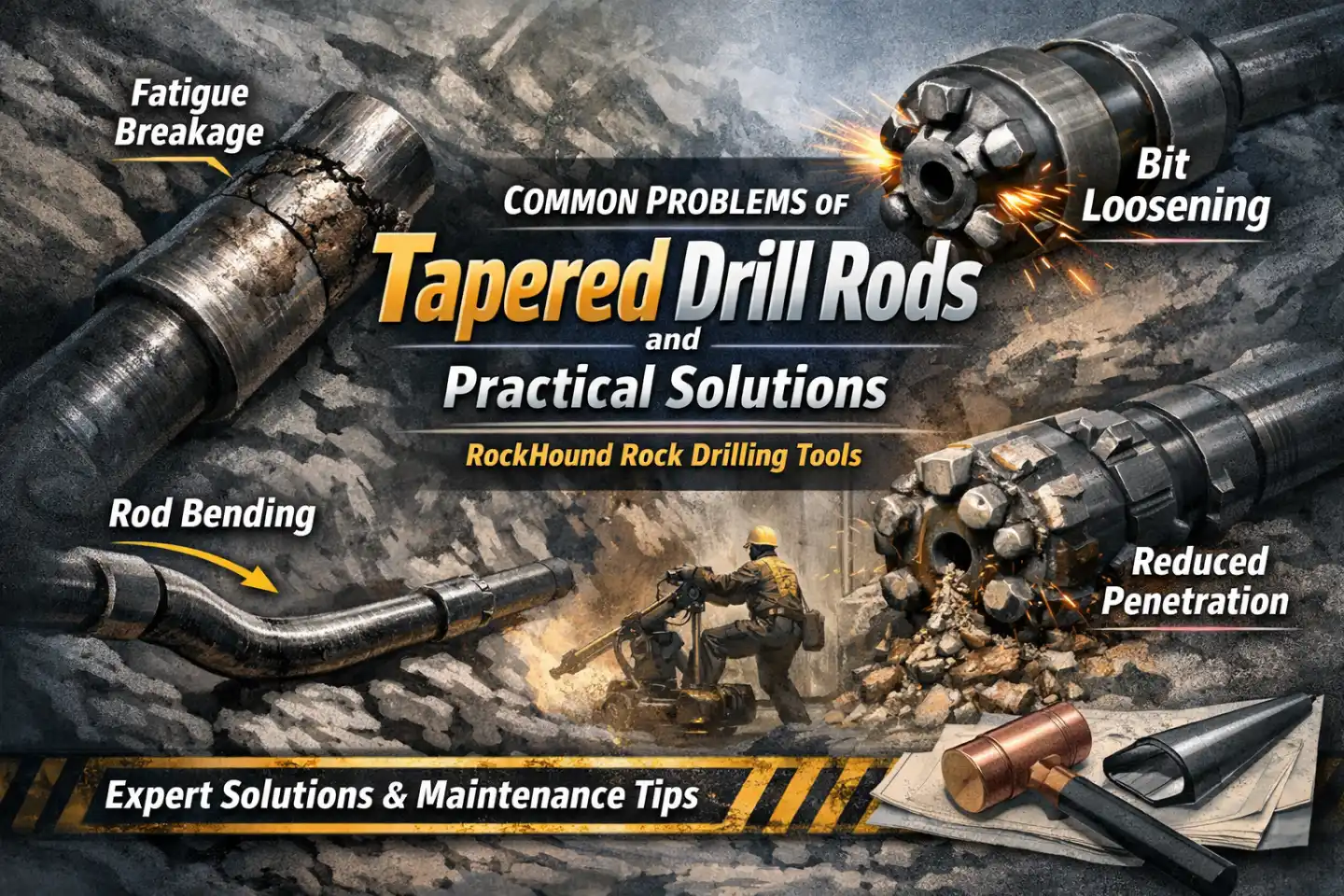
Shank breakage most commonly results from deploying an undersized rod (H22) in a machine whose blow energy exceeds the rod's design limits, or from a chuck-to-shank dimensional mismatch. Upgrading to an H25 in 23CrNi3Mo and verifying shank bushing compatibility typically resolves recurring shank fatigue failures.
RockHound H22 rods are available from 800 mm to 3,600 mm. H25 rods, due to their greater structural stiffness, are available up to 4,800 mm with custom lengths available on request.
For standard quarrying in limestone or sandstone with YT24-class drills, the 55SiMnMo H22 rod delivers the best value — providing adequate fatigue life, strong surface hardness, and a lower cost per meter drilled compared to premium-grade alternatives.