
Product Description
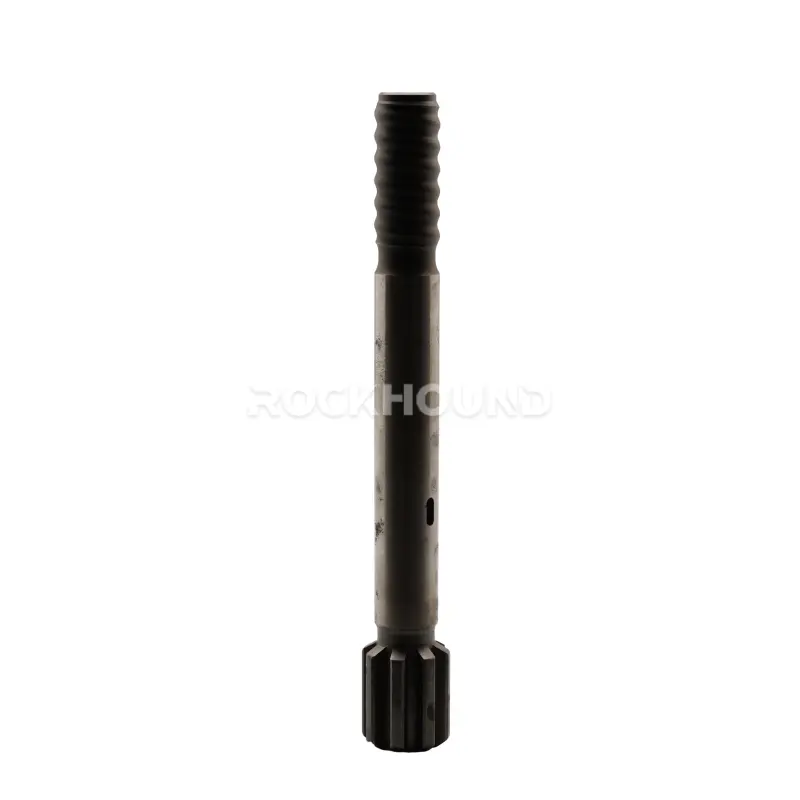
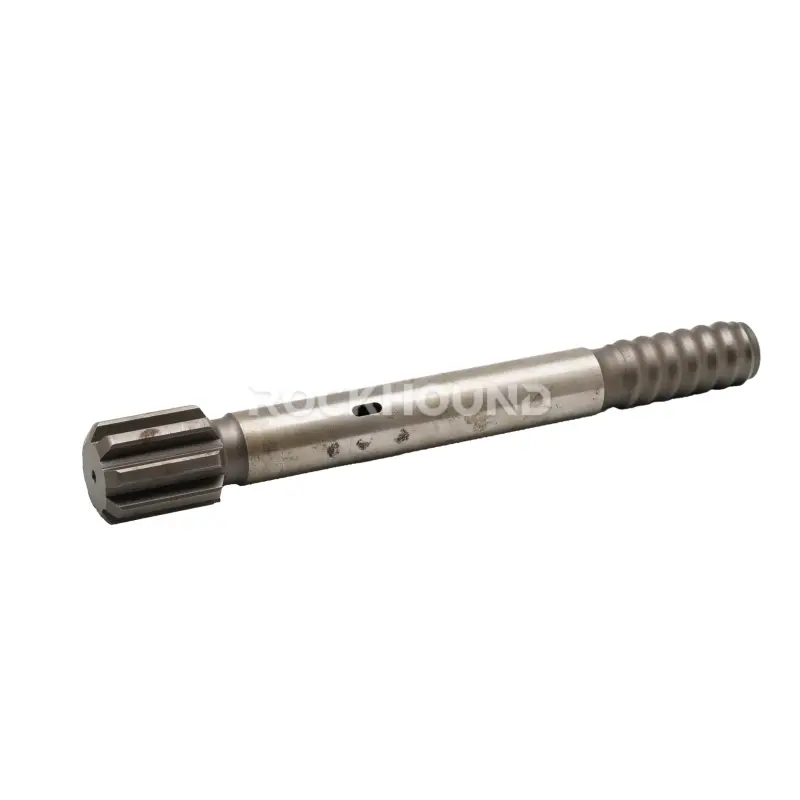
RockHound manufactures shank adapters specifically for the Montabert HC 40 drifter — a machine that fires at up to 6,300 blows per minute. At that rate, the shank sees more than 100 impacts every second. The interface has to be tight, the steel has to be tough, and the geometry has to stay accurate under sustained load. That is exactly what we engineered these for.
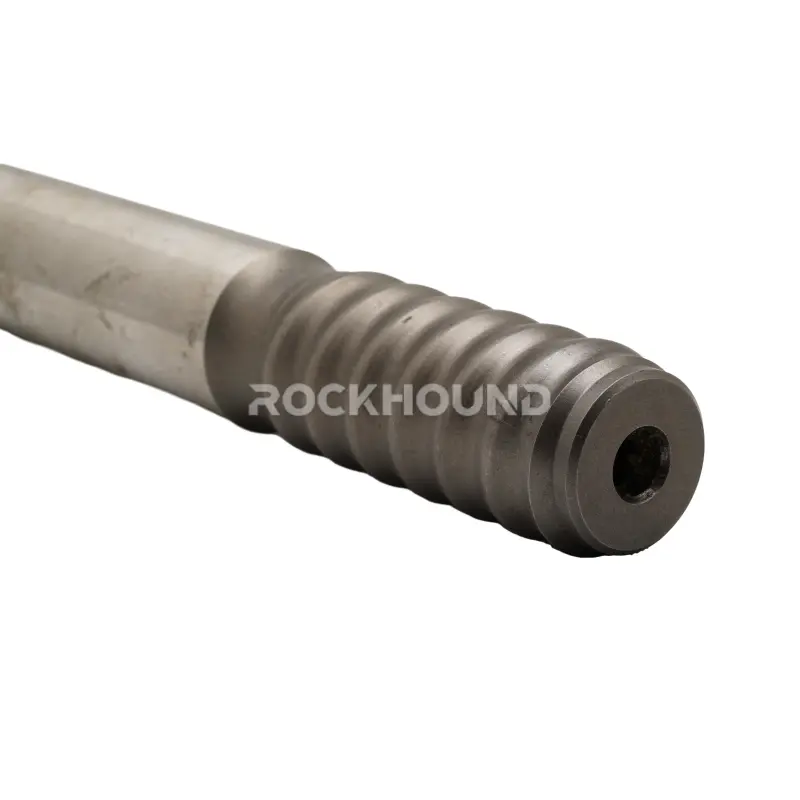
Three thread configurations are available: R32, R38, and T38, all at the 370 mm standard length. The outer diameter is 38 mm across all variants. Whether you are running anchor bolting in a narrow drift or pushing production in a large tunneling face, one of these thread sizes will suit your drill string.
Every piece is a direct, 100% dimensional replacement for the equivalent Sandvik and Epiroc OEM parts. You do not need to modify anything on the drifter. Bolt it in and drill.
Key Features
20-Hour Deep Carburizing
A full 20-hour carburizing and quenching cycle — not the 8–12 hours typical in lower-grade production. Carbon atoms penetrate the lattice to ~1.2–1.5 mm, creating an anti-fatigue shell that holds up in sustained high-frequency drilling.
High-Precision CNC Spline Milling
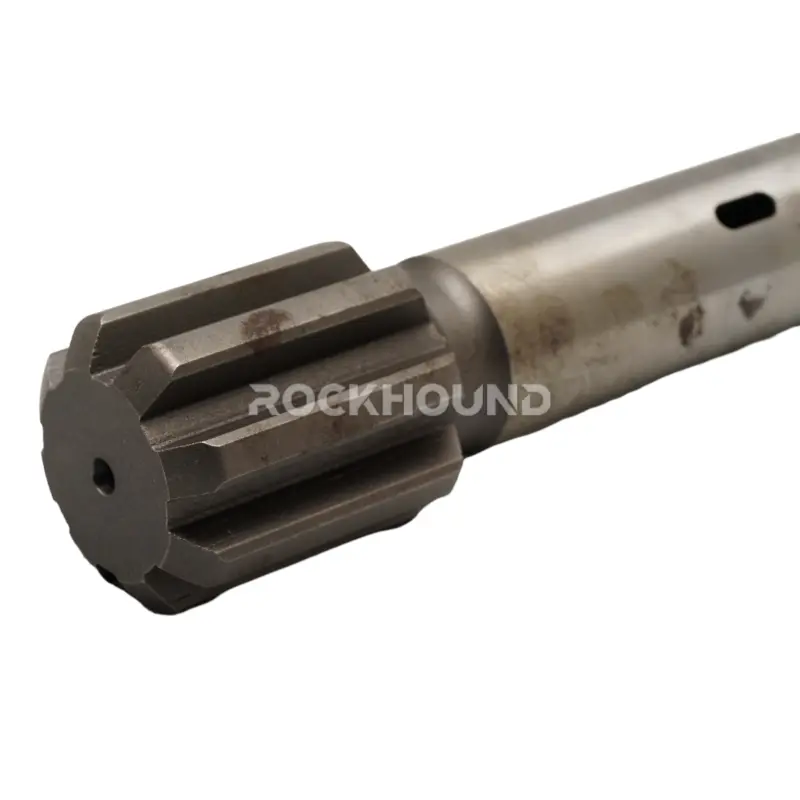
Splines are finish-milled on 5-axis CNC equipment. The resulting surface finish and dimensional tolerance ensure tight engagement with the HC 40 drive sleeve, so torque transfers cleanly without spline rattle or accelerated fretting wear.
Vacuum-Degassed Billet
Raw material is sourced only from vacuum-degassed billets. This removes dissolved hydrogen and oxide inclusions that would otherwise act as fatigue crack initiation sites — a common root cause of premature field failures.
100% OEM-Interchangeable
All critical dimensions — spline profile, shank body OD, thread geometry, flushing bore, and overall length — match the Montabert OEM specification. No shimming, machining, or hydraulic adjustment needed at installation.
Post-HT Thread Grinding
After heat treatment, all thread forms are finish-ground on a dedicated CNC grinder. Heat treatment distortion is corrected before the part ships, so thread runout stays within OEM tolerances even after carburizing warpage.
Custom Logo Marking
Fiber laser or CNC mechanical marking is available on the non-spline body zone. Maximum mark area: 100 × 100 mm. Ideal for distributor asset tracking or mine-site inventory systems. Free for orders ≥ 50 pcs.
Technical Specification
| Parameter | R32 Version | R38 Version | T38 Version |
|---|---|---|---|
| Thread Type | R32 (1¼”) | R38 (1½”) | T38 (1½”) |
| Overall Length (L) | 370 mm | 370 mm | 370 mm |
| Shank Body OD (D) | 38 mm | 38 mm | 38 mm |
| Weight (approx.) | 3.0 kg | 3.3 kg | 3.2 kg |
| Compatible Drifter | Montabert HC 40 / HC 50 | ||
| Material | 23CrNiMo alloy structural steel | ||
| Heat Treatment | 20-hour carburizing + quenching + tempering | ||
| Case Depth (approx.) | 1.2 – 1.5 mm | ||
| Surface Hardness | 58 – 62 HRC | ||
| RockHound Code | 458-3837-9154 | 458-3837-9155 | 458-3837-9176 |
| Epiroc Cross-Ref. | 90515895 | 90515966 | 90515989 |
| Sandvik Cross-Ref. | 7803-4724-01 | 7804-4724-01 | 7304-4724-01 |
Note on length variants: The HC 40 platform also accepts 447 mm and 270 mm length shanks on certain feed-system configurations. If your rig requires a non-standard length, contact RockHound for a custom quotation.
Who this is for: Underground mine operators, tunneling contractors, quarry maintenance engineers, and distributors who supply Montabert HC 40 or HC 50 drill rigs. If you currently buy Epiroc or Sandvik shank adapters for this drifter, RockHound gives you the same fit and service life at 40–60% of the OEM price.
Brand Comparison
The table below compares RockHound against OEM and generic-market options across the dimensions that matter most to a purchasing manager.
| Criterion | RockHound (rhdrill.com) | Sandvik / Epiroc (OEM) | Generic Low-Cost |
|---|---|---|---|
| Steel Grade | 23CrNiMo high-alloy billet | Proprietary alloy (e.g. Sanbar 64) | 40Cr or 20CrMnTi — lower Ni content |
| Heat Treatment | 20-hour deep carburizing cycle | Proprietary high-spec process | 8–12 hr or surface hardening only |
| Case Depth | ~1.2–1.5 mm | OEM standard (not published) | 0.5–0.8 mm typical |
| Spline Machining | 5-axis CNC finish mill | Precision CNC | Conventional milling; tolerance varies |
| Dimensional Fit | 100% OEM-interchangeable | Original spec baseline | Frequent thread tolerance overruns |
| Estimated Life vs OEM | 85 – 95% of OEM benchmark | 100% (baseline) | 30 – 50% of OEM benchmark |
| Unit Price vs OEM | ~40–60% of OEM price | Full price (baseline) | 15–25% of OEM — high hidden cost |
For a side-by-side technical breakdown of 23CrNiMo versus Sandvik’s proprietary Sanbar 64 steel, read our detailed material comparison: Rock Drill Rod Material: 23CrNiMo vs Sanbar 64 →
Applications
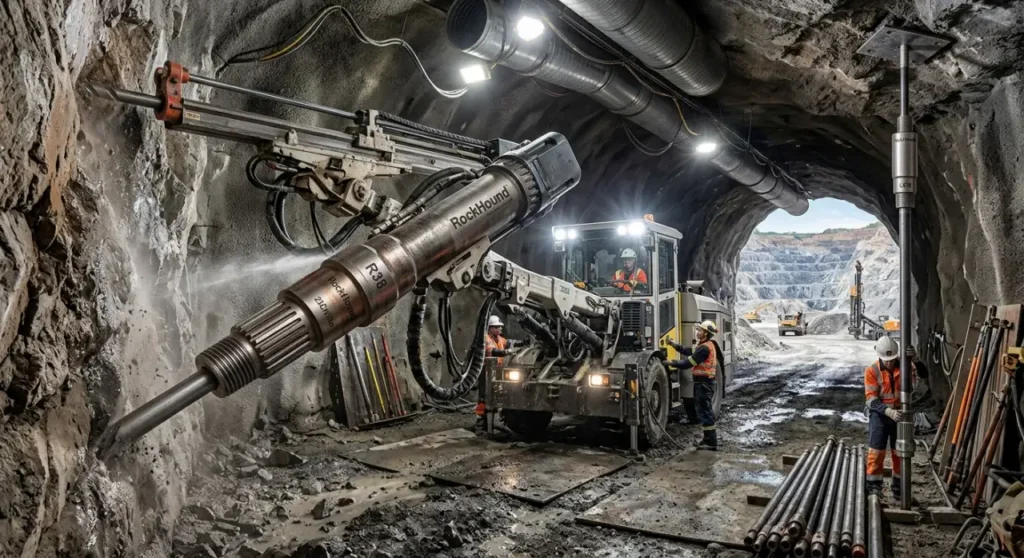
Underground Drifting & Tunneling
Tunneling faces put shank adapters under lateral bending loads on top of axial impact. R38 and T38 versions handle this well. Their larger thread diameter resists the side forces that come from slight drill-string misalignment in benched headings. T38’s trapezoidal thread form also decouples faster during rod changes, which keeps shift productivity up.
Roof Bolting
Roof-bolt rigs work in tight vertical clearance. The L370 length keeps the feed length compact. Male-thread shanks hold the structural advantage here — they absorb bending stress better than female (socket) variants when drilling at non-vertical angles into uncertain ground.
Underground Mine Production
In stope drilling and long-hole production, the HC 40 runs continuous shifts. Wear accumulates fast. Using a 23CrNiMo shank with 1.2–1.5 mm case depth means you change out on scheduled cycles rather than mid-shift failures. This is the direct financial argument for material quality over purchase-price minimization.
Quarrying & Surface Bench Drilling
Open-pit and quarry environments combine high-abrasion dust with high daily meterage. The deep-carburized spline surface on RockHound shanks resists fine-particle abrasion that gradually erodes softer spline flanks. Extended replacement intervals reduce crane-time and scheduled maintenance windows.
How to Choose the Right Shank Adapter
Three decisions determine the correct shank adapter for your HC 40 setup. Make them in this order.
- Match the thread to your drill rod. R32, R38, and T38 are not interchangeable. R32 suits smaller-diameter rods in light-to-medium applications. R38 handles heavier rods and higher torque loads. T38 uses a trapezoidal (buttress-style) thread flank that offers higher axial load capacity and quicker rod changes — a real advantage in high-meterage production faces. Do not upsize the thread to chase load capacity unless the rest of your drill string (couplings, rods, bits) matches that thread.
- Confirm the total length fits your feed system. L370 mm is the standard for most HC 40 and HC 50 drill rigs. Some specialized feed configurations require 447 mm or 270 mm. Pull the feed specification from your rig manual or measure the recess in the chuck body before ordering.
- Factor in rock hardness and drilling mode. In rock above 1,800 kgf/cm² UCS — granite, quartzite, ironstone — you need a shank with deep case hardening. The RockHound 20-hour carburizing cycle is designed precisely for this range. In softer rock, a shorter heat-treatment cycle may be acceptable, but it is never a problem to use a harder shank in soft ground. The reverse causes premature failure.
- Consider application-specific loads. Tunneling with lateral bit-positioning pressure? T38’s stiffer thread geometry resists bending better than R38 at equivalent diameter. Roof bolting with restricted clearance? R32 keeps rod diameter compact. Long-hole stoping with maximum meterage per shift? T38 or R38 with deep case hardening.
Maintenance Guide
A well-maintained shank adapter lasts significantly longer than a neglected one, even if both start as the same part. These are the practices that actually make a difference. Full maintenance reference →
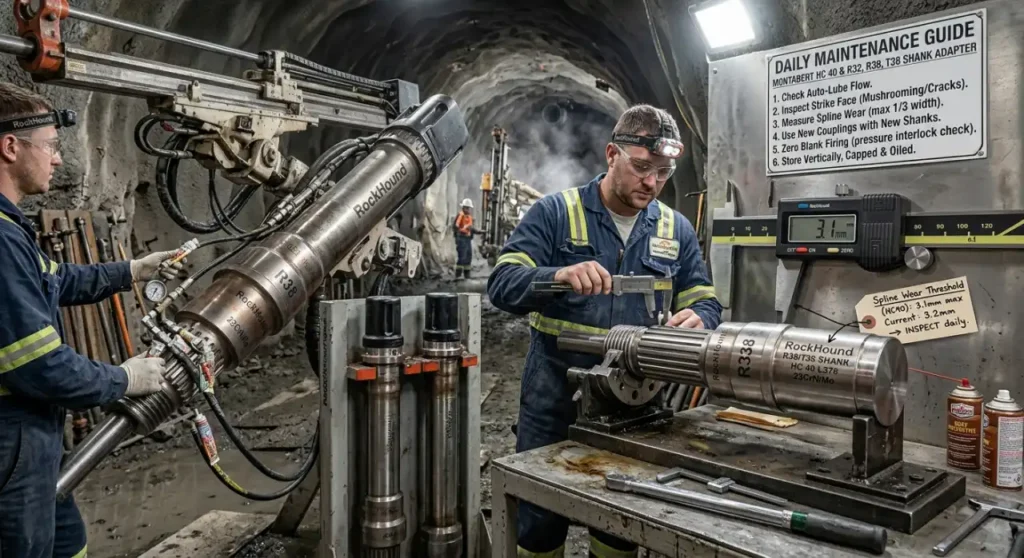
- Keep the auto-lube system charged. The spline-to-sleeve interface needs a continuous oil film. If that film breaks down — from a blocked lube line or empty reservoir — dry metal-on-metal friction heats the spline surface fast. That heat anneals the case hardening in minutes. Check lube flow at the start of every shift, not just at weekly service intervals.
- Inspect the strike face daily. Look for mushrooming, radial cracking, or irregular deformation at the back end. Any of these signals misalignment between the piston centerline and the shank axis. Run a misaligned shank and you accelerate wear on both the shank and the drifter piston — a much more expensive part.
- Never allow blank firing. Blank firing (pulling the trigger without bit contact on rock) sends the full piston energy into the internal retainer shoulder rather than into the drill string. One sustained blank-fire cycle can initiate a fatigue crack. Fit and enforce a pressure-interlock system if your rig does not already have one.
- Do not mix heavily worn couplings with a new shank. A worn coupling sleeve has enlarged thread play. When you thread a new shank into it, the loose fit creates bending moments and fretting at the thread roots. The new shank wears as fast as the old one did. Replace couplings together with shanks on any high-hour unit.
- Retire when spline wear exceeds one-third of original flank width. At that point, torque transfer becomes uneven and the remaining material is not carrying load safely. Continuing to run a worn shank costs more in drifter sleeve damage than the shank itself is worth.
- Store shanks vertically with end caps. Apply rust-preventive oil to both thread ends and the strike face before storage. Surface pitting from corrosion acts as a fatigue crack nucleus. Even a hairline surface rust spot can become a propagating crack under HC 40 impact loads.
Custom Logo Marking Service
Distributors and large mine operators often need to track drill string components by asset. RockHound supports this directly on the shank body.
Fiber laser marking
100 mm × 100 mm
Non-spline, non-thread body zone only
≥ 50 pieces per order
AI, DXF, SVG, PDF vector
+1–2 business days
FAQ
Thread fracture on HC 40 shanks usually has one of two root causes.
- Excessive feed pressure (over-pushing) combined with a slightly worn coupling — the combination creates bending load at the thread roots that the steel was not designed for.
- Mismatch between shank hardness and rock hardness; a shank with shallow case depth will show accelerated thread wear in rock above 1,500 kgf/cm² UCS, which gradually leads to stress-concentration fractures. Check your rig's feed pressure against the HC 40 specification, and confirm the shank you are using has adequate case depth for your geology.
Both are 1½" nominal diameter, but the flank geometry differs. R38 uses a rounded (rope) thread profile. T38 uses a trapezoidal (buttress) thread form. In practice, T38 makes-up and breaks-out faster — useful in high-meterage shifts with frequent rod changes. T38 also has a higher axial load capacity and slightly better resistance to bending at the thread connection, which is why tunneling and drifting applications often specify T38. R38 is a reliable choice for general underground drilling where rod-change speed is not a priority.
The key difference is base carbon content: 23CrNiMo sits at ~0.23% C while 40CrNiMo is around 0.40% C. The lower base carbon in 23CrNiMo makes it better suited for deep carburizing — the controlled carbon gradient from surface to core is more uniform, which produces a harder, more consistent case without brittleness. 40CrNiMo is harder through-section in the as-quenched state but does not carburize as cleanly; its case-to-core transition is steeper, which can promote spalling under repeated high-frequency impact loads like those the HC 40 produces. For carburized-shank applications, 23CrNiMo is the correct choice.
There are three clear retirement criteria. First, spline flank wear: when the measured flank width has reduced by one-third from the original dimension, retire the shank — at that point torque transfer becomes non-uniform and sleeve wear accelerates. Second, thread profile: if the thread flanks show step-wear (a visible shoulder worn into the flank surface), retire immediately. Third, strike-face condition: any radial cracking at the back face requires immediate retirement. Running a cracked strike face risks fragments entering the drifter oil circuit, which causes far more expensive damage than the shank itself is worth.
Yes. The Montabert HC 40 and HC 50 share the same shank adapter interface — same spline geometry, same shank OD (38 mm), same overall length (L370). RockHound product codes 458-3837-9154, 458-3837-9155, and 458-3837-9176 are confirmed fits for both drifter models.