
Description
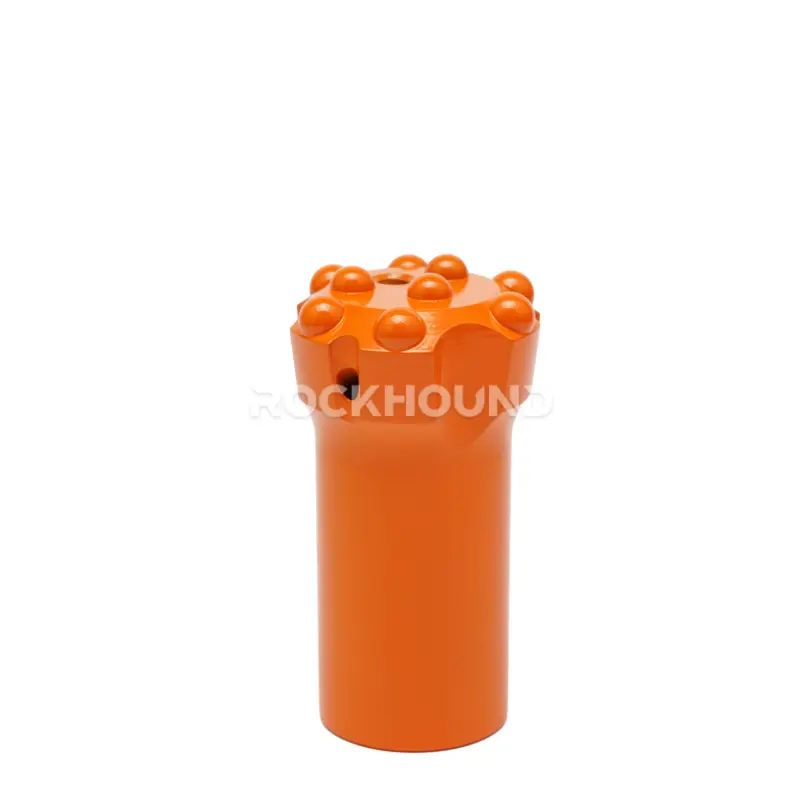
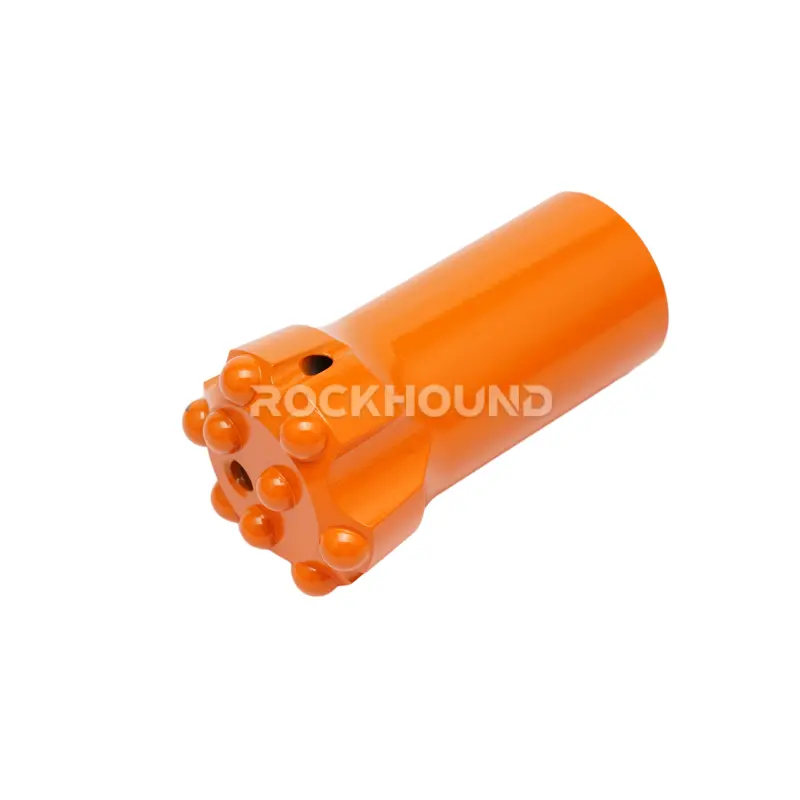
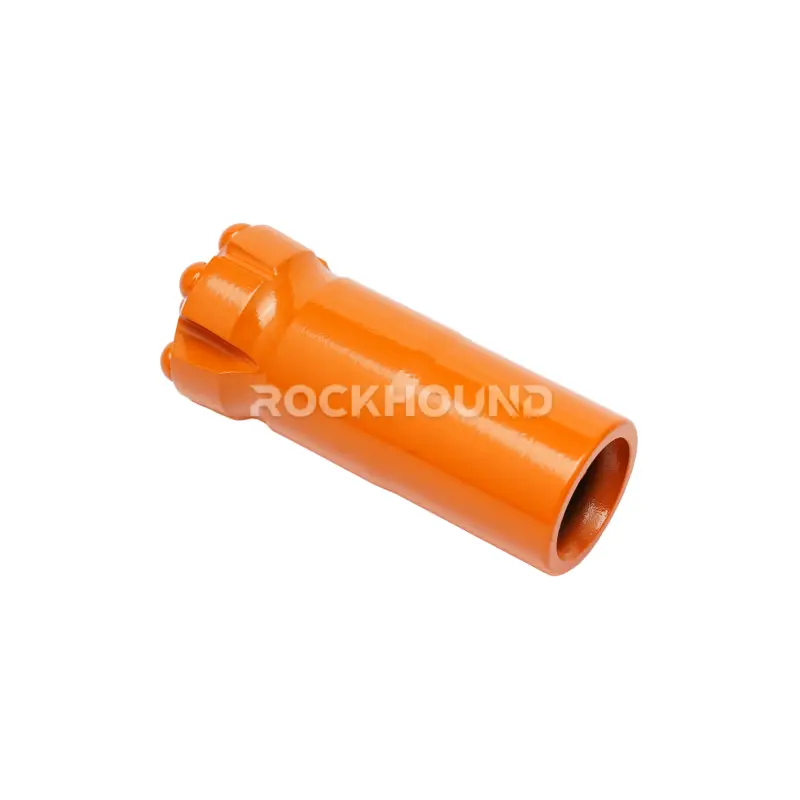
R38 button bits are a primary component in top hammer drilling systems used for medium-sized hole production. The “R38” designation refers to the rope thread connection, which is a standard for many underground and surface drilling rigs. These bits must withstand high-frequency impacts, often exceeding 3,000 blows per minute, while rotating under high torque to fracture rock effectively. The design of these bits focuses on three main goals: high penetration rates, long service life, and hole straightness.
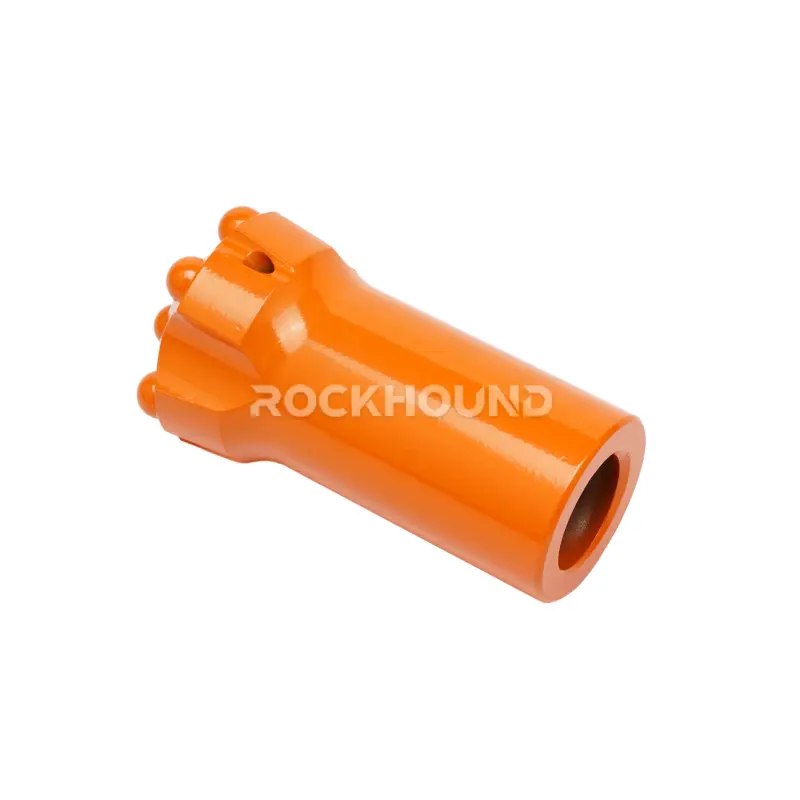
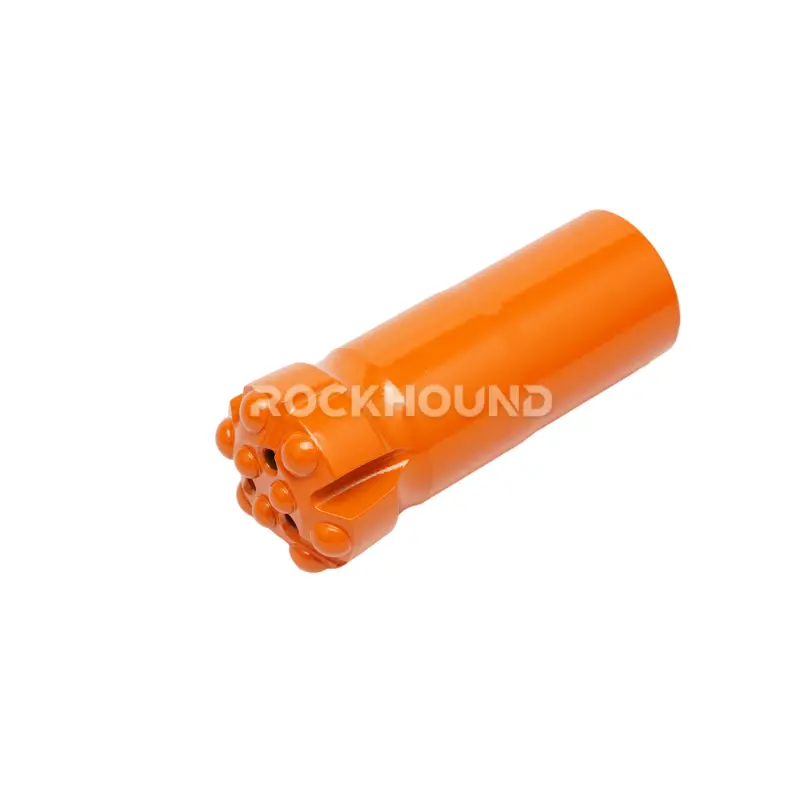
The structure of the bit includes a threaded skirt that connects to the drill rod and a bit face populated with tungsten carbide inserts. These inserts, often called buttons, are the parts that actually strike the rock. RockHound designs these bits to handle different rock types by varying the shape and arrangement of these buttons. Because rock drilling is a destructive process for both the rock and the tool, the materials used must be of the highest quality.
Modern drilling operations in underground mines and surface quarries require tools that can work with high-power hydraulic drifters. These drifters often output more than 18 kW of impact power. A standard bit would fail quickly under these forces. The R38 series from RockHound is built specifically to match these modern demands by using specialized metallurgy and precision manufacturing.
Material Science: The Bit Body (45CrNiMoVa)
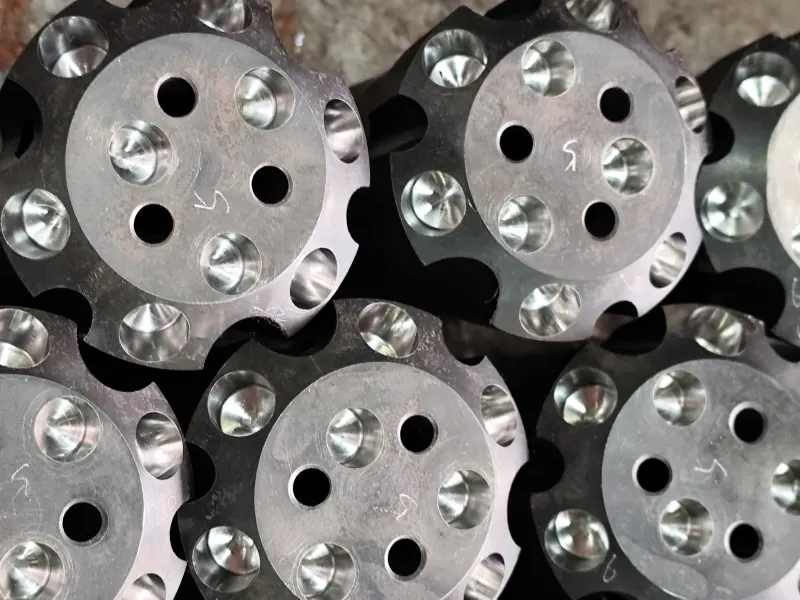
The body of the drill bit acts as the chassis for the carbide buttons. It must be strong enough to transmit impact energy without cracking, yet tough enough to absorb the shock of hitting hard rock surfaces. 1 RockHound uses 45CrNiMoVa, a high-alloy steel that contains chromium, nickel, molybdenum, and vanadium.
Mechanical Properties of 45CrNiMoVa
The mechanical properties of the steel determine its ability to survive the stressful cycle of tension, compression, and torsion during drilling.
| Property | Value (Typical) | Relevance to Drilling |
|---|---|---|
| Tensile Strength (σb) | ≥ 1150 MPa | Ability to resist pulling forces during bit retrieval. |
| Yield Strength (σs) | ≥ 950 MPa | The limit where the bit body will permanently deform. |
| Elongation (δ5) | ≥ 10% | Shows the ductility of the body before it breaks. |
| Impact Toughness (Akv) | ≥ 80 J | Resistance to sudden shocks from high-power hydraulic hammers. |
| Surface Hardness | 45 – 50 HRC | Protects the bit face from abrasion by rock cuttings. |
By using this specific alloy, RockHound ensures that the bit can withstand rock with a Uniaxial Compressive Strength (UCS) of over 120 MPa. This is common in hard granite or basalt formations.
Performance Characteristics of YK05
| Metric | Specification | Benefit to Operator |
|---|---|---|
| Hardness (HRA) | 90.5 – 91.0 | Longer intervals between sharpening sessions. |
| Transverse Rupture Strength (TRS) | ≥ 2600 MPa | Buttons are less likely to chip or “pop” in fractured rock. |
| Density (g/cm³) | 14.8 – 14.9 | High purity ensures consistent performance across batches. |
YK05’s low cobalt content means it has high thermal stability. During drilling, the friction between the button and the rock can create high temperatures. Some carbides soften when they get hot, leading to rapid wear. YK05 stays hard at high temperatures, which is a major advantage in dry drilling or when using low-pressure flushing water.
Product Features
The R38 button bit is designed with several specific features that improve its utility in the field.
- Optimized Flushing Design: The bit face has multiple flushing holes. These holes spray water or air to push rock cuttings away from the bit. Good flushing prevents the bit from drilling the same rock twice, which saves energy and prevents heat damage.
- Various Face Shapes: RockHound offers flat face, drop center, and concave designs. A flat face is best for hard rock, while a drop center helps drill straighter holes in soft or medium rock.
- Button Profile Options: Buttons can be spherical (best for hard rock) or ballistic (best for fast drilling in softer rock).
- High-Grade Alloy Skirt: The R38 rope thread is machined to ISO 10208 standards. This ensures it fits perfectly with your drill rods and handles the torque of the rotation motor without stripping the threads.
- Surface Protection: The bits are often spray-painted or treated to prevent rust during storage and transport.
- Top Hammer Button Bit: How It Works, Uses & Maintenance blog provides more detail on how these features work together during the drilling cycle.
Technical Specifications
The following tables provide the dimensions and button layouts for standard RockHound R38 button bits as shown in the product documentation.
R38 Button Bit Specifications (Configuration A)
Based on the provided technical data for standard R38 bits :
| Diameter (mm) | Diameter (inch) | Gauge Buttons (Qty × Size) |
Center Buttons (Qty × Size) |
Angle | Thread | Code | Weight (kg) |
|---|---|---|---|---|---|---|---|
| 64 | 2 1/2″ | 8 × 10mm | 4 × 10mm | 30° | R38 | 173-6412-5663 | 1.9 |
| 76 | 2 3/4″ | 8 × 11mm | 4 × 10mm | 35° | R38 | 173-7612-5665 | 2.3 |
R38 Button Bit Specifications (Configuration B)
Alternative layouts for different rock conditions :
| Diameter (mm) | Diameter (inch) | Gauge Buttons (Qty x Size) |
Center Buttons (Qty x Size) |
Angle | Thread | Code | Weight (kg) |
|---|---|---|---|---|---|---|---|
| 64 | 2 1/2″ | 6 x 12mm | 3 x 11mm | 30° | R38 | 173-6409-5603 | 1.6 |
| 70 | 2 3/4″ | 8 x 12mm | 4 x 11mm | 35° | R38 | 173-7012-5605 | 1.9 |
| 76 | 3″ | 8 x 12mm | 4 x 11mm | 35° | R38 | 173-7612-5605 | 2.5 |
These configurations allow users to choose between more small buttons (better for hard rock) or fewer large buttons (better for fast flushing and soft rock).
Application Scenarios
R38 bits are versatile tools used in many industries. Their primary applications are divided into underground engineering and surface bench drilling.
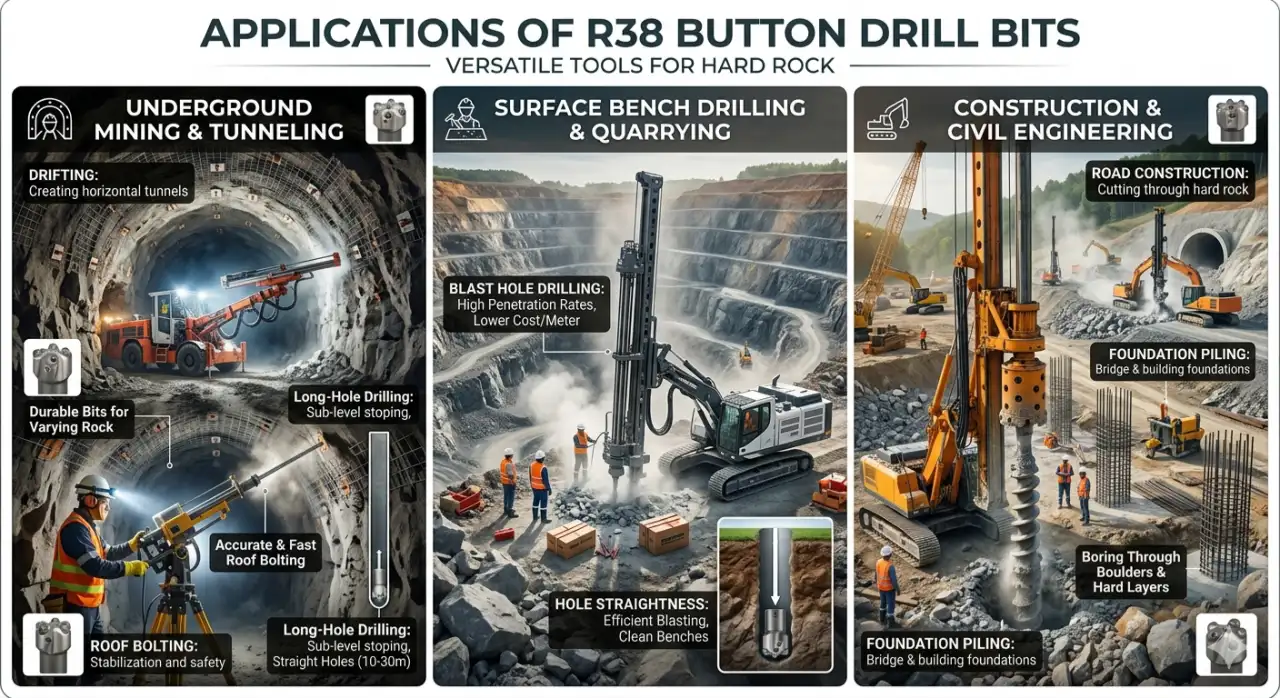
Underground Mining and Tunneling
In underground mining, bits are used in confined spaces for development and production.
Drifting: Creating horizontal tunnels. Bits must be durable to handle the varying rock faces found during tunnel advancement.
Roof Bolting: R38 bits are used to drill holes for rock anchors that stabilize the mine roof. Accuracy and speed are key to worker safety.
Long-Hole Drilling: Used in sub-level stoping where holes must be very straight over distances of 10 to 30 meters.
Bench Drilling and Quarrying
Bench drilling happens in open-pit mines and aggregate quarries where rock is removed in vertical layers or “benches”.
Blast Hole Drilling: Bits are used to drill vertical holes that are later filled with explosives. Here, high penetration rates are the priority to lower the cost per meter.
Hole Straightness: In deep benches, if the hole bends, the blast will be inefficient. Using bits with a drop center design or a flat face helps keep the drill string aligned.
Construction and Civil Engineering
R38 bits are also common in civil projects:
Foundation Piling: Drilling through boulders or hard layers to set foundations for bridges and buildings.
Road Construction: Breaking up hard rock for highway paths or tunnel entrances.
Maintenance and Care
To get the longest life out of an R38 bit, the operator must follow a maintenance schedule. Improper care leads to “button popping,” “body wash,” and early fatigue failure.
Regular Inspection
After each shift, the bit should be cleaned and inspected.
Check for Wear Flats: If the top of the carbide button becomes flat, it needs sharpening. If the flat area is more than 1/3 of the button’s diameter, the drilling speed will drop significantly and the stress on the bit will double.
Inspect the Body: Look for cracks on the face or near the button holes. Check for “body wash” where the steel is eroding away around the buttons.
Check Threads: The R38 threads should be clean and have no signs of “galling” (metal tearing). Worn threads can cause the bit to get lost in the hole.
Sharpening Protocols
Sharpening restores the shape of the button, which reduces the feed pressure needed and speeds up the drilling.
Use Diamond Grinding Pins: Use a professional grinding machine. Hand grinding with a stone is often imprecise and can damage the carbide.
Maintain Shape: Try to keep the original spherical or ballistic shape. Do not grind too much of the steel body away, as this weakens the button support.
Cool with Water: Always use water during grinding to prevent thermal shock, which causes micro-cracks in the carbide.
Lubrication and Storage
Thread Grease: Always apply a high-quality thread grease containing copper or graphite before attaching the bit to the rod. This prevents the threads from seizing under high heat.
Anti-Rust Coating: If storing the bits for more than a few days, spray them with light oil to prevent corrosion. Rust can act as a starting point for fatigue cracks.
Detailed guidance on maintenance can be found in the Top Hammer Drill Bit Material: 45CrNiMoV & YK05 blog.
How to Choose the Right R38 Button Bit
Selecting the right bit depends on the geology and the equipment you are using.
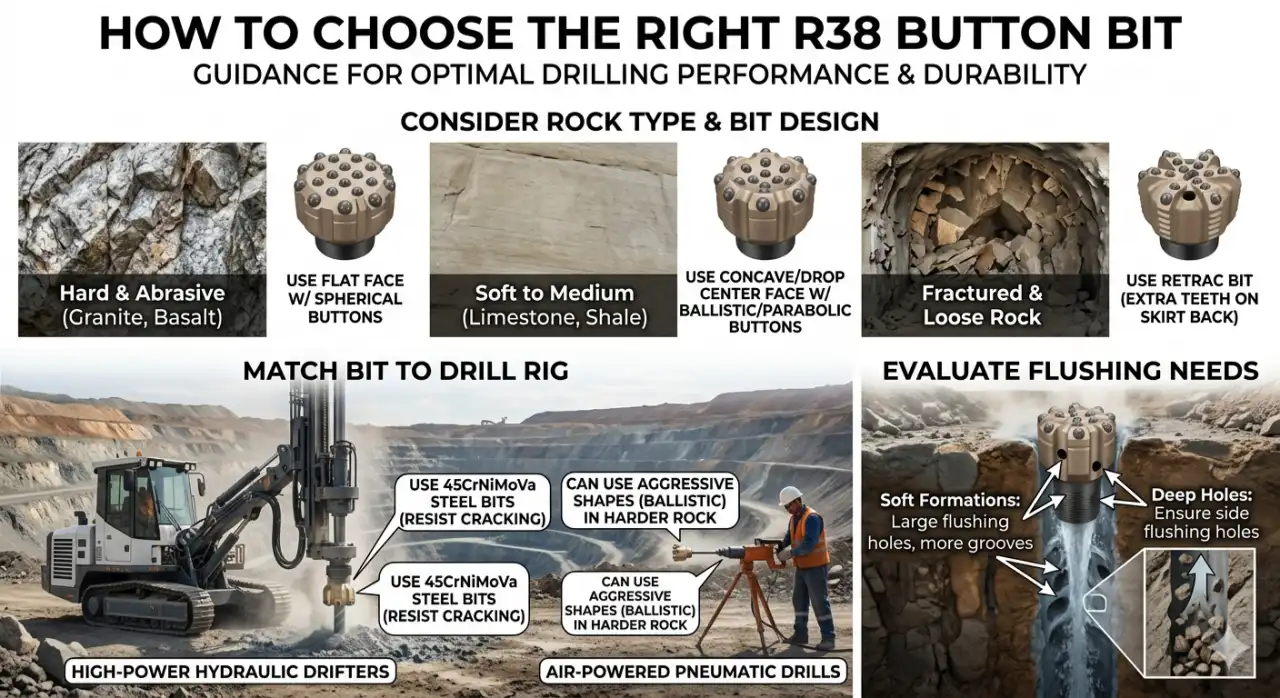
Consider Rock Type
Hard and Abrasive (Granite, Basalt): Use a Flat Face with Spherical Buttons. These are the most durable and resist fracturing.
Soft to Medium (Limestone, Shale): Use a Drop Center Face or a Concave Face with Ballistic or Parabolic Buttons. These will drill much faster.
Fractured and Loose Rock: Use a Retrac Bit. Retrac bits have an extra row of teeth on the back of the skirt. This helps the bit drill its way back out if the hole collapses behind it.
Match the Bit to the Drill Rig
High-Power Hydraulic Drifters: You must use bits made with 45CrNiMoVa steel. Cheaper 42CrMo bits will often crack under the intense impact energy of these modern machines.
Air-Powered (Pneumatic) Drills: These have lower impact power, so you can sometimes use more aggressive (ballistic) button shapes even in harder rock because the shock is less severe.
Evaluate Flushing Needs
Soft Formations: Large amounts of debris are produced. Choose a bit with large flushing holes or more flushing grooves on the side.
Deep Holes: Ensure the bit has side flushing holes. This helps move the cuttings up the long distance of the hole without getting stuck.
For a deep dive into design choices, see the Top Hammer Drill Bit Types:Face Design & Button Shape guide.
Branding and Customization
RockHound supports original equipment manufacturer (OEM) and custom branding services. We understand that branding is part of your professional identity.
Custom Marking: We can etch or stamp your logo, part numbers, and batch codes directly onto the bit body or the skirt.
Logo Size: We support a maximum logo size of 100*100mm.
- Color Options: While green is a standard industrial color for bits, we can provide custom spray-painting based on your requirements.
- Packaging: Bits are usually shipped in wooden boxes or reinforced cartons to ensure they arrive without damage.
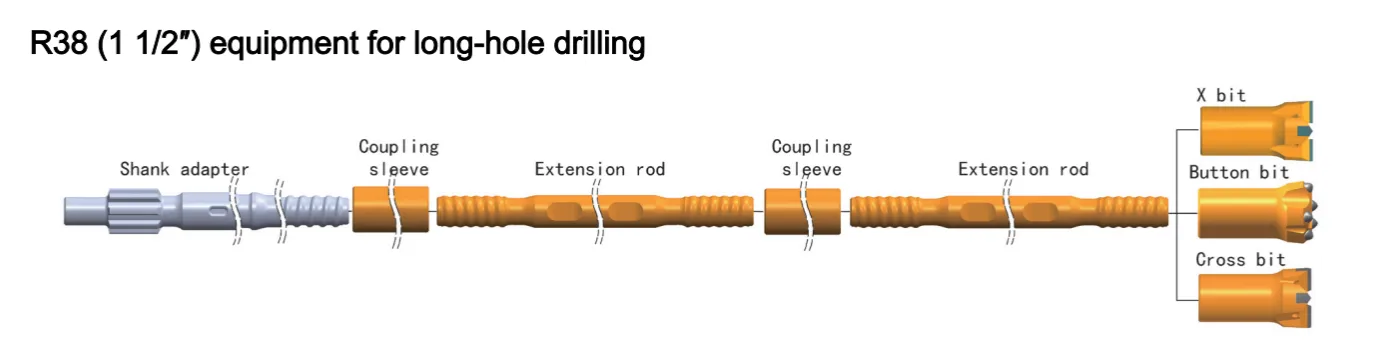
R38 Drilling Equipment System
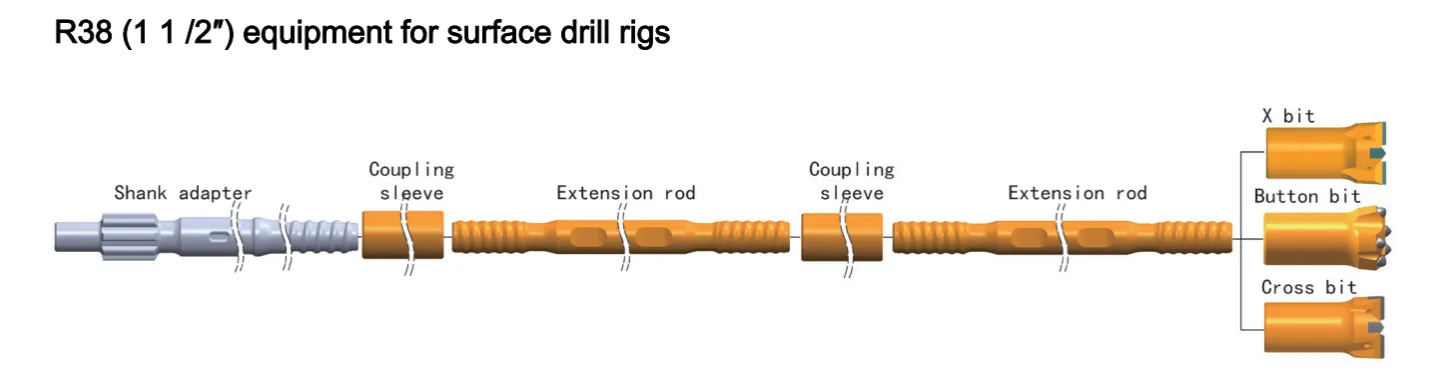
| R38 Rods | R38 Coupling Sleeve | R38 Shank Adapter |
|---|---|---|
| R38 Rods: | R38 Coupling Sleeve: | R38 Shank Adapter: |
FAQ
The lifespan depends entirely on the rock hardness and the operator's care. In soft rock, a bit might last for 500 meters of drilling. In very hard, abrasive granite, it might only last 50 meters. Using 45CrNiMoVa steel and YK05 carbide usually increases life by 20% to 40% compared to standard materials.
R38 is a "rope" thread with a rounded profile. It is easier to uncouple and handles dirt better. T38 is a trapezoidal thread that is more rigid and transmits energy more efficiently but can be harder to detach if it gets hot or dirty. Many rigs can use either depending on the rod used.
Look at the carbide buttons. If you see a flat spot that is 1/3 as wide as the button, it is time to sharpen. You might also notice that your penetration rate has slowed down or that the drill rig is vibrating more than usual.
Water is best for dust control and cooling, but in some soft clays, water can make the cuttings sticky, which blocks the bit. In those cases, compressed air is better. However, for hard rock, water is essential to keep the YK05 carbide from overheating.
Stop hammering immediately. Use the rotation and high-pressure flushing to try and clear the debris around the bit. If you are using a Retrac bit, the rear teeth should help you drill your way out as you pull back. Never try to force the bit out with just the hoist, as this can break the drill rods.