
Product description
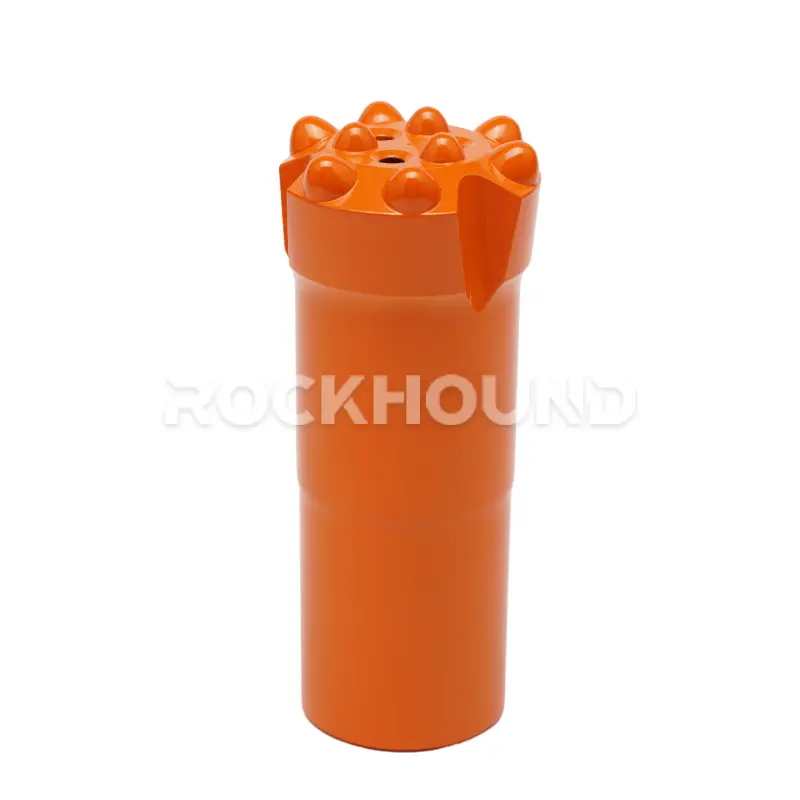
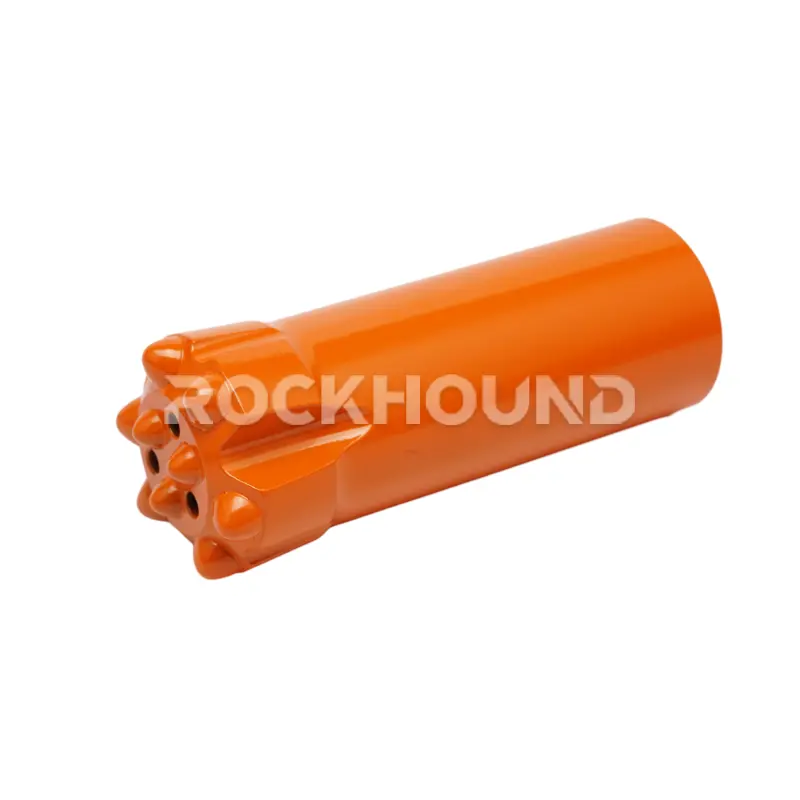
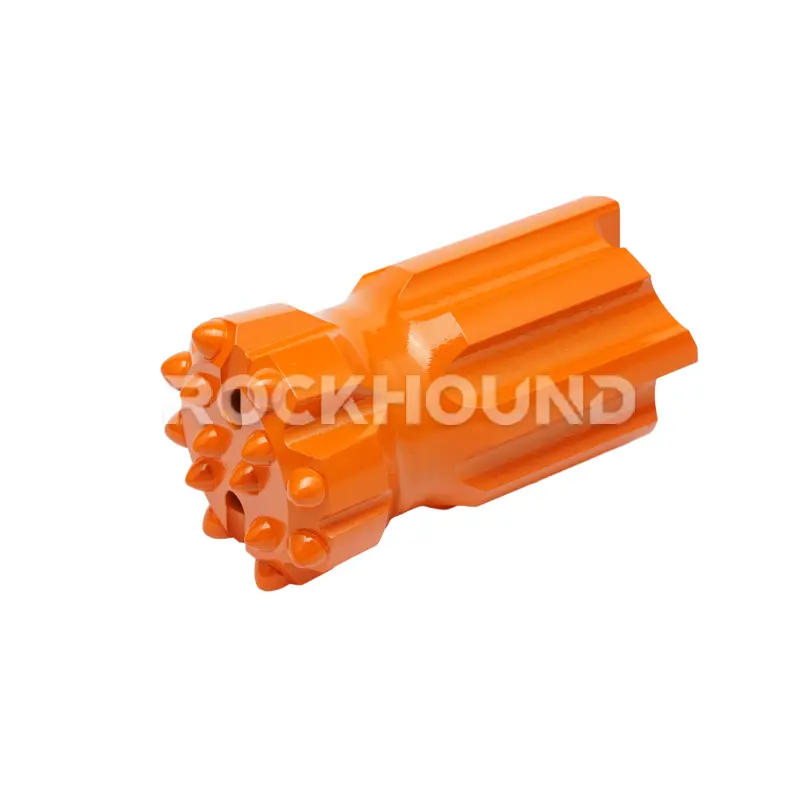
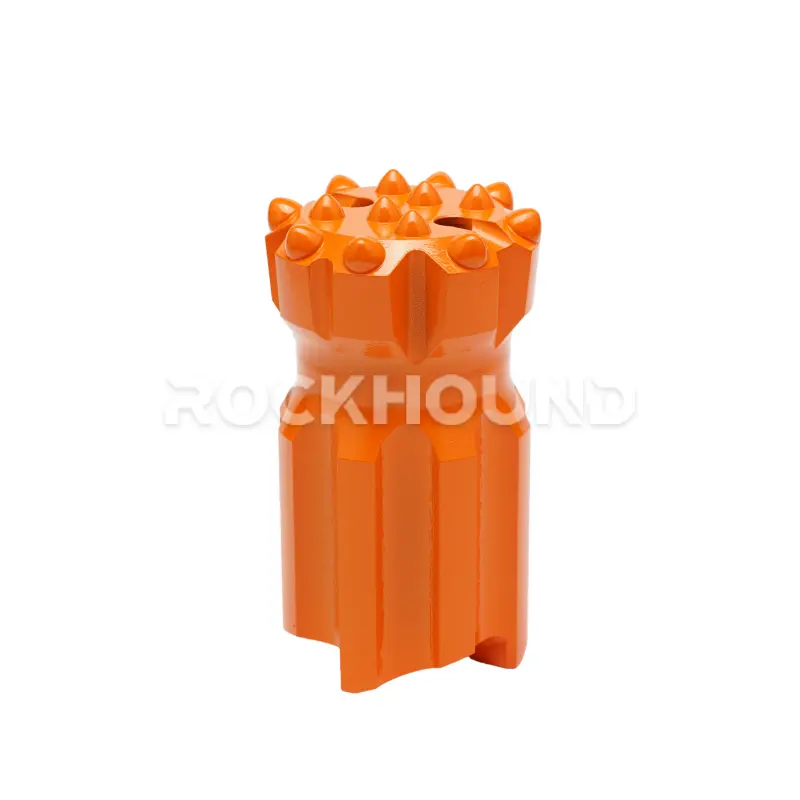
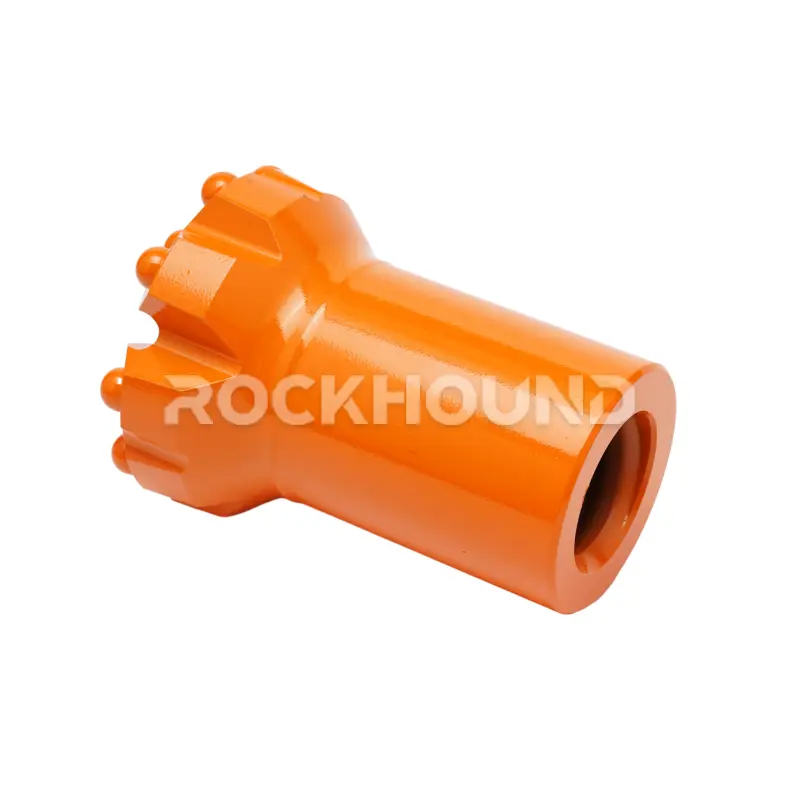
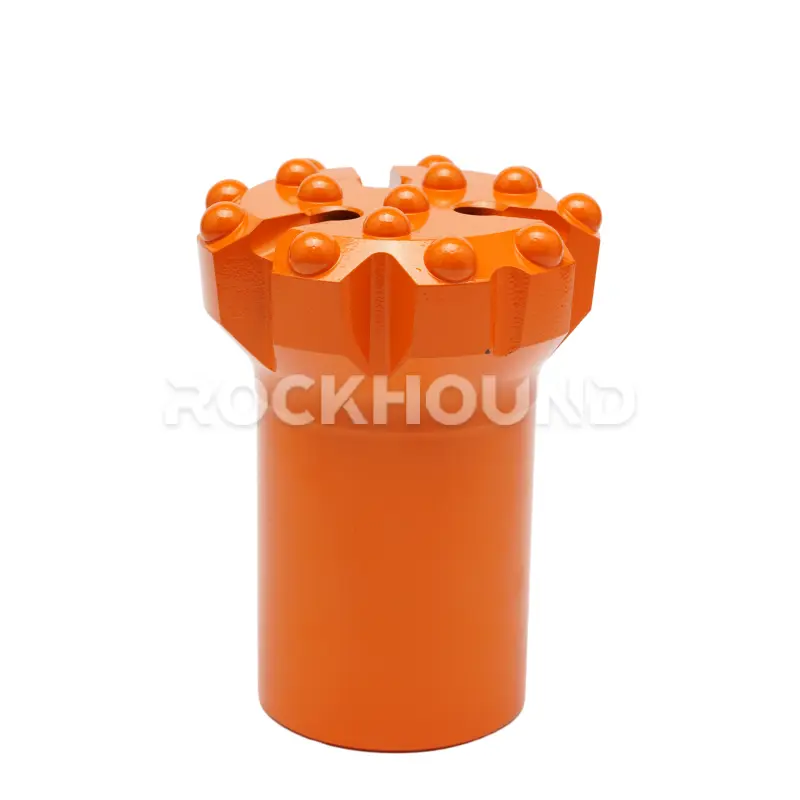
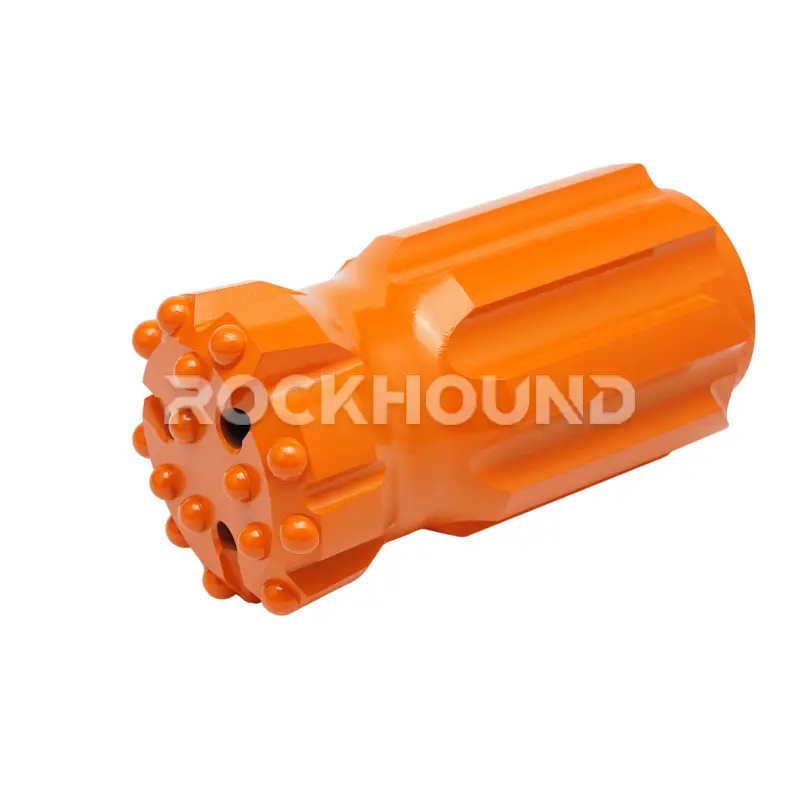
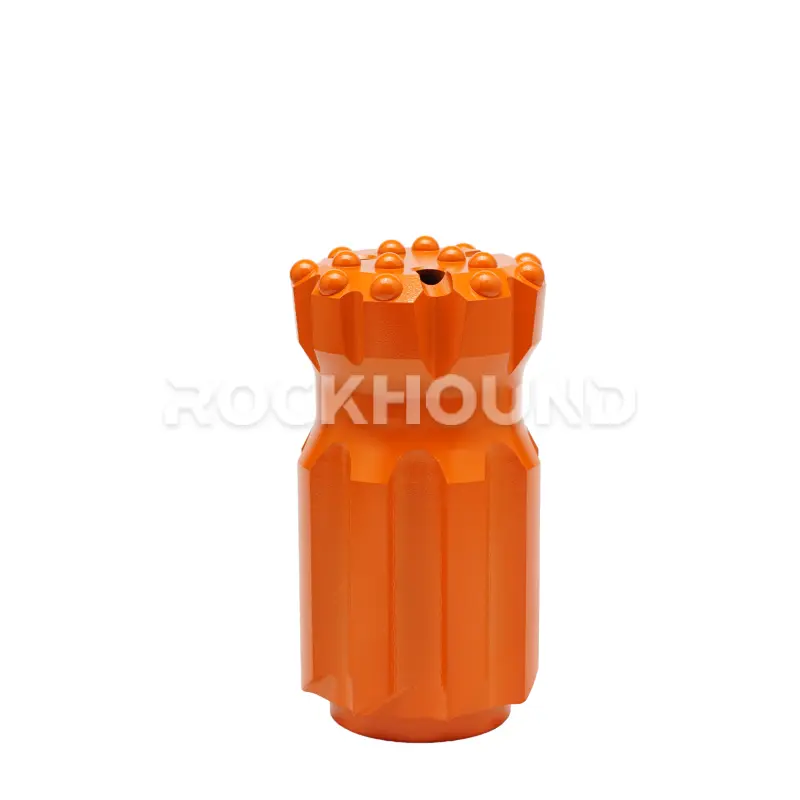
RockHound T38 Retrac Button Bits are purpose-built for high-energy top hammer drilling in demanding underground and surface applications. Each bit is precision-machined from 45CrNiMoVa alloy steel — a high-toughness, low-alloy grade that withstands the cyclic impact loads generated by modern hydraulic rock drills — and fitted with YK05 tungsten carbide inserts selected for their optimum balance of hardness (≥ 89.5 HRA) and transverse rupture strength.
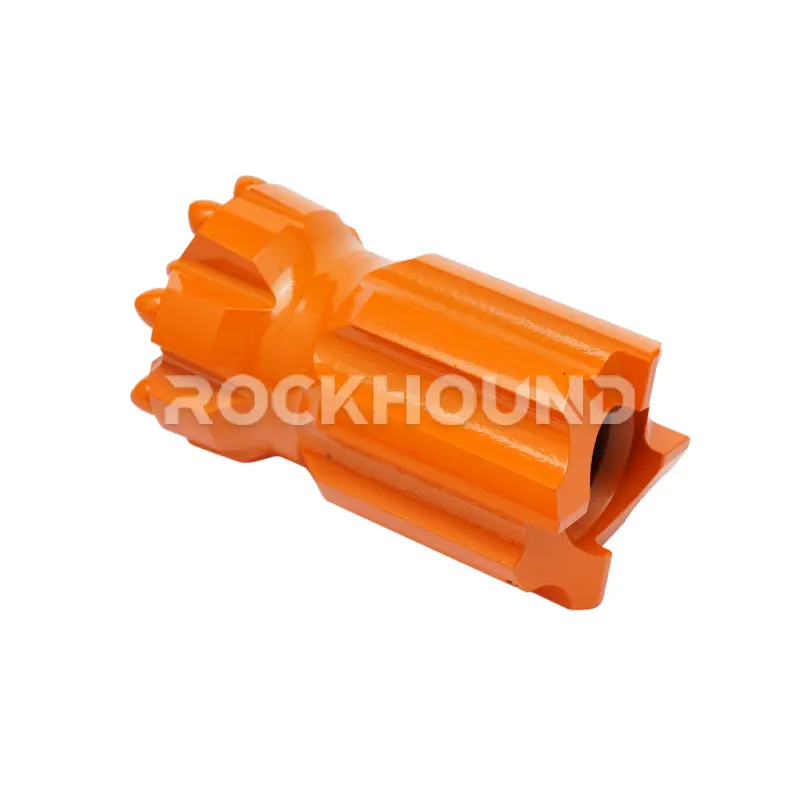
Available in diameters of 64 mm, 70 mm, and 76 mm with T38 (1½ in) thread, these bits cover the most common hole sizes used in bench blasting, production drilling, and exploratory tunneling. The retrac geometry — a fluted, back-tapered skirt — is the defining feature: it prevents bit jamming in fractured or caving ground by allowing controlled rotation during string withdrawal, reducing costly lost-hole events.
Every RockHound bit undergoes a 20-hour controlled heat treatment cycle, resulting in a case-hardened, fatigue-resistant body that outlasts standard commercial bits in head-to-head field trials. Threads are machined to Atlas Copco/Epiroc T38 gauge for drop-in compatibility with all major drill string components.
Custom branding available. RockHound supports OEM and private-label orders. Laser or pad-print your logo on the bit body (max. 100 × 100 mm). Minimum order quantities apply — contact us for details.
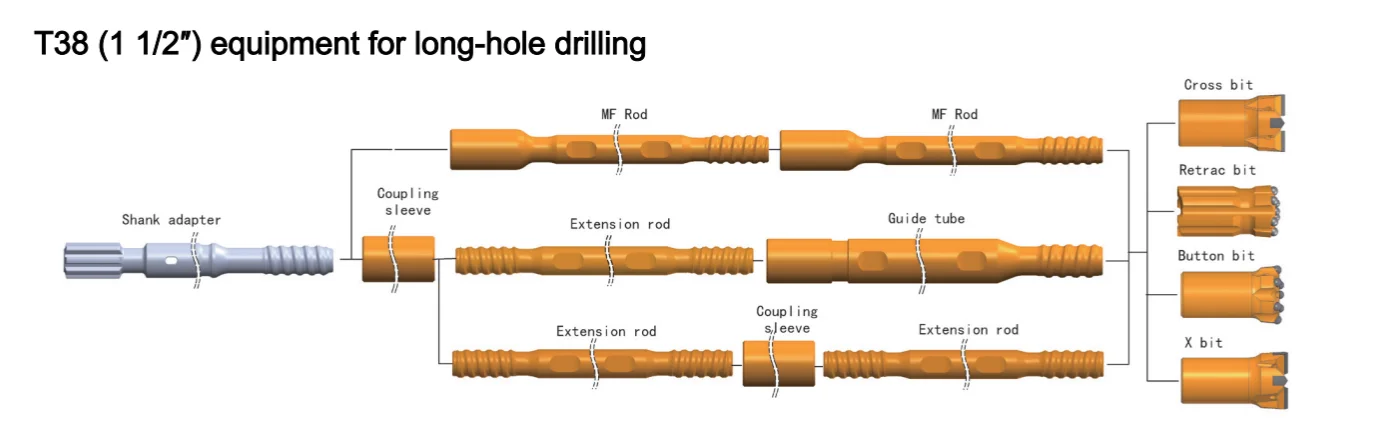
T38 Equipment For Long-Hole Drilling
Material & Key Features
Specifications
T38 Standard & Drop Center button bits
| Bit Type | Diameter (mm) | Diameter (inch) | Buttons (Gauge × Centre) | Gauge Angle | Product Code | Weight (kg) |
|---|---|---|---|---|---|---|
| Standard Button | 64 | 2 1/2 | 6×12 / 3×11 | 30° | 173-6409-7663 | 1.9 |
| Standard Button | 70 | 2 3/4 | 8×10 / 6×10 | 35° | 173-7014-7665 | 2.3 |
| Standard Button | 76 | 3 | 7×12 / 4×11 | 35° | 173-7611-7665 | 3.3 |
| Drop Center | 64 | 2 1/2 | 6×11 / 4×10 | 35° | 175-6410-7665 | 1.7 |
| Drop Center | 70 | 2 3/4 | 8×10 / 6×10 | 35° | 175-7014-7665 | 2.0 |
T38 Retrac bits (flat & drop center)
| Bit Type | Diameter (mm) | Diameter (inch) | Buttons (Gauge × Centre) | Gauge Angle | Product Code | Weight (kg) |
|---|---|---|---|---|---|---|
| Flat / Retrac | 64 | 2 1/2 | 4×10 / 8×10 | 30° | 174-6412-7603 | 1.9 |
| Flat / Retrac | 70 | 2 3/4 | 6×10 / 8×10 | 35° | 174-7014-7605 | 2.3 |
| Drop Center / Retrac | 64 | 2 1/2 | 6×11 / 4×10 | 35° | 176-6410-7605 | 1.7 |
Related Readings:Rock Drill Bits Manufacturing Process
Work Principle
T38 Retrac Button Bits convert the reciprocating shock pulse of a top hammer drill into efficient rock fragmentation through three simultaneous mechanisms. Understanding these mechanisms helps drillers optimize feed force, rotation speed, and flushing pressure for their specific rock mass.
For a detailed breakdown of button bit mechanics, see our guide: Top Hammer Button Bit: How It Works, Uses & Maintenance →
Applications
Underground production drilling
Long-hole blasting rings, sub-level stoping; retrac design prevents stuck bits in caving backs and fractured ore bodies.
Open-pit bench drilling
64–76 mm holes in granite, basalt, and limestone benches; high penetration rate with standard flat face.
Quarry aggregate production
Consistent gauge diameter preserves accurate burden/spacing ratios, reducing blast oversize and downstream crusher wear.
Tunnel face drilling
Drop center face maintains hole straightness in mixed-face conditions; retrac shank eases bit change in confined headings.
Slope stabilisation & anchoring
Bolt-hole drilling in jointed rock slopes; retrac geometry prevents bit loss in open joints.
Civil & geotechnical drilling
Foundation piling, ground investigation boreholes, and rock anchoring in urban construction.
Compatible with rock drills from Epiroc (Atlas Copco), Sandvik, Montabert, Furukawa, and equivalent T38-standard equipment.
Maintenance
Proper maintenance of T38 Retrac Button Bits is the most cost-effective way to lower cost-per-metre. Field data consistently shows that poor maintenance practice — not rock conditions — is responsible for the majority of premature bit failures.
To maximize the lifespan of your 45CrNiMo1V T38 bits:
Timely Sharpening: Do not over-drill. Sharpen buttons when they reach about 1/3 of their original height to prevent “anti-sharpening” and button failure.
Thread Lubrication: Always use high-quality thread grease to prevent galling and ensure easy uncoupling from the rod.
Correct Drilling Pressure: Maintain stable feed pressure; excessive pressure can cause carbide breakage, while too little can lead to premature thread wear.
Flushing Inspection: Ensure water or air flushing is constant during drilling to keep the bit face cool and clean.
Storage: Store in a dry environment and apply anti-rust oil if not in use for extended periods.
How to choose the right T38 button bit
Selecting the correct face design, button profile, and diameter is a three-variable decision. Use the decision cards below as a starting framework, then validate against your specific rock mass classification (RMR or Q-system) and drill rig specifications.
Rock hardness
Hard to very hard (UCS > 120 MPa)
Use Standard flat face. High UCS rock requires maximum carbide protrusion and a stiff face to initiate fracture. Ballistic button profile for high penetration in siliceous granite or quartzite.
Rock hardness
Medium to hard (UCS 60–120 MPa)
Drop Center face improves hole straightness and reduces deviation in layered or jointed limestone, sandstone, and schist. Semi-spherical buttons tolerate mica and clay inclusions without chipping.
Ground conditions
Fractured, jointed, or caving ground
Always choose a Retrac variant. Any formation with a Rock Quality Designation (RQD) below 50 % is a candidate for bit jamming. The retrac skirt pays back its small cost premium within the first stuck-bit incident it prevents.
Hole diameter & depth
Matching diameter to rod string
64 mm is ideal for T38 drill strings up to 18 m. For deeper holes (18–27 m), step up to 70 mm or 76 mm to maintain flushing velocity and reduce string deflection. Over-sizing the bit relative to the rod wastes energy on gauge friction.
Drill rig
Rig compatibility
Confirm your rig’s impact energy output (J) and rotation torque (Nm) fall within the T38 bit operating envelope. Under-powered rigs wear buttons without fracturing rock efficiently; over-powered rigs can crack bit bodies at the thread root.
Bit type guide
Quick reference by application
Need a broader overview? See our guide: Top Hammer Drill Bit Types: Face Design & Button Shape → and How Many Types of Top Hammer Button Bits →
Bundle Purchase Suggestion
Pairing the right bit with the right rod is crucial for drilling performance. Offer these bundles to increase your Average Order Value (AOV).
Option A: The Efficiency Bundle (For Bench Drilling)
Bit: T38-64mm Standard Button Bit.
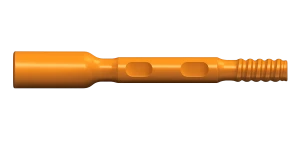
Benefit: MF rods eliminate the need for coupling sleeves, ensuring faster rod changes and higher energy efficiency.
Option B: The Precision Bundle (For Deep Hole Drilling)
Bit: T38-64mm Drop Center Retrac Bit.
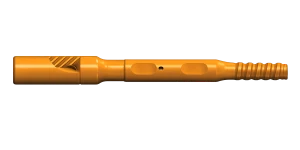
Benefit: The Drop Center bit combined with a rigid Guide Tube ensures maximum hole straightness and easy retrieval in complex rock layers.
FAQ
A T38 retrac button bit is a top hammer drill bit with a 1½-inch (T38) threaded shank and a fluted, back-tapered skirt (the "retrac" section) that prevents the bit from becoming wedged in the borehole during extraction. It should be used whenever ground conditions include fractures, clay seams, weak overburden, or any rock mass with RQD below 50 %, where a standard bit would risk jamming and causing a lost drill string.
RockHound Retrac Bit is characterized by its specialized fluted or grooved skirt design at the rear of the bit body.
Its primary function is to assist in retrieving the bit more easily from broken, loose, or caving rock formations.
If your drilling operations frequently encounter "stuck" tools or difficulty in pulling the drill string back, switching to a Retrac design can drastically reduce downtime and the risk of lost equipment.
- For hard to very hard rock (UCS > 120 MPa, e.g. granite, quartzite, hard basalt), the Standard flat face with ballistic button profile is recommended. The flat face maximises button count in contact with intact rock per blow, while the ballistic (pointed) button nose concentrates stress at the Hertzian contact zone to initiate fracture efficiently. Drop Center should be considered if hole straightness is a priority, even in hard rock. Review our face design guide → for a comprehensive comparison.
Yes. RockHound T38 bits are machined to the Atlas Copco/Epiroc T38 thread gauge standard, which is also adopted by Sandvik, Montabert, and Furukawa for this thread class. They are drop-in compatible with T38 MF (male-female) rods, shank adapters, and couplings from all major OEMs without modification.
The number and arrangement of tungsten carbide buttons vary by model to optimize performance:
64mm Bits: Typically feature 6 gauge buttons and 3 to 4 center buttons.
70mm Bits: Usually configured with 8 gauge buttons and 6 to 8 center buttons.
Gauge Angles: Gauge button angles typically range between $30^\circ$ and $40^\circ$ to ensure stable rock cutting and efficient energy distribution.
You should sharpen the tungsten carbide buttons when the wear flat reaches approximately 1/3 of the button diameter or when you notice a significant drop in the penetration rate. Drilling with over-worn buttons leads to uneven stress on the bit body, which can cause carbide fracturing or bit body failure. Regular maintenance can improve total drilling meters by over 20%.
- Button Chipping: Often caused by over-drilling or excessive feed pressure; ensure regular sharpening and adjust drilling parameters.
- Thread Galling: Usually due to insufficient lubrication or loose connections; always apply high-quality thread grease before coupling.
- Flushing Hole Blockage: Leads to bit face overheating; always verify that water or air flushing is clear before starting the drill.
T38 thread bits are designed for hole diameters from approximately 51 mm up to 89 mm, with the sweet spot at 64–76 mm. The three diameters offered by RockHound — 64 mm, 70 mm, and 76 mm — cover the most common production-drilling specifications in underground hard-rock mines and surface quarries. For diameters above 89 mm, a T45 or T51 thread shank is recommended for adequate energy transmission.