
Description
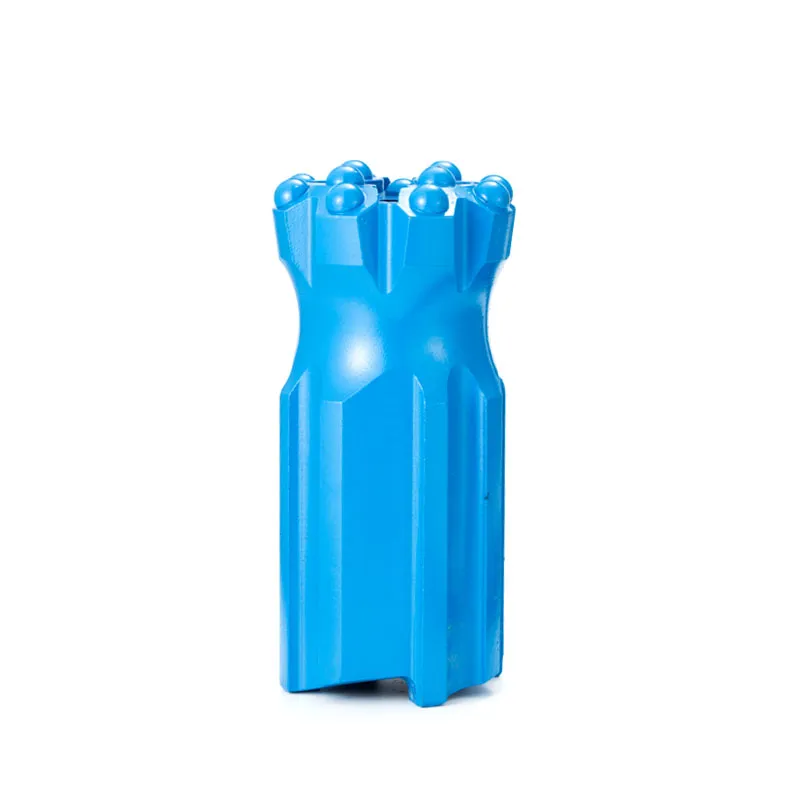
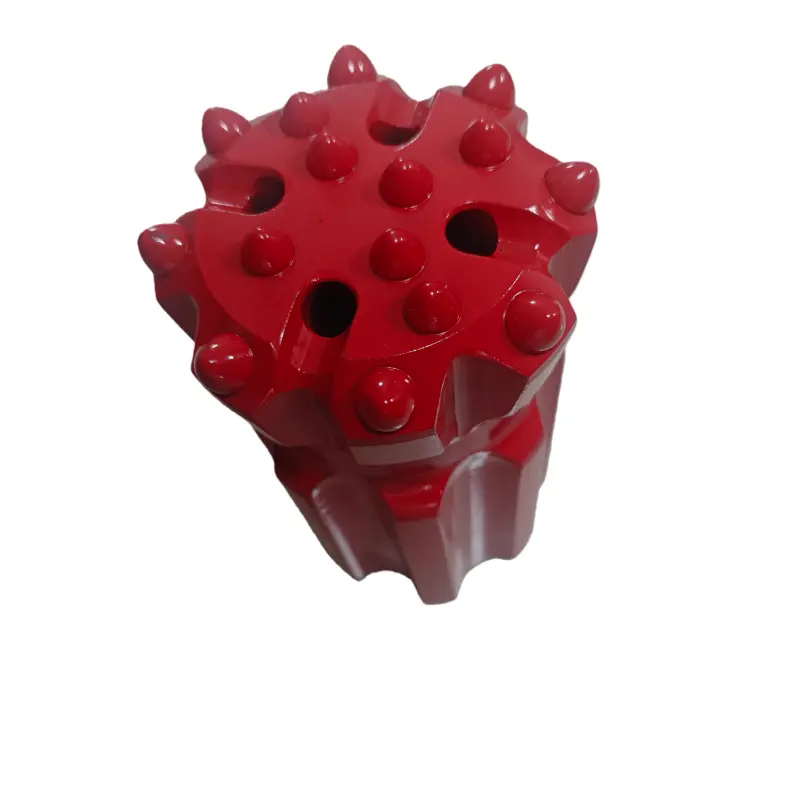
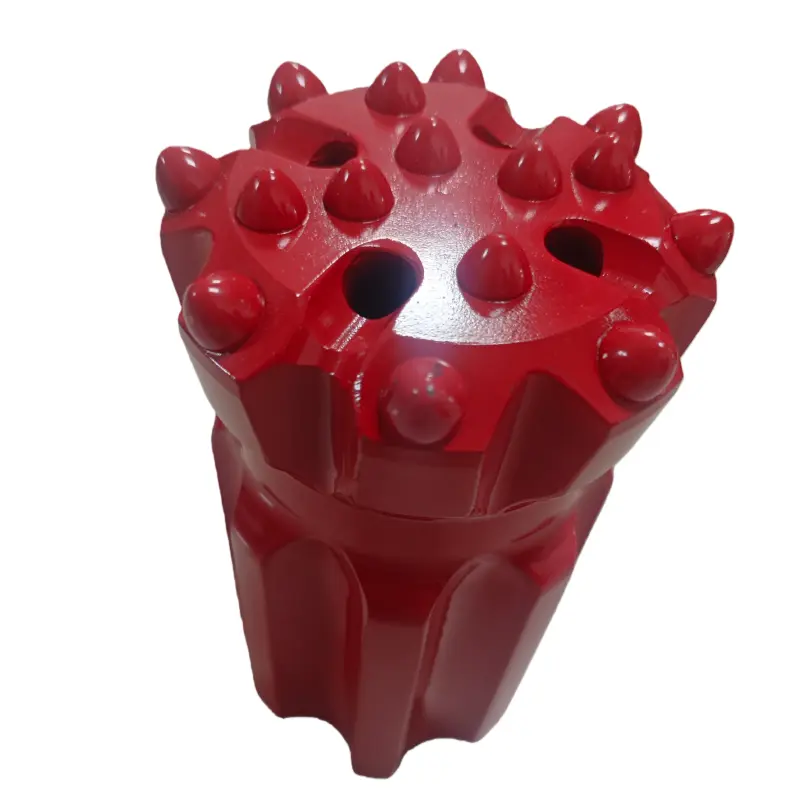
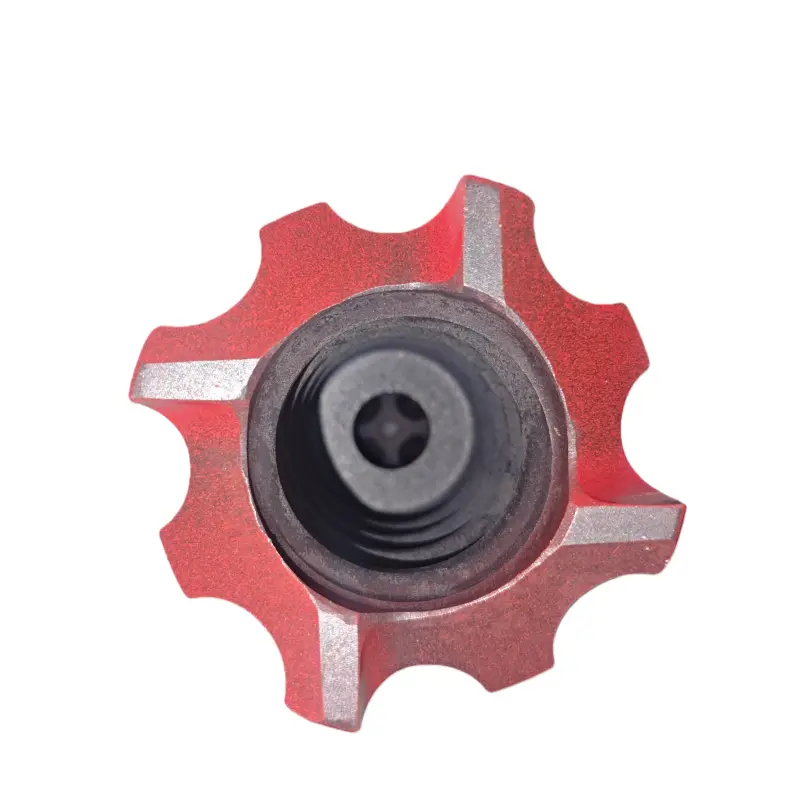
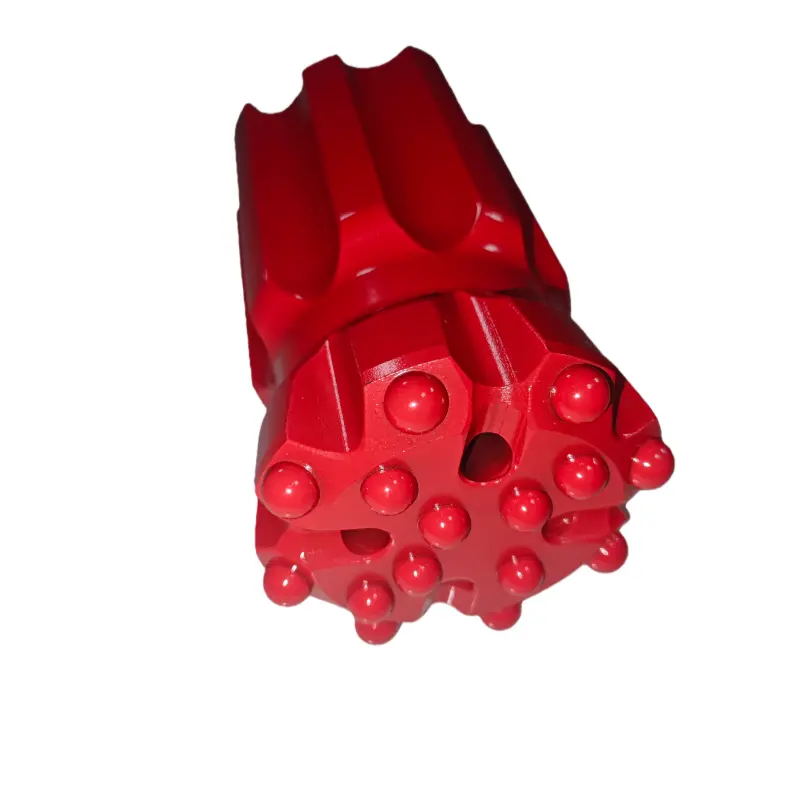
The T51 Retrac Button Bit is a top hammer drill bit designed for medium to hard rock where hole collapse or caving is a real problem. The defining feature is the retrac skirt — a reverse-taper body profile that cuts away fallen material as you pull the string back. Ordinary bits get stuck in loose or jointed ground. This one does not.
Every bit in this series is machined from 45CrNiMoV alloy steel, heat-treated for 20+ hours at controlled temperature cycles to reach the fatigue strength that modern hydraulic rock drills demand. The tungsten carbide inserts are YK05 grade — a cobalt-balanced formulation that handles high-frequency impact without cracking.
Available from 89 mm (3½″) to 127 mm (5″) in standard button, flat-face retrac, drop-center, and drop-center retrac configurations. All bits use the T51 thread standard, so they mate directly with any T51 drill rod or extension steel in your fleet.
Whether you are running bench blasts in an open-pit quarry, driving long-hole stopes underground, or drilling anchors for civil foundations, this bit is built to reduce cost-per-meter — not just drill a hole.
Material
- Tensile strength > 1,300 MPa
- High fatigue cycle life
- Resists deformation under impact
- Compatible with hydraulic drill systems
- Hardness: 89–91 HRA
- TRS > 3,000 N/mm²
- Anti-spalling under shock loads
- Consistent insert retention
Features
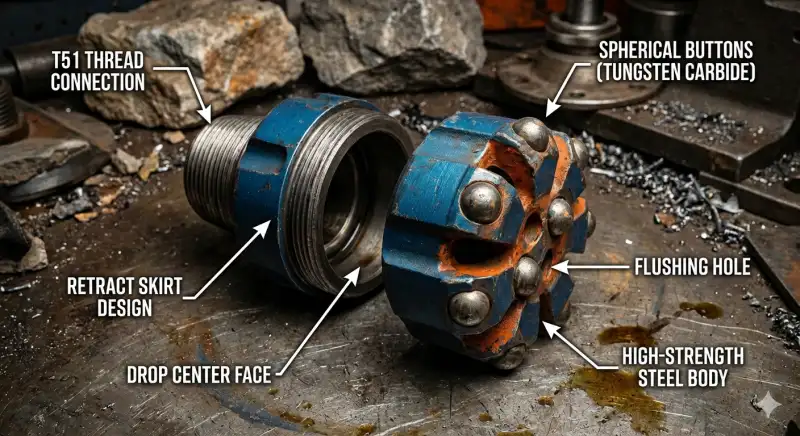
- Retrac Skirt — No Stuck ToolsThe inverted-taper body profile acts as a back-cutter on every withdrawal. Caved material around the bit gets displaced rather than packed, keeping the drill string free even in severely fractured ground. This single feature eliminates the most expensive failure mode in broken rock drilling: losing a drill string in the hole.
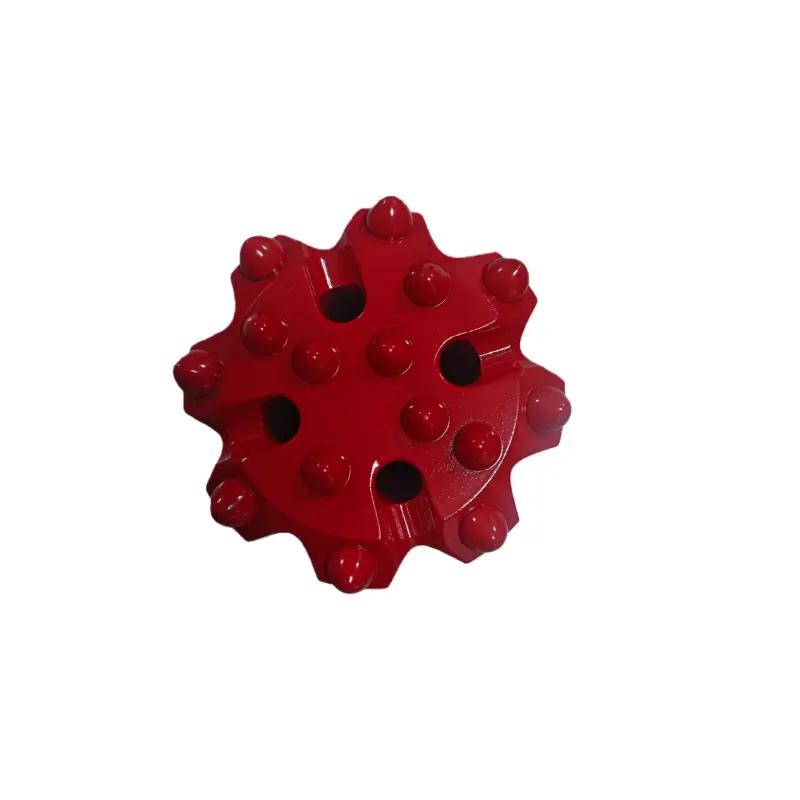
- YK05 Tungsten Carbide ButtonsYK05 grade carbide uses a controlled cobalt matrix to balance hardness and toughness. The result: buttons resist spalling on the first impact and stay sharp longer than standard-grade inserts. Available in spherical, ballistic, and parabolic profiles to match your rock’s compressive strength.
- 45CrNiMoV Alloy Steel BodyThe body is forged from 45CrNiMoV steel and put through a 20+ hour heat treatment process. This builds the fatigue resistance needed to survive thousands of high-energy impacts per minute from a modern hydraulic rock drill — without cracking or deforming at the thread shank.
- Drop Center Face — Straight HolesThe concave drop-center face geometry creates a self-centering effect at the start of each hole. In jointed or hard-banded rock where deviation is common, the drop center acts as a pilot guide, keeping the bit on the planned drill vector and reducing the correction required on each pass.
- High-Flow Flushing ChannelsOptimized hole geometry across the bit face moves cuttings out of the bottom of the hole fast. Proper flushing prevents regrinding — the biggest cause of premature button wear — and keeps bit temperature within the operating range of the carbide. Works with both air and water flushing media.
- Precision T51 Thread
- The T51 thread is machined to tight tolerances and hardened to prevent galling. A snug thread-to-rod interface means full energy transfer from each piston stroke to the face of the bit — not wasted in play at the connection. Decoupling after deep holes remains quick and clean.
Specifiation
All bits use T51 thread. Gauge button angle 35° standard, 40° available on select Drop Center Retrac models. Weights listed for standard carbide configuration.
| Thread bit, Button | D (Diameter) | Buttons (No × Size mm) | Gauge Button Angle | Thread | Product Code | Weight (kg) | ||
|---|---|---|---|---|---|---|---|---|
| mm | inch | Gauge | Centre | |||||
| Button (Standard) |
89 | 3 1/2 | 9 × 11 | 6 × 10 | 35° | T51 | 173-8915-7805 | 4.0 |
| Button | 102 | 4 | 9 × 12 | 6 × 12 | 35° | T51 | 173-0215-7805 | 4.8 |
| Button | 115 | 4 1/2 | 9 × 13 | 6 × 12 | 35° | T51 | 173-1515-7805 | 5.8 |
| Button | 127 | 5 | 9 × 14 | 6 × 13 | 35° | T51 | 173-2715-7805 | 8.0 |
| Button / Drop Center | 89 | 3 1/2 | 8 × 12 | 6 × 11 | 35° | T51 | 175-8914-7805 | 4.8 |
| Button / Flat / Retrac | 89 | 3 1/2 | 9 × 11 | 6 × 10 | 35° | T51 | 174-8915-7805 | 4.9 |
| Button / Flat / Retrac | 102 | 4 | 9 × 12 | 6 × 12 | 35° | T51 | 174-0215-7805 | 7.1 |
| Button / Drop Center / Retrac | 89 | 3 1/2 | 8 × 12 | 6 × 11 | 35° | T51 | 176-8914-7805 | 4.7 |
| Button / Drop Center / Retrac | 89 | 3 1/2 | 8 × 12 | 7 × 11 | 40° | T51 | 176-8915-7864 | 4.7 |
| Button / Drop Center / Retrac | 102 | 4 | 8 × 12 | 7 × 12 | 40° | T51 | 176-0215-7864 | 5.3 |
Custom diameters, thread sizes, and button configurations available on request. Contact the RockHound sales team for project-specific drawings.
Button Shape Comparison-Spherical vs. Ballistic vs. Parabolic
Button shape is the fastest way to tune penetration rate or service life without changing the bit body. Match the shape to your UCS range and project priority.
| Button Type | Features | Performance | Application Suggestions |
|---|---|---|---|
| Spherical Button | Rounded, arc-shaped top; very thick and robust design. | Exceptional durability. While penetration speed is slightly slower, it is extremely resistant to fracturing. | Ideal for extremely hard rock formations or high-impact drilling environments. |
| Ballistic Button | Pointed, streamlined top design. | High Rate of Penetration (ROP). Cuts deeper into rock with 10-20% higher efficiency than spherical buttons. | Best for soft to medium-hard rock, ideal for projects prioritizing rapid construction progress. |
| Parabolic Button | A balanced hybrid design between spherical and ballistic shapes. | Combines the high speed of ballistic buttons with the long service life of spherical buttons. | The best-selling universal model for independent sites, offering an excellent cost-performance ratio. |
How a T51 Retrac Button Bit Breaks Rock
Understanding the cycle helps you set correct drill parameters and catch wear problems early.
Applications
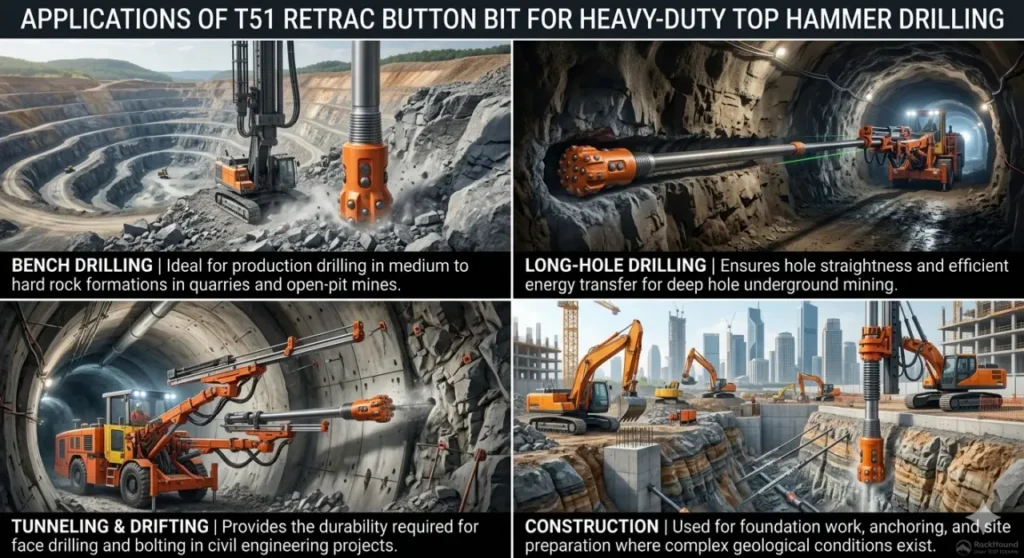
The T51 Retrac Button Bit covers the core top-hammer use cases across mining and civil construction.
- Open-Pit Bench DrillingProduction drilling in quarries and open-pit mines runs on cost-per-meter. This bit’s high-impact resistance and consistent hole diameter across the full run length reduce the number of bits consumed per blast pattern. The retrac skirt handles the bench floor breakage zone where bit retrieval problems concentrate.
- Long-Hole Underground MiningIn stope drilling, hole deviation above 2–3° causes blast fragmentation problems. The drop-center face geometry and stiff T51 thread connection keep hole deviation low in long lifters and uppers. Hole depths of 20–35 m are typical. The retrac skirt prevents string-loss incidents that cause production delays in narrow-vein operations.
- Tunneling & DriftingFace drilling in tunnel headings requires consistent penetration across a full round — from easer holes through the contour. Mixed ground with fractured zones is standard in hard-rock tunneling. The retrac design handles the collar zone of each hole where broken material re-enters, without slowing the drill cycle.
- Civil Foundation & AnchoringRock anchor drilling for slope stabilization, dam foundations, and retaining walls often encounters highly fractured or weathered rock. At these sites, a stuck bit means project delay and mobilization cost. The retrac skirt is the lowest-risk option for any site where ground conditions are variable or unknown.
Maintenance
How to Extend Bit Life in the Field
Bit life is determined as much by how you operate and maintain the bit as by the rock you drill. These four practices have the highest impact on cost-per-meter.
How to Choose the Right T51 Bit Configuration
| Condition / Priority | Recommended Face | Button Shape | Gauge Angle | Reasoning |
|---|---|---|---|---|
| Intact Hard Rock (Granite, Basalt) |
Flat / Standard Button 173-xx |
Spherical | 35° | Maximum button durability. Flat face spreads load across all buttons simultaneously. |
| Fractured or Caving Ground | Flat Retrac or DC Retrac 174-xx / 176-xx |
Spherical or Parabolic | 35° | Retrac skirt prevents stuck tools. Use parabolic if ROP is also a concern. |
| High Deviation Risk (Long holes) | Drop Center 175-xx / 176-xx |
Spherical or Parabolic | 35°–40° | Concave center keeps hole straight. 40° gauge gives better wall contact in weak rock. |
| Speed Priority (Soft–Medium rock) | Drop Center 175-xx |
Ballistic or Parabolic | 35° | Ballistic gives 10–20% higher ROP. Drop center stabilizes at collar to prevent deviation. |
| Mixed Geology (Variable UCS) |
DC Retrac 176-xx |
Parabolic | 35° | Parabolic handles hard/soft layers without resharpening. Retrac covers worst-case recovery. |
| Lowest Cost-Per-Meter | Standard Button 173-xx |
Parabolic | 35° | Lowest unit price. Parabolic provides best balance of ROP and regrind intervals for fleet. |
Not sure which configuration suits your project? Send us your rock type (or UCS test data), target hole depth, and current drill rig model. The RockHound team will recommend a starting configuration and can supply a small trial batch before a full order.
Related Products
- T51 Shank Adapter (Compatible with Atlas Copco, Sandvik, Furukawa)
- T51 Coupling Sleeves (Available in Middle Stop and Reduction)
FAQ
A T51 Retrac Button Bit is a top hammer drill bit that connects to a drill rod via the T51 thread standard and uses a retrac skirt — a reverse-taper body — to prevent the bit from getting stuck in fractured or caving ground. The bit face carries tungsten carbide buttons that break rock under high-frequency piston impacts from a hydraulic rock drill. The T51 thread handles impact energy levels typical of heavy-duty hydraulic equipment in the 15–25 kW power class.
A standard button bit has a straight or slightly flared skirt. When rock material caves around it during drilling, that material packs against the bit body and can trap the tool in the hole. A retrac bit has a stepped or tapered skirt that extends below the widest part of the bit. When you pull the string back, the skirt back-cuts the fallen material, keeping the borehole clear. The trade-off is slightly higher unit cost and a heavier body — but in fractured ground, a stuck standard bit costs far more than the price difference.
T51 bits cover the full UCS range from soft limestone (30–60 MPa) up to massive granite and quartzite (180–250 MPa). The selection variable is button shape, not the bit body: use ballistic buttons in soft rock for maximum penetration rate, spherical buttons in very hard rock for maximum button life, and parabolic buttons in mixed or medium-hard formations where you need both. The retrac body adds value in any formation where joints, faults, or weathering create zones of broken material.
+
Service life in meters drilled varies significantly by rock hardness, flushing quality, drill parameters, and regrinding practice. In medium granite with correct flushing and regrinding at the right interval, a well-maintained bit can run 200–400 meters. In hard quartzite or with poor flushing, expect 80–150 meters. The four biggest factors that shorten bit life are:
- regrinding too late
- insufficient flush volume
- over-rotation speed for the rock type
- incorrect thread lubrication causing galling. For a detailed maintenance workflow, see our guide on Top Hammer Button Bit Maintenance.
Yes. RockHound supports logo stamping on the bit body for OEM and distributor customers. The maximum imprint area is 100 × 100 mm. Custom packaging and product code re-labeling are also available. Contact the sales team with your artwork file (vector format preferred) and volume requirement for a quotation.