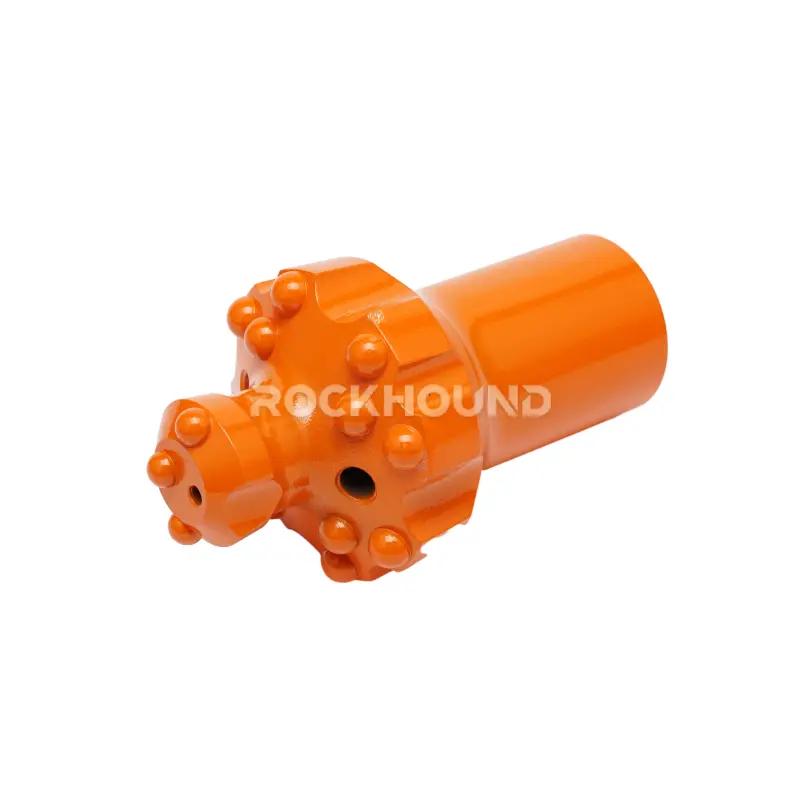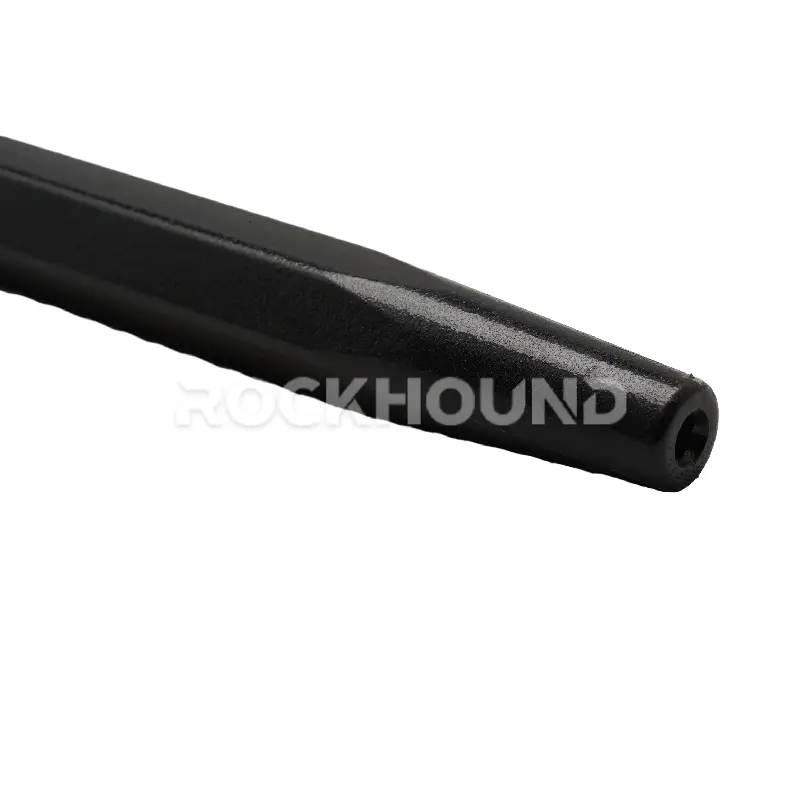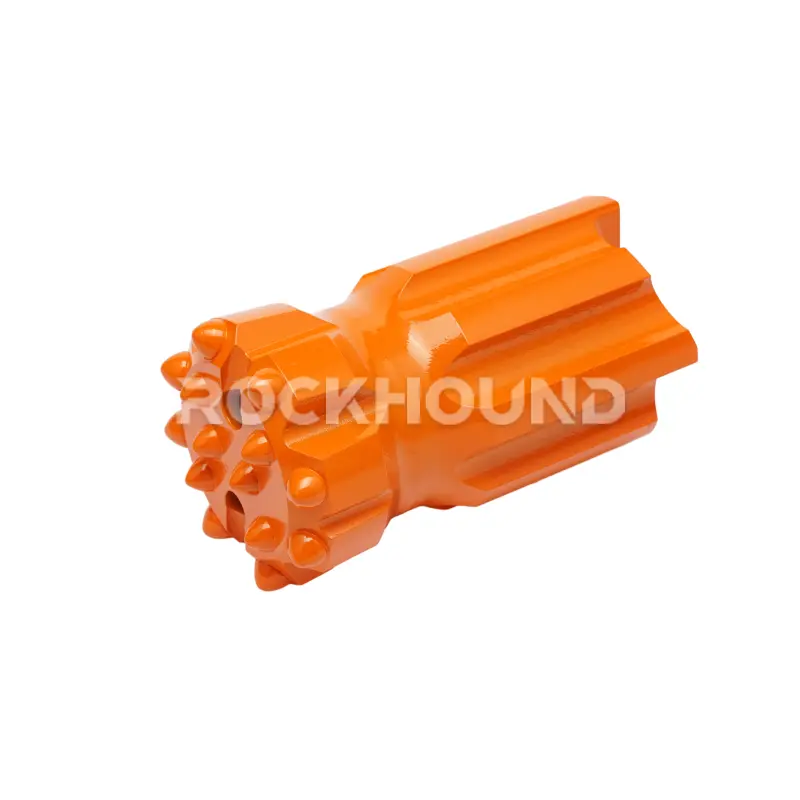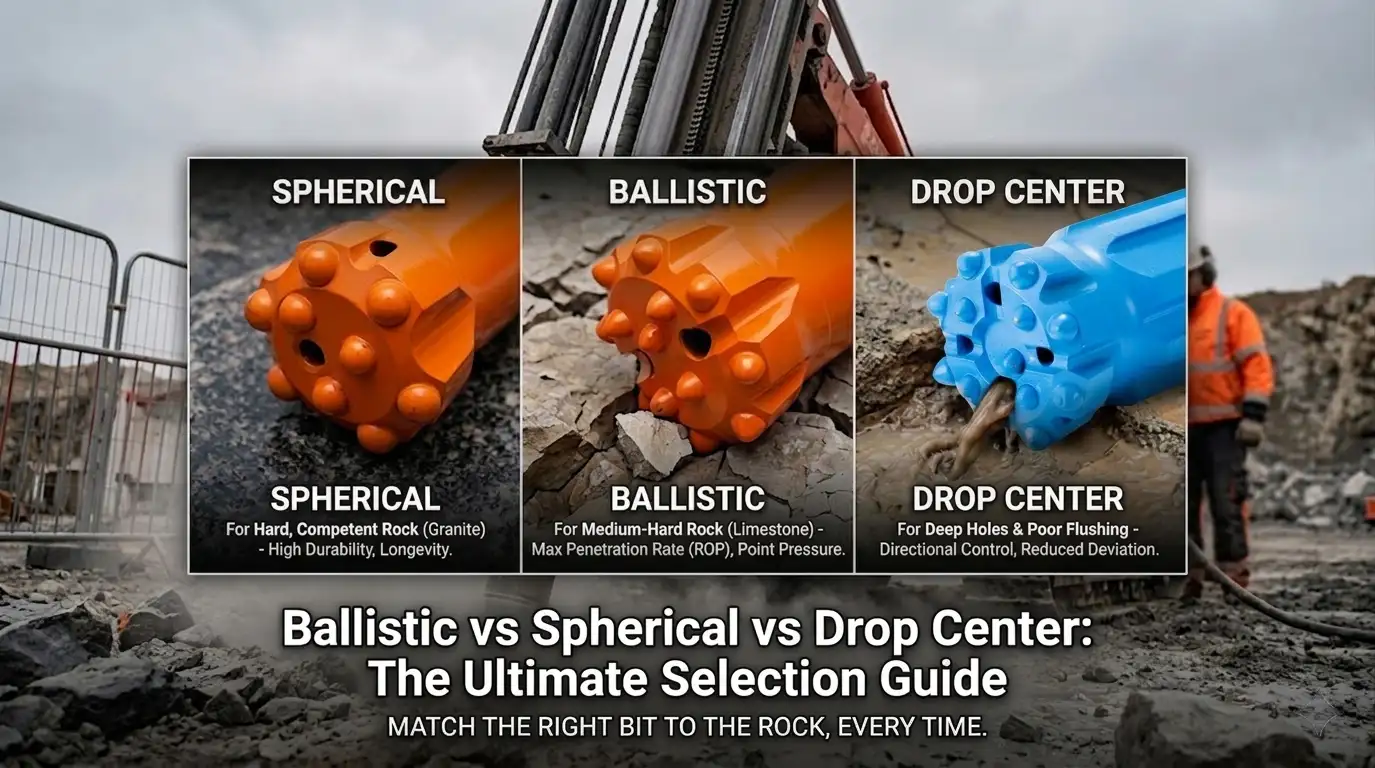
Button drill bits shape is one of the most overlooked decisions in top hammer drilling. Drill crews often default to “whatever came with the last order,” yet switching button geometry for the wrong rock type can cut tool life by 30–50% or drag penetration rates down to a crawl.
This guide covers three core button shapes used across top hammer button bits: ballistic, spherical, and drop center. Each has a specific mechanical logic. Each performs best in a defined rock environment. And knowing which to use — before the bit goes in the hole — is what separates efficient drilling from expensive guesswork.
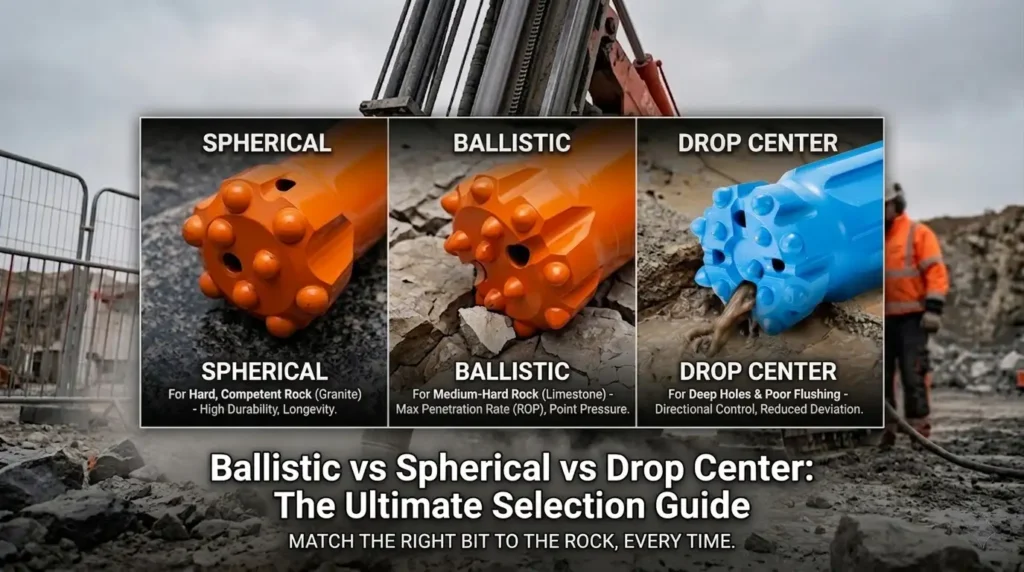
Why Button Geometry Controls Everything
A button bit works by transmitting percussive energy from the drill string into the rock face. The shape of each carbide insert determines how that energy transfers — whether it concentrates at a point, spreads across a rounded surface, or applies force along a concave face profile.
Three variables interact with geometry directly:
- UCS (Uniaxial Compressive Strength): Measures compressive rock hardness in MPa. Granite runs 150–250 MPa; sandstone, 20–100 MPa.
- Protodyakonov Hardness Coefficient (f): A field-practical index widely used in mining and drilling. Calculated as f = UCS(MPa) / 10. Granite: f = 14–20; sandstone: f = 2–8.
- Abrasiveness (Cerchar Index): High-quartz rock like quartzite wears carbide fast regardless of compressive hardness.
- Hole deviation sensitivity: Long-hole stoping and bench blasting demand tight angular tolerance. Face design directly affects how the bit tracks downhole.
Understanding these values for your specific formation is the first step. The button shape decision follows directly from that assessment. See our full rock type selection framework.
Ballistic Button Bits: Built for Penetration Rate in Medium-Hard Rock
Ballistic buttons have an elongated, tapered profile — shaped roughly like a bullet tip. This geometry concentrates impact energy into a smaller contact area, producing higher point pressure on the rock face.
The result: faster crack initiation and higher ROP (Rate of Penetration) in medium-hard formations where rock breaks relatively cleanly under impact.
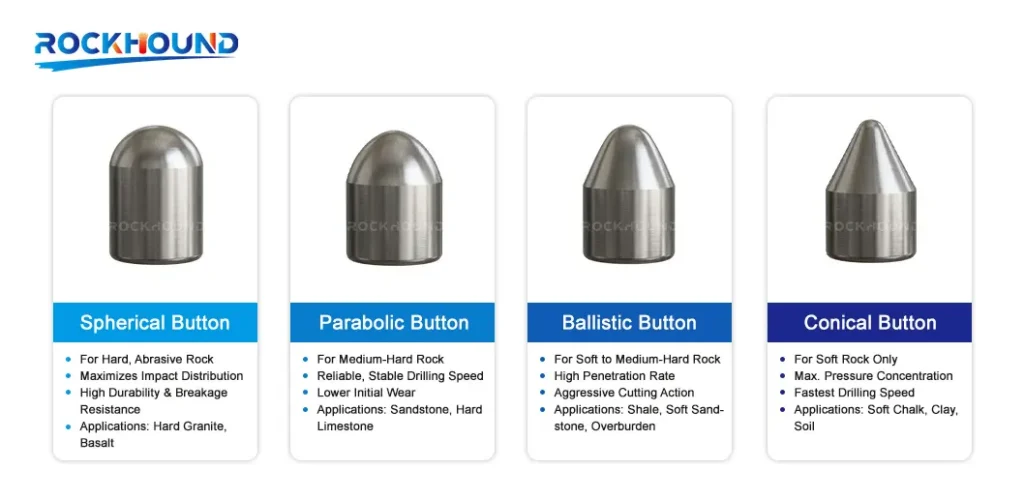
Ideal rock range: f = 4–10 (UCS 40–100 MPa)
Best-fit formations include:
- Limestone and dolomite (f = 4–10, UCS 60–180 MPa)
- Medium sandstone with low-to-moderate quartz content (f = 2–6)
- Fractured or layered formations where aggressive penetration outweighs longevity
- Short-hole bench drilling with high bit turnover
Where ballistic buttons struggle: The tapered tip increases point-load stress on the carbide. In extremely hard rock (granite, f > 14) or highly abrasive formations, buttons chip or wear asymmetrically far faster than spherical designs. For abrasion-heavy environments like quartzitic sandstone (f = 12–16), TRS (Transverse Rupture Strength) demand on carbide is high — and ballistic tips fail first.
Choose ballistic when speed is the priority and the rock doesn’t fight back too hard.
Spherical Button Bits: Longevity Under Extreme Compressive Force
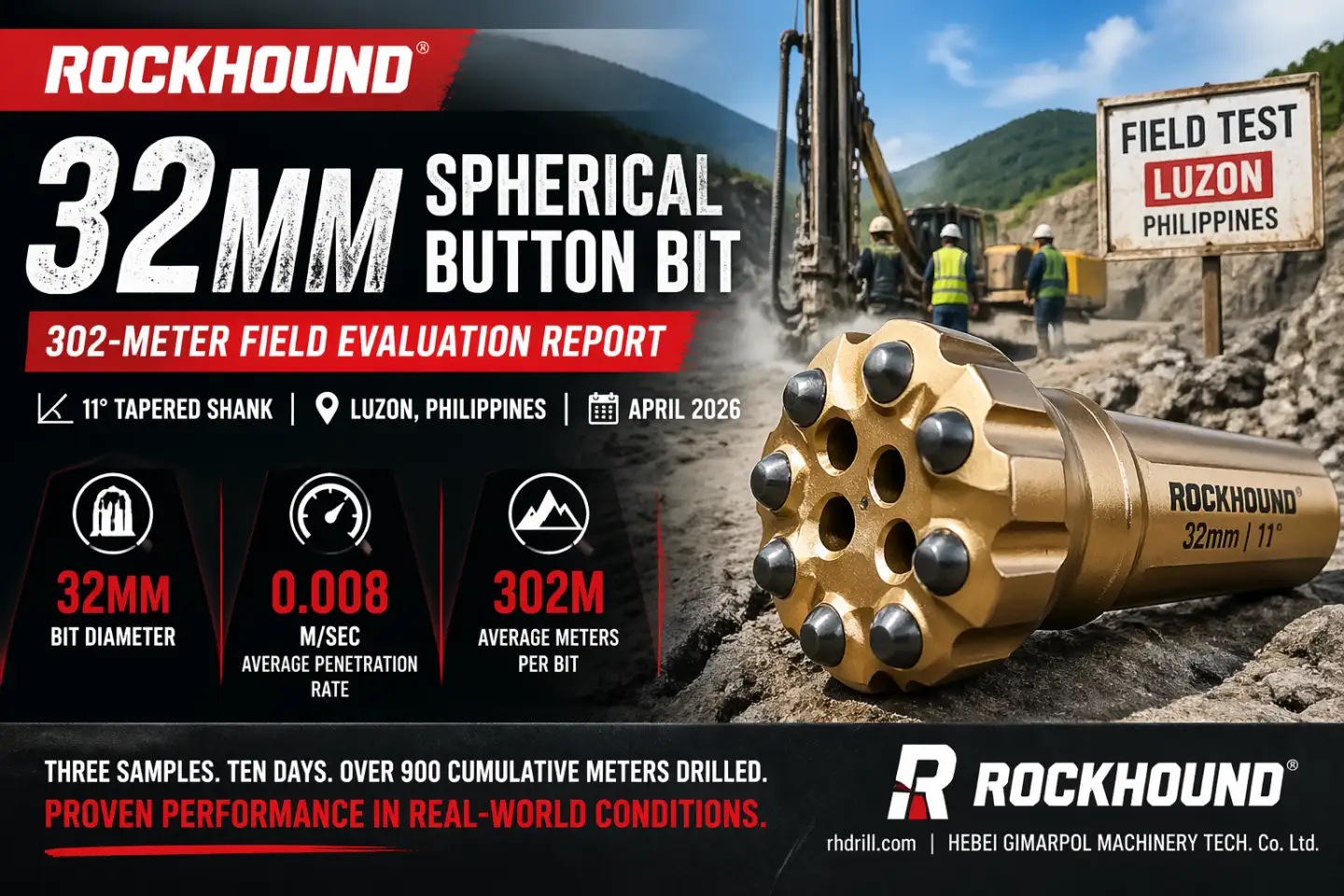
Spherical buttons are hemispheres. The rounded geometry distributes impact stress across a wider contact surface, reducing peak carbide stress per strike. This is why spherical buttons retain their shape — and performance — through far more meters in very hard, competent rock.
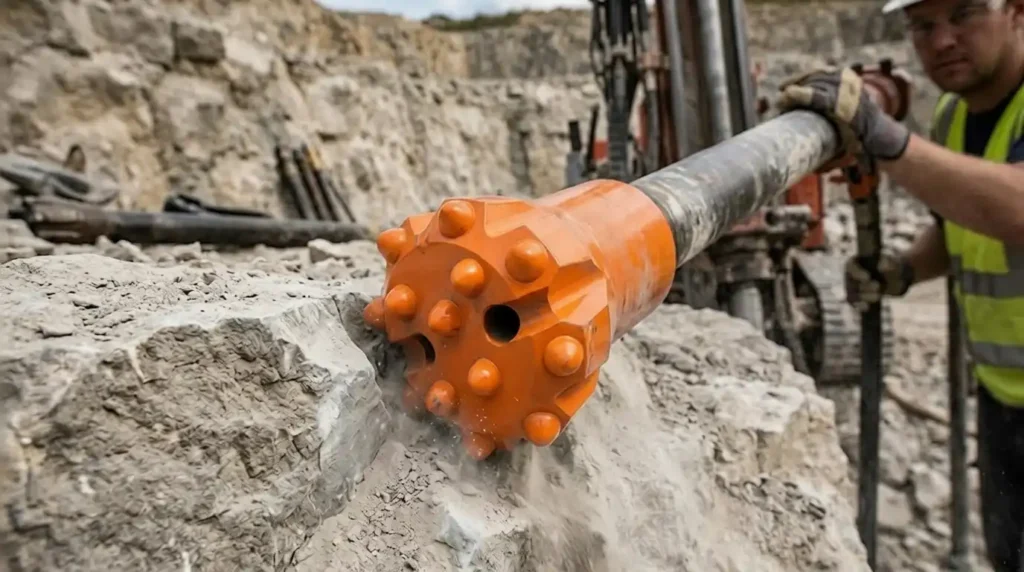
Ideal rock range: f = 10–20 (UCS 100–280 MPa)
In granite quarrying and underground hard rock mining, spherical bits are the standard for one reason: they last. A spherical bit in the right application consistently outperforms a ballistic bit on cost-per-meter, even if it drills slightly slower per shift.
Best-fit formations include:
- Granite, gneiss (f = 14–20, UCS 150–280 MPa)
- Basalt and diorite (f = 8–14, UCS 120–250 MPa)
- High-abrasivity formations where button wear is the dominant failure mode
- Long production drilling cycles where regrinding frequency matters
- Quartzite and ironstone (f = 12–18) — high quartz content demands carbide retention
The trade-off: Spherical buttons produce lower point-pressure per strike. In softer or more fractured rock (f < 8), that reduced aggressive contact means slower ROP. You’re paying for durability you don’t need.
Carbide grade matters critically here. Spherical buttons for granite applications typically use premium grades like YK05, with HRA hardness ≥ 89.5, paired with 20+ hours deep carburizing on the steel body. These manufacturing details determine whether the button survives repeated regrinding cycles intact. More on production standards: Rock Drill Bits Manufacturing Process.
Drop Center Button Bits: When Hole Quality Is Non-Negotiable
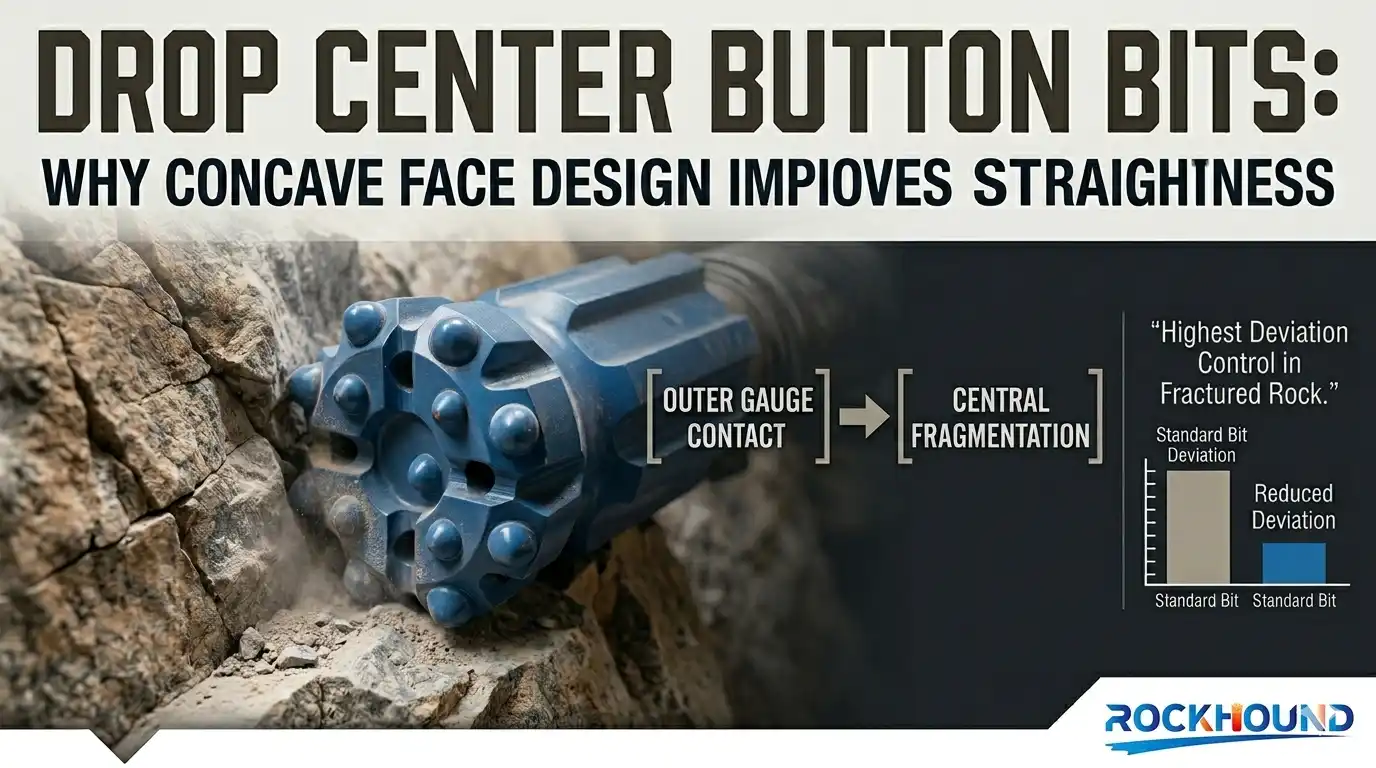
Drop center bits solve a different problem entirely. The face is concave — gauge buttons sit higher than center buttons, creating a recessed face profile. This geometry, combined with enlarged flushing ports, directly addresses two linked failure modes: hole deviation and cuttings evacuation problems.
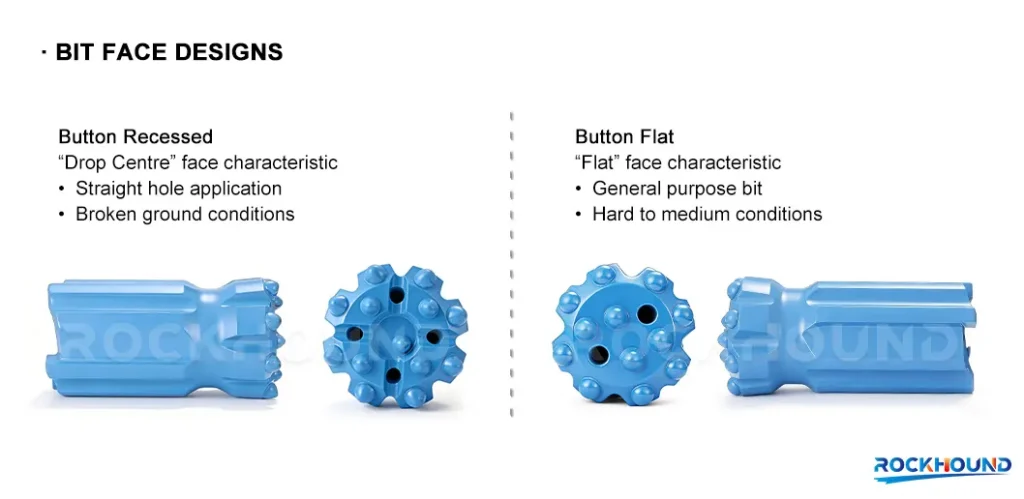
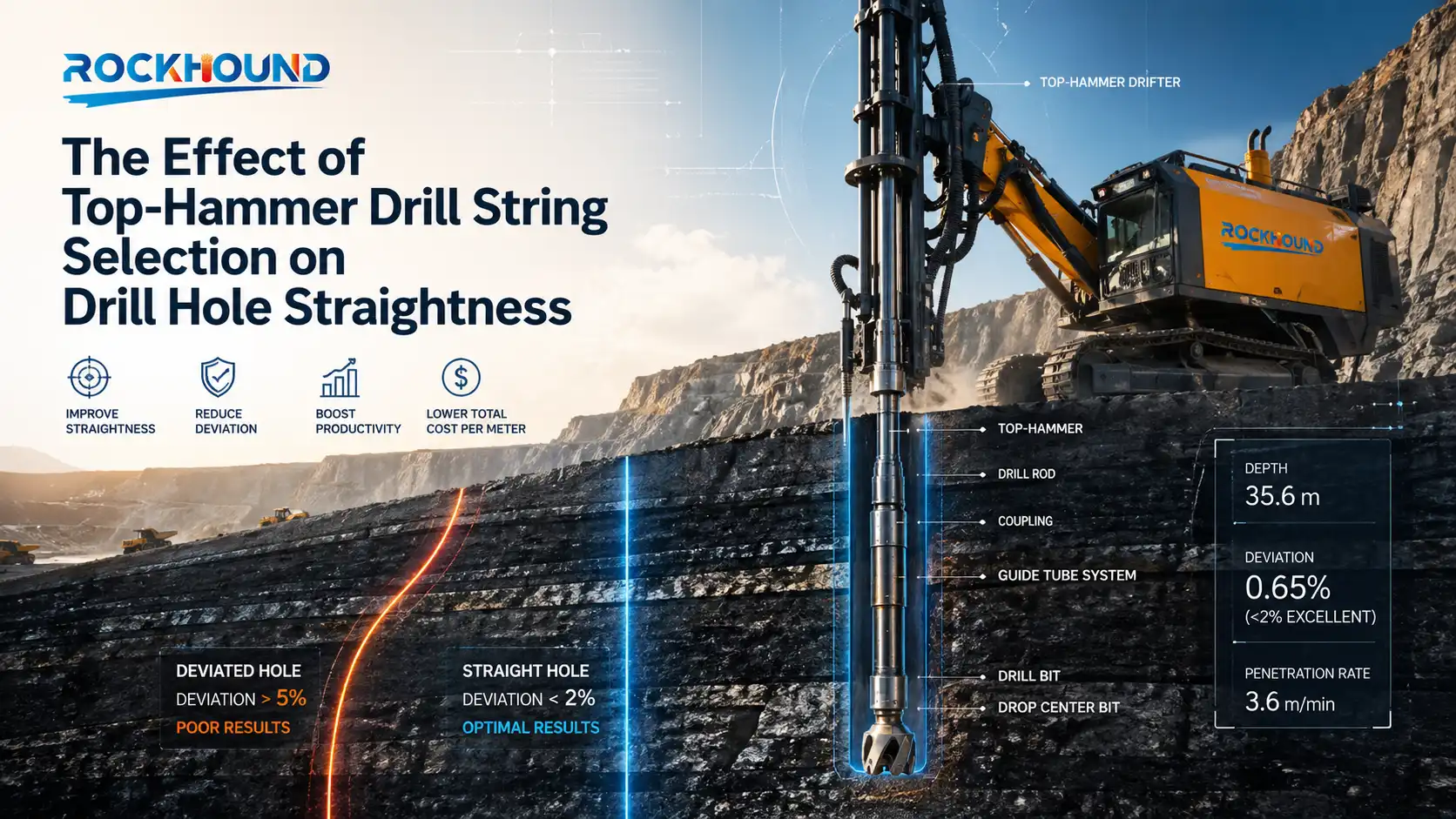
In deeper holes, a flat-face bit tends to wander as it encounters varying rock hardness. The concave face design naturally guides the bit along the established borehole axis — this is the core mechanical reason why drop center button bits improve hole straightness in top hammer drilling, particularly in long-hole applications where collar-to-toe alignment is a critical QC metric.
The flushing advantage is equally significant. Cuttings accumulate at the face under pressure. Standard flat-face bits can trap fines between the face and borehole bottom, especially in wet or clay-contaminated conditions. The drop center geometry combined with optimized flush channels creates better chip transport, reducing re-drilling of already-broken material.
Applicable rock range: All hardness classes (f = 2–20), prioritized by hole depth and condition
Best-fit applications include:
- Deep bench drilling (>15 m) where angular deviation accumulates
- Wet drilling environments with poor natural flushing
- Fractured or interbedded rock (f = 2–8) with variable face resistance
- Tunneling and underground development where gauge wear and deviation are critical
- Any scenario requiring a true concave face drill bit geometry for directional control
The limitation: Drop center bits carry a higher manufacturing cost due to complex face geometry. They also require careful regrinding to maintain the concave profile — flattening it defeats the purpose. For shallow, high-turnover drilling in competent homogeneous rock, flat or retrac face designs often suffice.
For a full breakdown of face designs across all bit types, see: Top Hammer Drill Bit Types: Face Design & Button Shape.
Button Bit Selection Table: Rock Type × f Value × Button Shape
| Rock Type | f Value | UCS (MPa) | Cerchar Index | Recommended Button | Key Priority |
|---|---|---|---|---|---|
| Granite / Gneiss | 14–20 | 150–280 | High (4–6) | Spherical | Wear resistance |
| Basalt / Diorite | 8–14 | 120–250 | Moderate–High | Spherical | Durability |
| Quartzite / Ironstone | 12–18 | 150–300 | Very High (>6) | Spherical | Carbide retention |
| Limestone / Dolomite | 4–10 | 60–180 | Low–Moderate | Ballistic | Penetration rate |
| Sandstone (low quartz) | 2–6 | 20–80 | Low | Ballistic | ROP speed |
| Marble / Soft limestone | 2–5 | 40–80 | Low | Ballistic | Aggressive ROP |
| Fractured mixed rock | 2–8 | Variable | Variable | Drop Center | Hole straightness |
| Deep bench / long-hole | Any | Any | Any | Drop Center | Flushing + deviation |
| Wet / clay-contaminated | Any | Any | Any | Drop Center | Chip evacuation |
Cerchar Abrasivity Index reference: ISRM Suggested Methods for Rock Characterization. Protodyakonov f values based on standard mining classification (f = UCS MPa ÷ 10).
Quick Decision Framework
Three questions narrow the choice to one answer:
- What is the f value? f > 12 — lean spherical. f < 8 — lean ballistic. f 8–12 — assess abrasivity.
- Is hole deviation or poor flushing a documented site problem? Yes — use drop center regardless of f value.
- Is cost-per-meter or drill shifts-per-bit the primary KPI? Cost-per-meter favors spherical in hard rock. Shifts-per-bit favors ballistic in medium formations.
If none of the answers is clean, the formation is mixed — and drop center often resolves mixed-formation uncertainty better than either alternative.
For background on how top hammer drilling systems interact with bit geometry at the face, reviewing the percussion mechanics is worth the time before finalizing specs.
FAQ
The primary differences are tip geometry, penetration rate (ROP), and wear resistance:
Ballistic Buttons: Have a pointed, tapered tip that concentrates impact. They deliver higher ROP in soft to medium-hard rock (f = 4–10).
Spherical Buttons: Have a hemispherical tip that distributes force evenly. They provide superior carbide wear resistance in very hard formations (f > 12).
Choose a drop center button bit for long or deep holes where:
Hole deviation or drifting is a documented issue.
Drilling through fractured, jointed, or interbedded formations.
Cuttings flushing is inadequate (its concave design and enlarged ports optimize chip evacuation).
Technically yes, but practically no. Granite is highly abrasive and very hard (f = 14–20). The pointed ballistic tip concentrates stress on a small area, leading to rapid chipping and asymmetric wear. Spherical buttons last significantly longer per meter in granite, making them far more cost-effective.
Also known as a drop center bit, it features a recessed face profile where the center sits lower than the outer gauge buttons. This geometry:
Self-centers the bit in the hole naturally, minimizing angular deviation.
Directs cuttings away from the center toward the flushing ports, improving chip clearance in deep or wet holes.
The Protodyakonov coefficient (f = \text{UCS} \div 10) simplifies rock hardness into a practical guideline:
f < 8 (Soft/Medium): Favors ballistic bits for maximum drilling speed.
f > 12 (Very Hard): Favors spherical bits for extended wear life.
f = 8–12 (Transition): Requires assessing rock abrasivity to decide.
Note: If hole deviation is a major issue, drop center geometry may override these hardness guidelines.
Far far away, behind the word mountains, far from the countries Vokalia and Consonantia, there live the blind texts. Separated they live in Bookmarksgrove right at the coast
Rule of thumb: Regrind when button wear exceeds ⅓ of the original button height. Shape drastically affects the process:
Spherical: Easiest and most consistent to regrind and maintain.
Ballistic: Requires precise angle maintenance to keep the pointed profile.
Drop Center: Demands special templates to preserve the concave profile. Improper grinding flattens the face, destroying its deviation-control benefits.