What Is a Drop Center Button Bit?
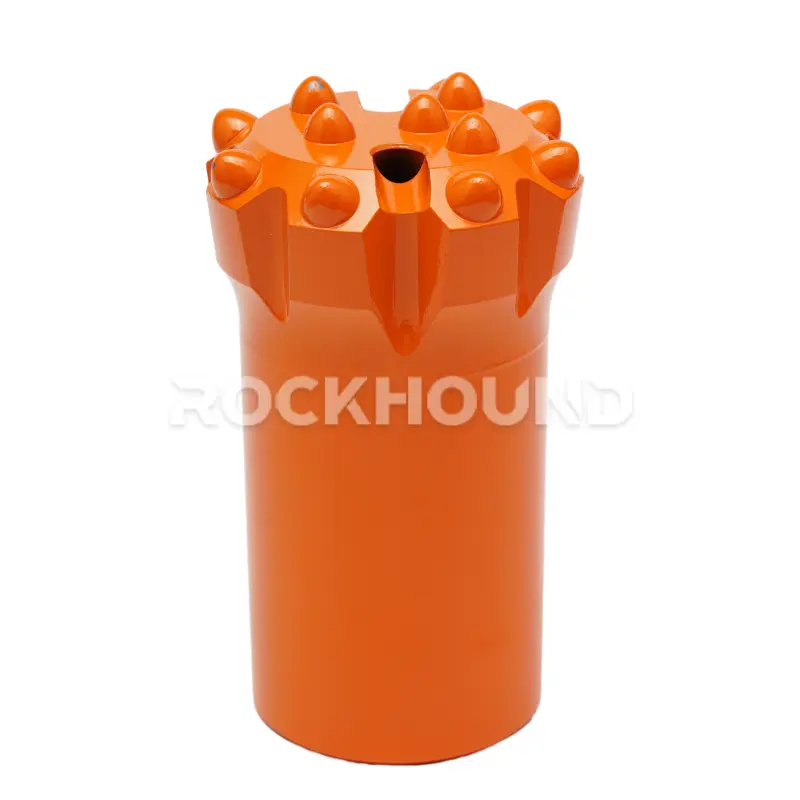
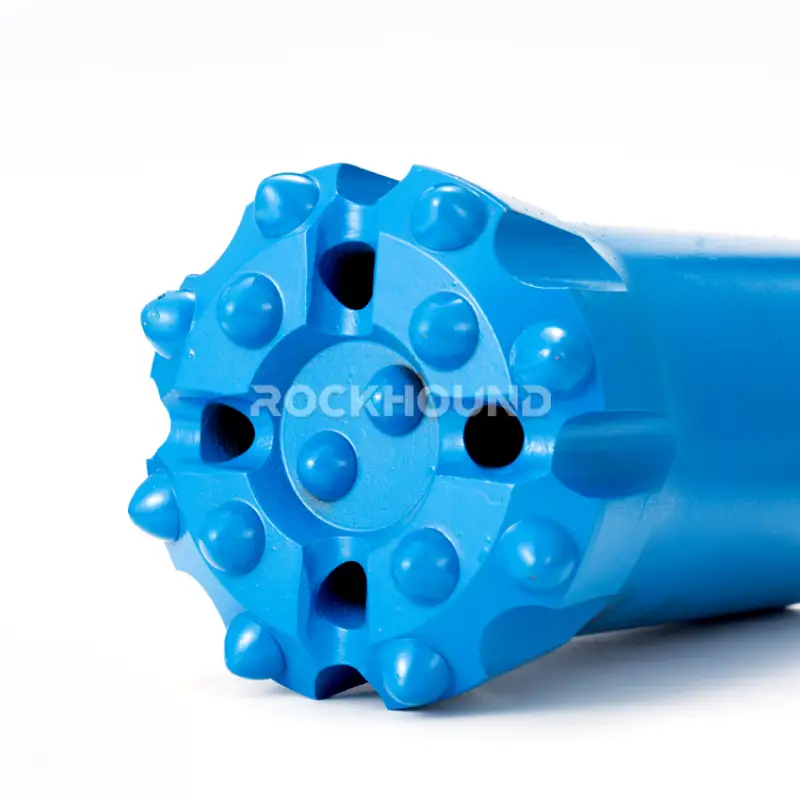
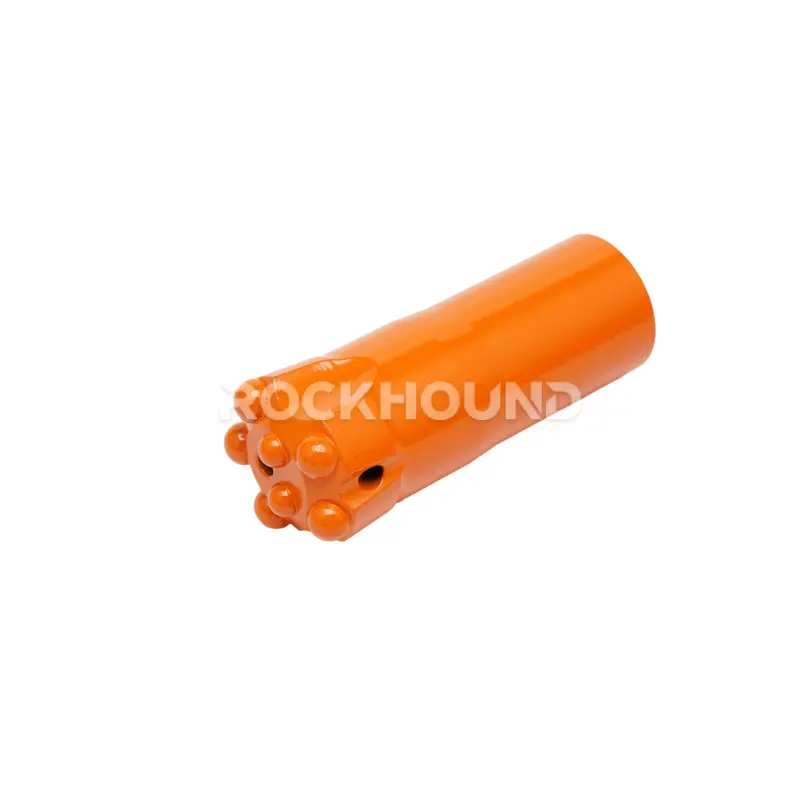
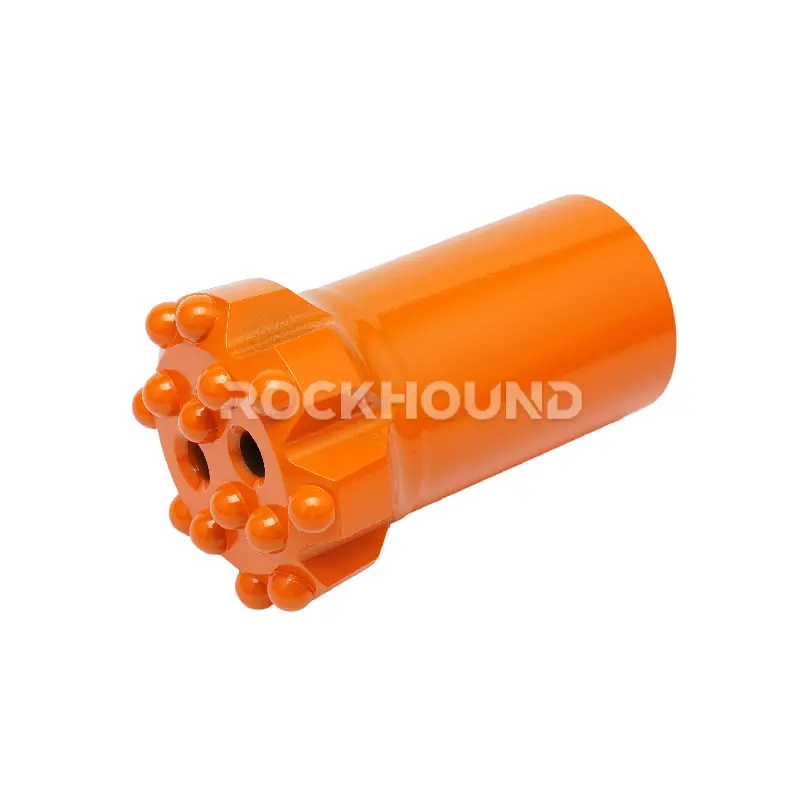
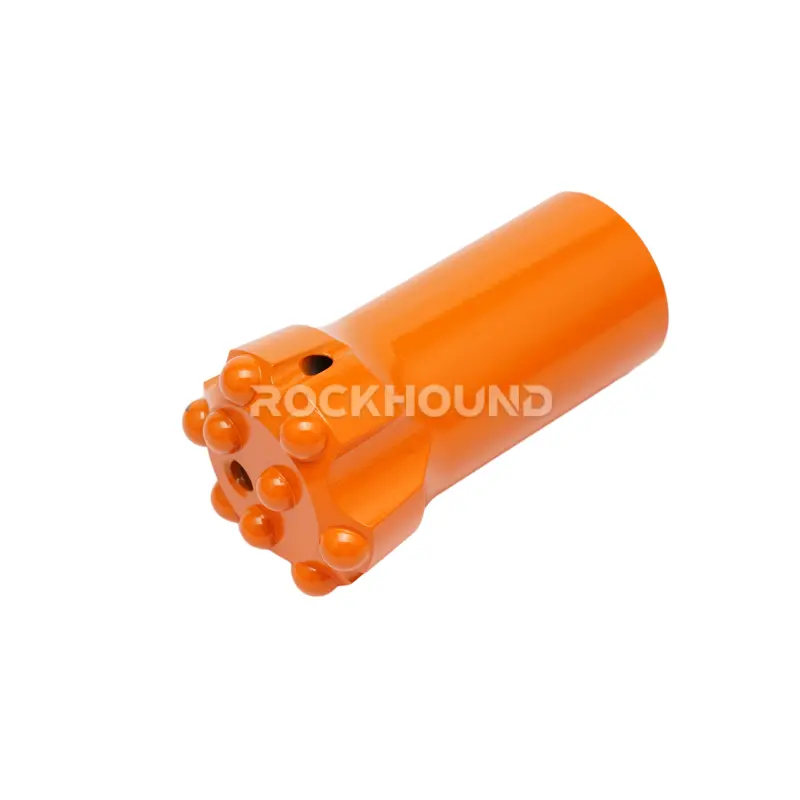
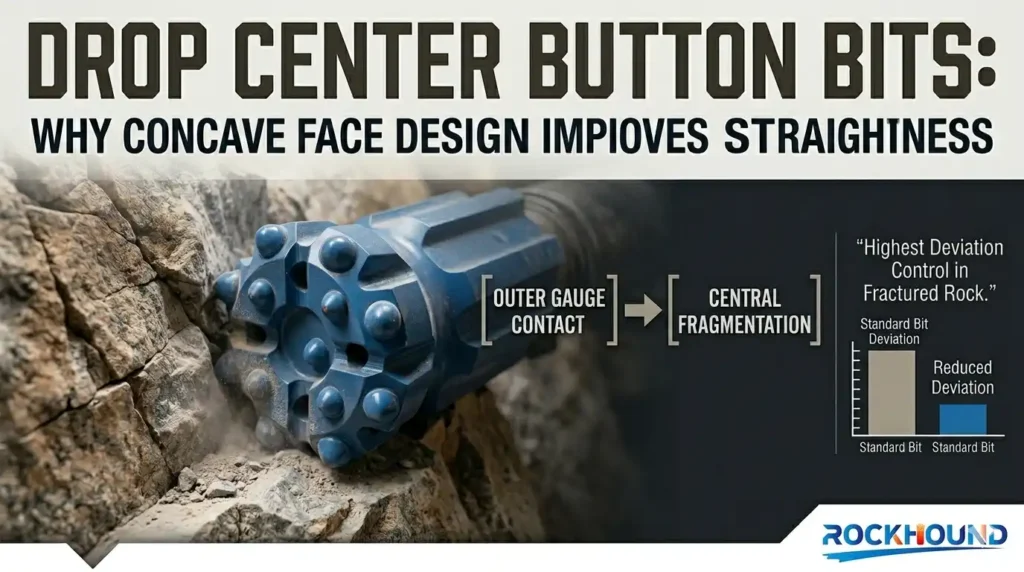
A drop center button bit is a top hammer percussive drill bit whose face geometry features a recessed central section. It’s a deliberate “drop” at the center of the bit face, which combined with a raised outer gauge row. This geometry integrates the directional stability of a concave profile with the aggressive center fragmentation of a convex design, producing a hybrid face that addresses both hole deviation and penetration efficiency simultaneously.
Understanding what makes this design distinct requires a quick look at the full face-design landscape. Top hammer drill bit face designs span four primary configurations — flat, convex, concave, and drop center — and each one distributes percussive impact energy differently across the bit face. Selecting the correct face design, alongside the appropriate bit type, button shape, and skirt style, directly determines Rate of Penetration (ROP), hole straightness, and total Cost per Meter.
The drop center is not a minor variation on the concave face. It is a distinct geometry — one that, when matched to the right formation and hole depth, consistently outperforms the alternatives on the metric that matters most in precision drilling: directional accuracy.
The Geometry Function of "Drop Center"
To understand how a concave face improves hole straightness, you have to think about what happens at the moment of percussive impact — the fraction of a second when the bit face contacts rock, energy transfers, and the crack network begins to propagate.
Outer-First Contact: The Core Mechanism
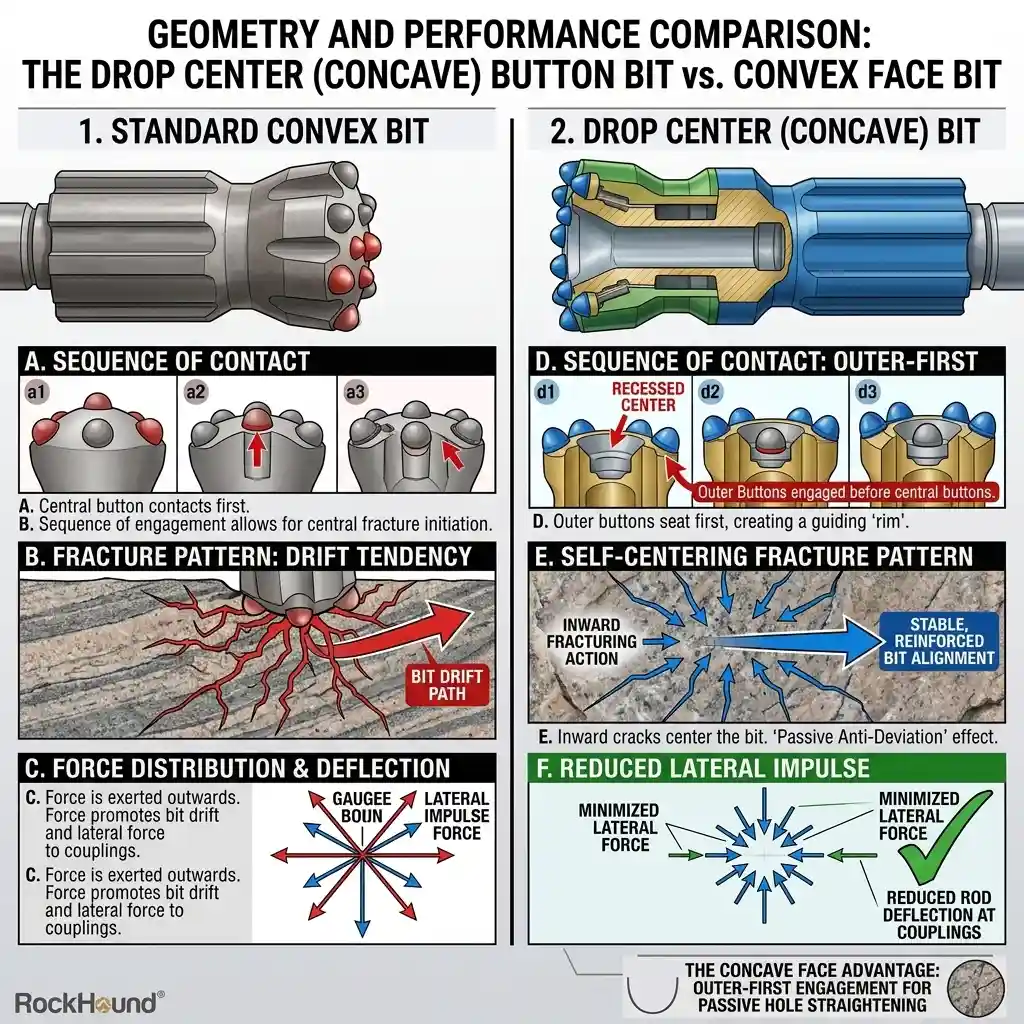
On a flat or convex face, the central buttons engage the rock first (or simultaneously with the gauge row). This creates a fragmentation initiation point at the hole center. In homogeneous, uniform rock, that works well. In formations with any structural anisotropy — jointing, bedding, variable hardness — that centrally-initiated crack pattern can cause the bit body to drift toward lower-resistance zones. The hole begins to deviate before the operator has any feedback that it’s happening.
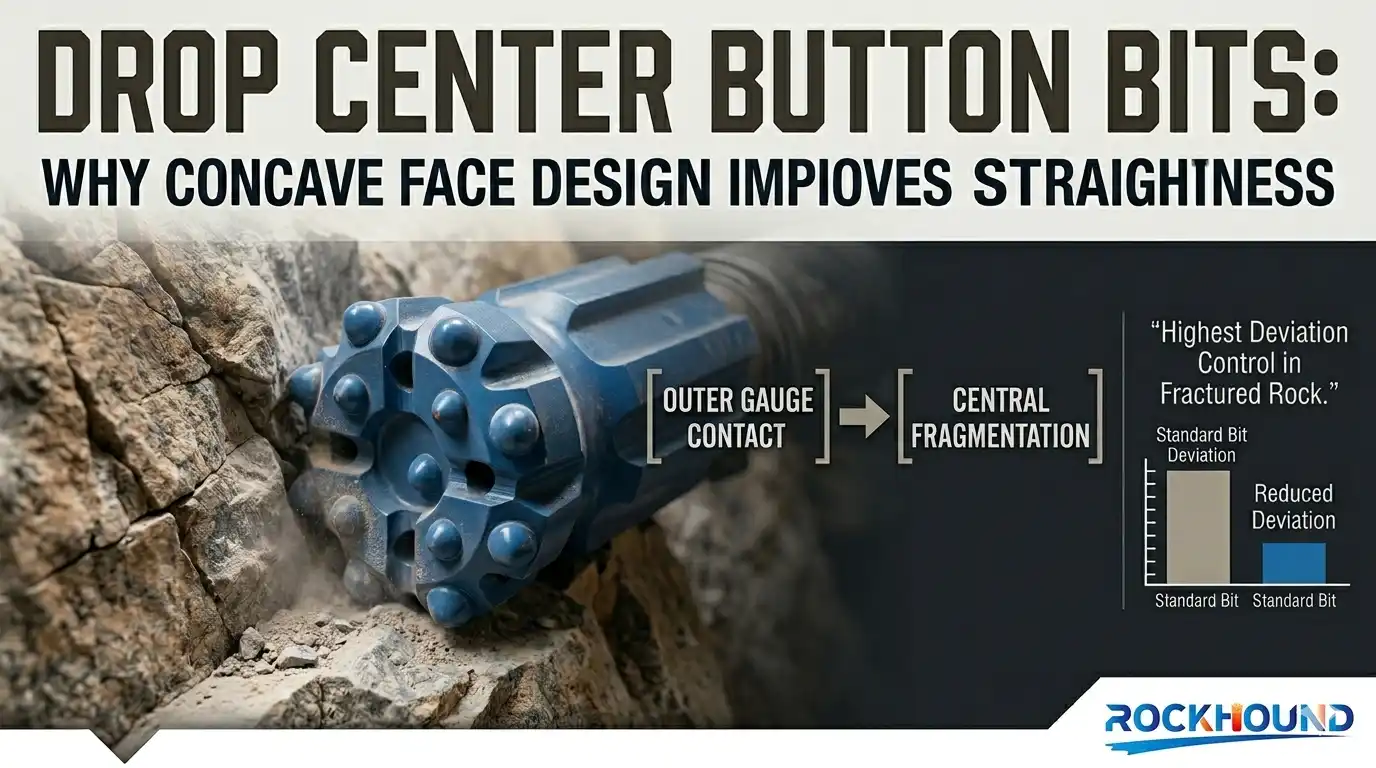
The drop center geometry inverts this sequence. The outer gauge row contacts the rock before the center buttons, effectively wrapping the bit face around the rock mass at the hole perimeter before fracturing the center. This outer-first engagement creates an inward-directed fracture pattern that naturally centers the bit body relative to the hole wall, providing a passive anti-deviation effect without requiring external guide devices.
Think of it this way: the raised gauge row acts like a rim that locks the bit inside the borehole before the central impact energy is released. Every strike reinforces the bit’s position relative to the hole axis rather than allowing it to seek the path of least resistance through the rock.
The Self-Centering Effect
The concave design acts as a “straightening feature,” with the central depression providing greater stability and minimizing bit wobble and vibration for a smoother drilling process. This also reduces stress on the drilling rig, extending its operational lifespan.
The self-centering effect is particularly decisive where blast pattern accuracy directly governs overbreak, ground support requirements, and explosive efficiency. In underground development headings, for example, a 50mm deviation at the toe of a 12-meter blast hole can shift burden distribution enough to cause half a face of overbreak on one side and a stubborn toe on the other.
Reduced Vibration & Lateral Force
When the outer row seats before impact energy is fully transferred, it also reduces the lateral impulse components that cause the drill string to deflect during the power stroke. In a standard flat-face bit, off-axis energy components from inhomogeneous rock translate directly into rod deflection — particularly dangerous at rod couplings, where bending stress concentrates. The drop center geometry partially absorbs that lateral component through the geometry of initial contact, before it can propagate up the string.
Drop Center vs Other Face Designs
Not every formation calls for a drop center bit. Choosing the wrong face design for a given rock type or depth profile is one of the most common sources of underperformance in top hammer drilling programs. Here is how the four primary designs stack up against each other:
| Face Design | Fragmentation Sequence | Hole Straightness | Penetration Rate (ROP) | Best Application |
|---|---|---|---|---|
| Flat Face | Uniform, simultaneous contact | Moderate — adequate in very hard, competent rock | Good in high-UCS abrasive formations | Quartzite, granite; CAI > 3; shallow benches |
| Convex Face | Center-first; outer row follows | Lower — prone to deviation at depth | Highest in medium-hard formations; 10–20% higher ROP vs. flatter designs in medium-hard formations | Open-pit bench blasting; soft to medium rock |
| Concave Face | Outer-first; self-centering passive | High — excellent in medium to hard rock | Moderate | Tunnel face drilling; precision blastholes in jointed rock |
| Drop Center | Outer-first + recessed center initiation | Highest — effective even in fractured/unconsolidated rock | Balanced; strong overall effective ROP through stable cuts | Long-hole stoping; deep bench drilling; fractured formations |
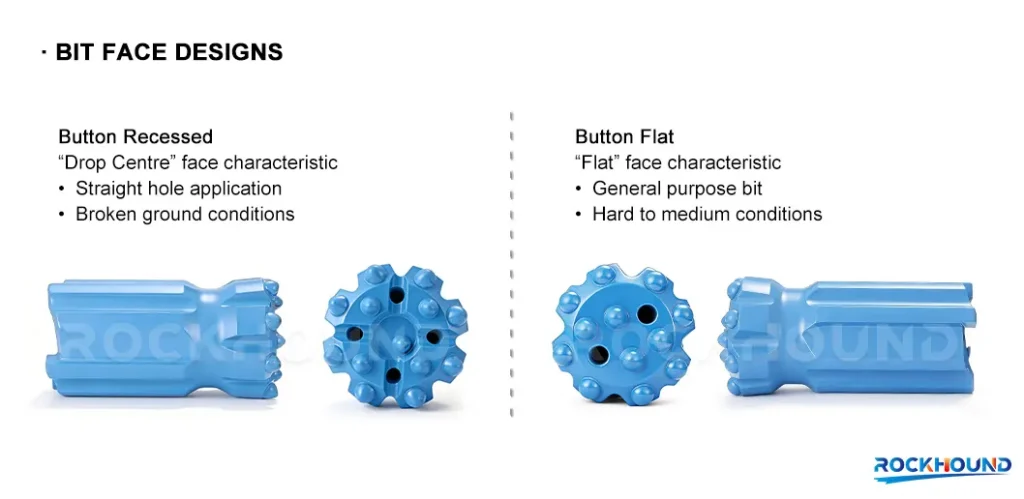
The drop center effectively combines the directional discipline of the concave profile with the fragmentation efficiency of an aggressive center-contact design. It features a concave dished face with a central depression, designed for excellent hole straightness and stability, especially in fractured or less consolidated rock formations, reducing bit deviation and vibration.
One important nuance: the distinction between a “concave face” and a “drop center” is sometimes blurred in product literature. Technically, a drop center has a more pronounced central recess with a specific raised gauge geometry, while a concave face is a more uniformly dished profile. Both improve hole straightness over flat or convex alternatives, but the drop center’s hybrid geometry delivers the highest deviation control in demanding conditions.
When To Choose Drop Center Button Bits
Selecting the right bit comes down to matching geometry to ground conditions and operational objectives. Here are the scenarios where drop center bits consistently deliver the best return:
Long-Hole Stoping and Underground Drilling
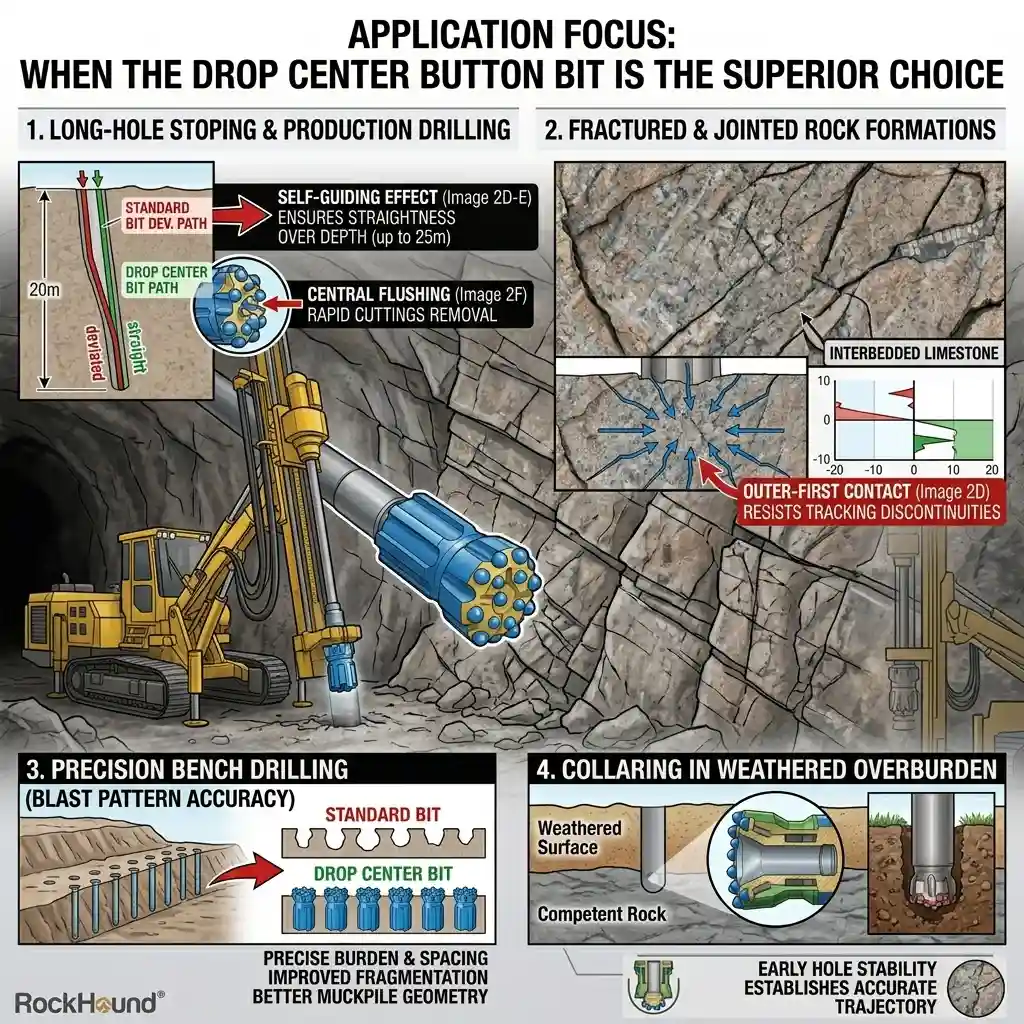
This is the home territory of the drop center bit. In long-hole stoping, blast holes commonly reach 15–25 meters in length, and deviation accumulates with depth. A hole that drifts 3% over 20 meters misses its designed burden by 600mm — enough to leave standing pillars of unmined ore, generate oversized blocks, and damage hangingwall conditions. Drop center button bits provide a self-guiding effect that ensures superior hole straightness and significantly reduces deviation, especially in long-hole drilling applications. The drop-center geometry also enhances flushing efficiency by directing cuttings toward the center for rapid removal.
Fractured and Jointed Rock Formations
In structurally complex rock — heavily jointed granite, layered schist, interbedded limestone/shale sequences — any face design that concentrates initial contact at the hole center will allow the bit to follow discontinuity planes rather than the intended hole axis. The drop center’s outer-first engagement keeps the bit anchored to its own created hole geometry with each successive strike, resisting the tendency to track joints or softer interlayers.
Bench Drilling Where Blast Pattern Accuracy Is Critical
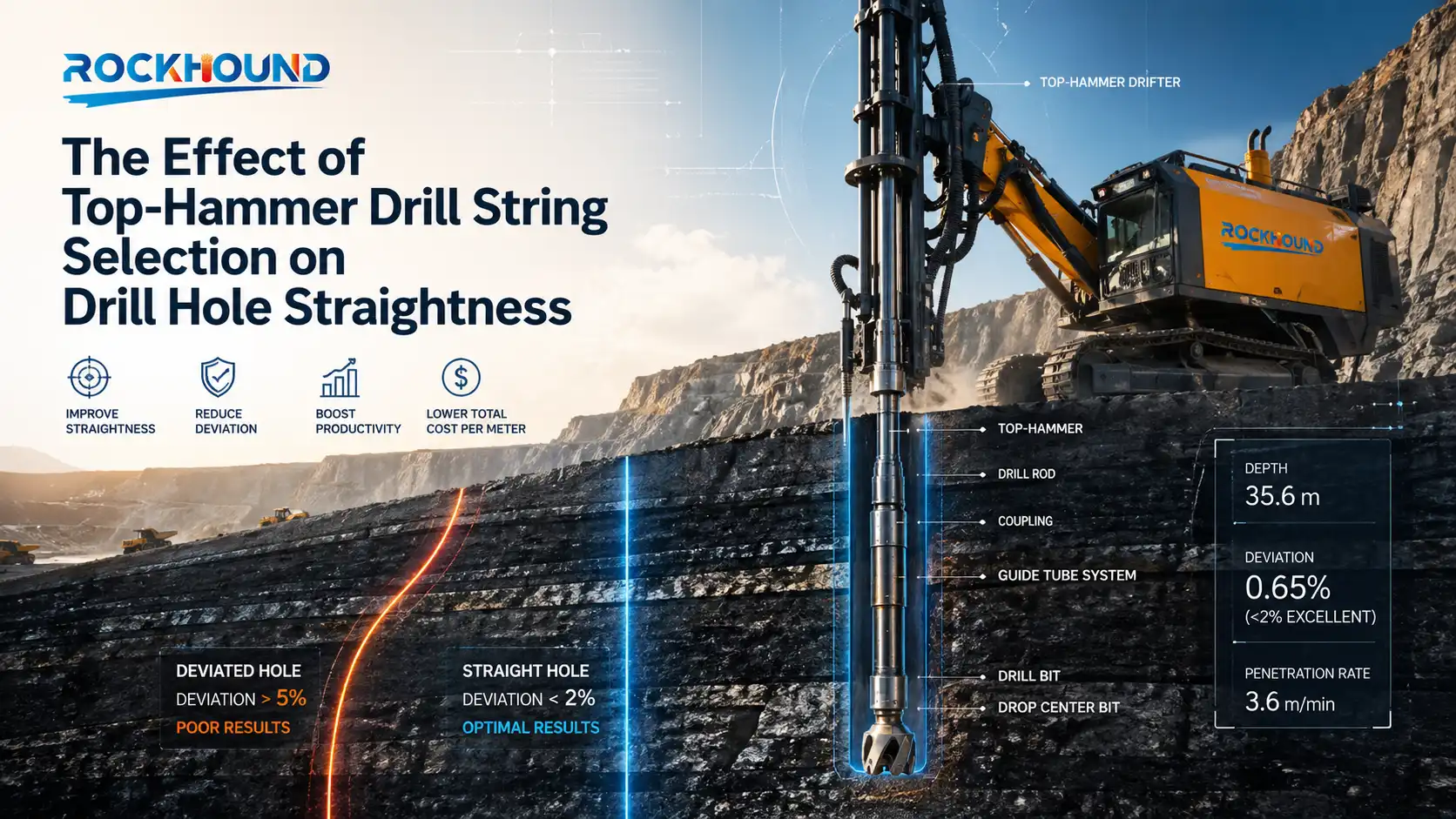
Drill hole deviation refers to the departure of a drilled hole from its intended path in terms of length, direction, and angle. Accurate assessment of this deviation is essential in mining and civil engineering projects where the precision of hole placement affects fragmentation, blasting efficiency, and overall project outcomes.
In production blasting on tight bench patterns, a deviated hole in the middle of a row doesn’t just affect that hole — it distorts the burden-spacing relationship for every adjacent hole. Drop center bits allow drilling engineers to hold tighter collar-to-toe tolerances, which translates directly into more predictable fragmentation curves and better muck pile geometry.
Flushing Performance
Hole straightness gets the headline, but flushing efficiency is the operational benefit that drop center bit users often mention first in field discussions — because poor flushing directly causes regrinding of cuttings, elevated bit temperature, premature carbide wear, and, in extreme cases, hole collapse.
The drop center geometry enhances flushing efficiency by directing cuttings toward the center for rapid removal. The recessed center creates a converging airflow path that draws broken material toward the flushing channels rather than allowing it to pack into the bit-rock interface. This is particularly valuable in fine-grained or cohesive formations where cuttings tend to build up on the bit face rather than being cleanly evacuated.
In practical terms: operators running drop center bits in underground development headings consistently report fewer bit face packing events, more consistent penetration rates through the drilling cycle, and less visible “re-grinding” signature on worn carbide surfaces compared to flat-face bits in the same formation.
For a deeper look at how bit geometry interacts with the broader drilling system, see our guide to Top Hammer Button Bit: How It Works, Uses & Maintenance.
Thread Sizes and Specifications: Matching the Bit to Rod Drilling System
Drop center button bits are available across the full range of standard top hammer thread systems. The thread specification must match the rod string being used — a mismatch here is both a performance issue and a safety concern.
| Thread Standard | Nominal Bit Diameter Range | Typical Application |
|---|---|---|
| T38 | 51–64 mm | Underground development; extension drilling; medium production |
| T45 | 64–76 mm | Bench drilling; underground production; versatile range |
| T51 | 76–89 mm | Heavy production; large-diameter bench holes; demanding formations |
| R32 | 38–51 mm | Light development; tunneling; secondary holes |
For operations unsure whether drop center is the right face design for their current thread and diameter specification, our guide to choosing the right top hammer drill bits walks through the full selection framework, including formation-specific recommendations.
Material and Manufacturing
A drop center geometry only delivers its straightness advantage as long as the carbide buttons and bit body maintain their dimensional integrity. A bit that mushrooms, chips, or loses button protrusion within the first few hundred meters is a bit that no longer holds the geometry its face design was built around.
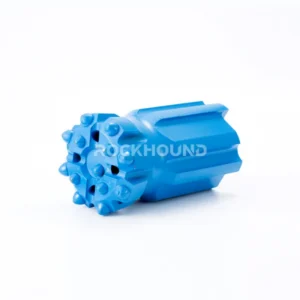
At RockHound, our drop center button bits are manufactured with:
- 45CrNiMoVa alloy steel for the bit body — a high-toughness, fatigue-resistant composition that absorbs repeated percussive loading without stress cracking at the button seat zones
- YK05 tungsten carbide for the buttons — a carbide grade engineered for the specific combination of toughness and wear resistance needed in medium to hard, abrasive formations
- 20-hour deep carburizing of the bit body, producing a hardened case layer that resists gauge wear while maintaining core toughness — critical for maintaining the raised gauge row geometry that makes the drop center’s outer-first contact sequence possible
These are not incidental material choices. The drop center design puts particular stress on the gauge buttons, which take the first contact on every strike. If the carbide grade is too brittle, gauge buttons fracture. If the steel at the button seat is under-hardened, buttons loosen and lose the protrusion height that defines the geometry. The manufacturing specification has to support the design intent.
For a detailed breakdown of our full production process, see Rock Drill Bits Manufacturing Process.
How to Know If Your Current Bit Face Design Is Costing You
The challenge with hole deviation is that it doesn’t announce itself cleanly. Here are the field indicators that a face design change — potentially to drop center — may be warranted:
- Blast fragmentation consistently worse at the toe than the collar — classic signature of progressive deviation accumulating with depth
- Irregular muck pile geometry — asymmetric pile height, stubborn toes on one side of the bench, inconsistent burden breakage
- Drill rods showing abnormal coupling wear — lateral bending stress from a drifting bit concentrates at rod-to-coupling interfaces
- Higher-than-expected specific charge (kg explosive / tonne rock) needed to achieve target fragmentation — a direct consequence of holes not sitting where the blast design assumed they would be
- Re-drilling frequency increasing without a change in formation hardness or rig condition
If two or more of these indicators are present, the investment in drop center bits will almost certainly return a positive cost-per-meter calculation — even if the unit price is modestly higher than the flat-face bits currently being used.
For operations newer to the full decision framework around top hammer drilling — including how bit selection interacts with rod selection, flushing, and rig setup — What Is Top Hammer Drilling? The Complete Guide provides the foundation.
RockHound manufactures rock drill tools including drop center button bits, flat face bits, retrac bits, and tapered button bits for top hammer applications in mining, quarrying, tunneling, and construction. For application support or product specifications, contact our technical team at rhdrill.com.
FAQ
Both feature inward-curving faces for self-centering, but their geometry and performance differ:
Concave Face: Features a uniform, consistent inward curve across the entire face.
Drop Center Bit: A hybrid design with a deeper central recess and a raised outer gauge row. This delivers more aggressive center fragmentation and superior deviation control, making it ideal for fractured or unconsolidated rock.
They excel in medium-hard to hard formations with structural complexities (jointing, bedding planes, or fractures).
Best Fit: Granite, jointed limestone, fractured basalt, schist, and interbedded sequences.
Alternative: Use flat face bits for ultra-hard, uniform rock (e.g., massive quartzite); use convex/ballistic bits for soft, low-strength formations.
Button protrusion is the primary indicator. Replace or service the bit when:
Gauge protrusion drops below 30–40%: The outer-first contact sequence is lost, causing increased deviation.
Visible damage occurs: Button fractures or flat-spotting on $\ge 2$ adjacent buttons.
Performance drops: A measurable increase in drilling time per meter.
Tip: Establish a regular protrusion measurement routine rather than relying on quick visual checks.
Yes, particularly for perimeter and lifter holes where deviation control and profile accuracy are critical.
Best Practice: Use a mixed-face strategy. Deploy drop center bits for perimeter/roof holes to ensure clean tunnel contours, and use flat or convex face bits for cut holes to maximize penetration rates.
They are available in all major top hammer thread standards:
R32 (38–51 mm) | T38 (51–64 mm) | T45 (64–76 mm) | T51 (76–89 mm)
Crucial: Thread selection must match your drill rig's rod and shank adapter. Never mix thread standards in a single string, as this causes stress concentration and risks rod breakage.